

of the metal oxide and boron oxide
using carbon or aluminium. Chemically, they are stable to nonoxidizing
acids but are attacked by strong oxidizing agents and by strong alkalis.
Magnesium boride (MgB 2 ) is unusual
in that it can be hydrolysed to boranes. Industrially, metal borides are
used as refractory materials. The
most important are CrB, CrB 2 , TiB 2 ,
and ZnB 2 . Generally, they are fabricated using high-temperature powder metallurgy, in which the article
is produced in a graphite die at over
2000°C and at very high pressure.
Items are pressed as near to Ünal
shape as possible as machining requires diamond cutters and is extremely expensive.
Born, Max (1882–1970) Germanborn British physicist who was
awarded the 1954 Nobel Prize for
physics (with W. Bothe) for his work
on statistical mechanics. With
*Heisenberg he also developed matrix mechanics.
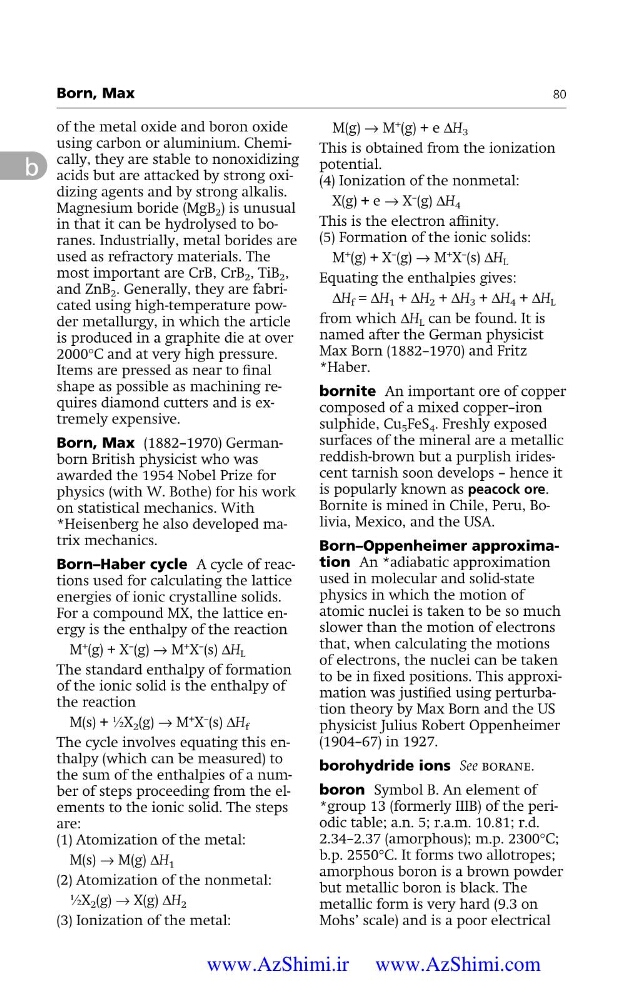
Born–Haber cycle A cycle of reactions used for calculating the lattice
energies of ionic crystalline solids.
For a compound MX, the lattice energy is the enthalpy of the reaction
M
+ (g) + X
– (g) → M
+ X
– (s) ∆H L
The standard enthalpy of formation
of the ionic solid is the enthalpy of
the reaction
M(s) + ½X 2 (g) → M
+ X
– (s) ∆H f
The cycle involves equating this enthalpy (which can be measured) to
the sum of the enthalpies of a number of steps proceeding from the elements to the ionic solid. The steps
are:
(1) Atomization of the metal:
M(s) → M(g) ∆H 1
(2) Atomization of the nonmetal:
½X 2 (g) → X(g) ∆H 2
(3) Ionization of the metal:
M(g) → M
+ (g) + e ∆H 3
This is obtained from the ionization
potential.
(4) Ionization of the nonmetal:
X(g) + e → X
– (g) ∆H 4
This is the electron afÜnity.
(5) Formation of the ionic solids:
M
+
(g) + X
–
(g) → M
+ X
– (s) ∆H L
Equating the enthalpies gives:
∆H f = ∆H 1 + ∆H 2 + ∆H 3 + ∆H 4 + ∆H L
from which ∆H L can be found. It is
named after the German physicist
Max Born (1882–1970) and Fritz
*Haber.
bornite An important ore of copper
composed of a mixed copper–iron
sulphide, Cu 5 FeS 4 . Freshly exposed
surfaces of the mineral are a metallic
reddish-brown but a purplish iridescent tarnish soon develops – hence it
is popularly known as peacock ore.
Bornite is mined in Chile, Peru, Bolivia, Mexico, and the USA.
Born–Oppenheimer approximation An *adiabatic approximation
used in molecular and solid-state
physics in which the motion of
atomic nuclei is taken to be so much
slower than the motion of electrons
that, when calculating the motions
of electrons, the nuclei can be taken
to be in Üxed positions. This approximation was justiÜed using perturbation theory by Max Born and the US
physicist Julius Robert Oppenheimer
(1904–67) in 1927.
borohydride ions See borane.
boron Symbol B. An element of
*group 13 (formerly IIIB) of the periodic table; a.n. 5; r.a.m. 10.81; r.d.
2.34–2.37 (amorphous); m.p. 2300°C;
b.p. 2550°C. It forms two allotropes;
amorphous boron is a brown powder
but metallic boron is black. The
metallic form is very hard (9.3 on
Mohs’ scale) and is a poor electrical
Born, Max
80
b
www.AzShimi.ir www.AzShimi.com
using carbon or aluminium. Chemically, they are stable to nonoxidizing
acids but are attacked by strong oxidizing agents and by strong alkalis.
Magnesium boride (MgB 2 ) is unusual
in that it can be hydrolysed to boranes. Industrially, metal borides are
used as refractory materials. The
most important are CrB, CrB 2 , TiB 2 ,
and ZnB 2 . Generally, they are fabricated using high-temperature powder metallurgy, in which the article
is produced in a graphite die at over
2000°C and at very high pressure.
Items are pressed as near to Ünal
shape as possible as machining requires diamond cutters and is extremely expensive.
Born, Max (1882–1970) Germanborn British physicist who was
awarded the 1954 Nobel Prize for
physics (with W. Bothe) for his work
on statistical mechanics. With
*Heisenberg he also developed matrix mechanics.
Born–Haber cycle A cycle of reactions used for calculating the lattice
energies of ionic crystalline solids.
For a compound MX, the lattice energy is the enthalpy of the reaction
M
+ (g) + X
– (g) → M
+ X
– (s) ∆H L
The standard enthalpy of formation
of the ionic solid is the enthalpy of
the reaction
M(s) + ½X 2 (g) → M
+ X
– (s) ∆H f
The cycle involves equating this enthalpy (which can be measured) to
the sum of the enthalpies of a number of steps proceeding from the elements to the ionic solid. The steps
are:
(1) Atomization of the metal:
M(s) → M(g) ∆H 1
(2) Atomization of the nonmetal:
½X 2 (g) → X(g) ∆H 2
(3) Ionization of the metal:
M(g) → M
+ (g) + e ∆H 3
This is obtained from the ionization
potential.
(4) Ionization of the nonmetal:
X(g) + e → X
– (g) ∆H 4
This is the electron afÜnity.
(5) Formation of the ionic solids:
M
+
(g) + X
–
(g) → M
+ X
– (s) ∆H L
Equating the enthalpies gives:
∆H f = ∆H 1 + ∆H 2 + ∆H 3 + ∆H 4 + ∆H L
from which ∆H L can be found. It is
named after the German physicist
Max Born (1882–1970) and Fritz
*Haber.
bornite An important ore of copper
composed of a mixed copper–iron
sulphide, Cu 5 FeS 4 . Freshly exposed
surfaces of the mineral are a metallic
reddish-brown but a purplish iridescent tarnish soon develops – hence it
is popularly known as peacock ore.
Bornite is mined in Chile, Peru, Bolivia, Mexico, and the USA.
Born–Oppenheimer approximation An *adiabatic approximation
used in molecular and solid-state
physics in which the motion of
atomic nuclei is taken to be so much
slower than the motion of electrons
that, when calculating the motions
of electrons, the nuclei can be taken
to be in Üxed positions. This approximation was justiÜed using perturbation theory by Max Born and the US
physicist Julius Robert Oppenheimer
(1904–67) in 1927.
borohydride ions See borane.
boron Symbol B. An element of
*group 13 (formerly IIIB) of the periodic table; a.n. 5; r.a.m. 10.81; r.d.
2.34–2.37 (amorphous); m.p. 2300°C;
b.p. 2550°C. It forms two allotropes;
amorphous boron is a brown powder
but metallic boron is black. The
metallic form is very hard (9.3 on
Mohs’ scale) and is a poor electrical
Born, Max
80
b
www.AzShimi.ir www.AzShimi.com