

between collisions and (∂f/∂t) coll is the
rate of change of f(r,v,t) due to collisions. The Boltzmann equation can
be used to calculate *transport
coefÜcients, such as conductivity. The
equation was proposed by Ludwig
*Boltzmann in 1872.
Boltzmann formula An equation
concerning the entropy S of a system
that derives from statistical mechanics. It states that entropy is related to
the number W of distinguishable
ways in which the equation S = k
lnW, where k is the Boltzmann constant, can describe the system. It expresses in quantitative terms the
concept that entropy is a measure of
the disorder of a system. It was discovered in the late 19th century by
Ludwig *Boltzmann while he was
studying statistical mechanics.
bomb calorimeter An apparatus
used for measuring heats of combustion (e.g. caloriÜc values of fuels and
foods). It consists of a strong container in which the sample is sealed
with excess oxygen and ignited electrically. The heat of combustion at
constant volume can be calculated
from the resulting rise in temperature.
bond See chemical bond.
bond dissociation energy See
bond energy.
bond energy An amount of energy
associated with a bond in a chemical
compound. It is obtained from the
heat of atomization. For instance, in
methane the bond energy of the C–H
bond is one quarter of the enthalpy
of the process
CH 4 (g) → C(g) + 4H(g)
Bond energies (or bond enthalpies)
can be calculated from the standard
enthalpy of formation of the compound and from the enthalpies of atomization of the elements. Energies
calculated in this way are called average bond energies or bond–energy
terms. They depend to some extent
on the molecule chosen; the C–H
bond energy in methane will differ
slightly from that in ethane. The
bond dissociation energy is a different measurement, being the energy
required to break a particular bond;
e.g. the energy for the process:
CH 4 (g) → CH 3 •(g) + H•(g)
bond enthalpy See bond energy.
bonding orbital See orbital.
bond order A value indicating the
degree of bonding between two
atoms in a molecule relative to a single bond. Bond orders are theoretical
values depending on the way the calculation is done. For example, in
ethane the bond order of the carboncarbon bond is 1. In ethene, the bond
order is 2. In benzene the bond order
as calculated by molecular orbital
theory is 1.67.
bone black See charcoal.
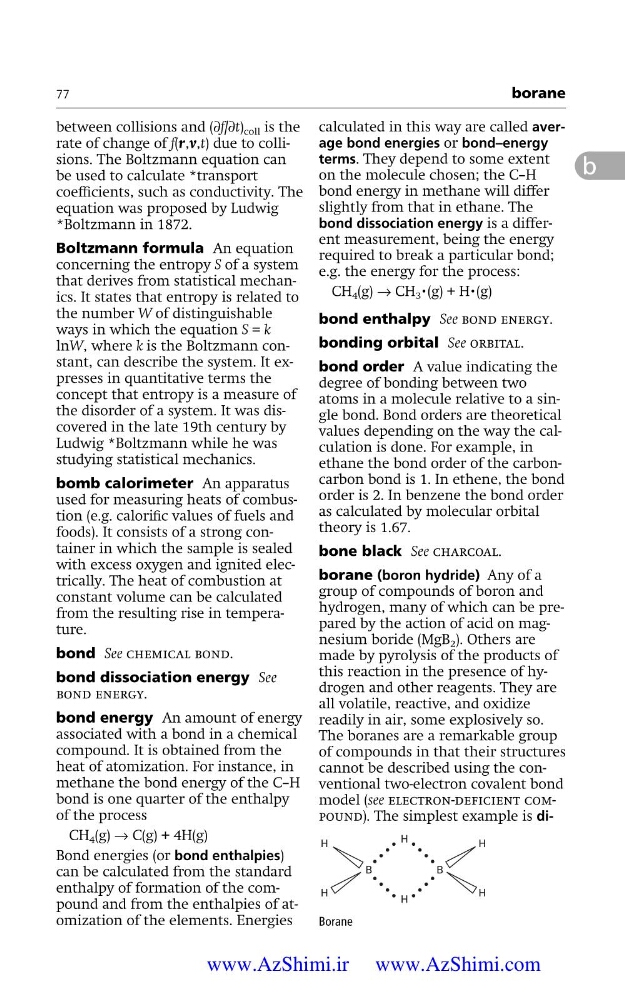
borane (boron hydride) Any of a
group of compounds of boron and
hydrogen, many of which can be prepared by the action of acid on magnesium boride (MgB 2 ). Others are
made by pyrolysis of the products of
this reaction in the presence of hydrogen and other reagents. They are
all volatile, reactive, and oxidize
readily in air, some explosively so.
The boranes are a remarkable group
of compounds in that their structures
cannot be described using the conventional two-electron covalent bond
model (see electron-deficient compound). The simplest example is di77
borane
b
H
H
H
H
B
B
H
H
Borane
www.AzShimi.ir www.AzShimi.com
rate of change of f(r,v,t) due to collisions. The Boltzmann equation can
be used to calculate *transport
coefÜcients, such as conductivity. The
equation was proposed by Ludwig
*Boltzmann in 1872.
Boltzmann formula An equation
concerning the entropy S of a system
that derives from statistical mechanics. It states that entropy is related to
the number W of distinguishable
ways in which the equation S = k
lnW, where k is the Boltzmann constant, can describe the system. It expresses in quantitative terms the
concept that entropy is a measure of
the disorder of a system. It was discovered in the late 19th century by
Ludwig *Boltzmann while he was
studying statistical mechanics.
bomb calorimeter An apparatus
used for measuring heats of combustion (e.g. caloriÜc values of fuels and
foods). It consists of a strong container in which the sample is sealed
with excess oxygen and ignited electrically. The heat of combustion at
constant volume can be calculated
from the resulting rise in temperature.
bond See chemical bond.
bond dissociation energy See
bond energy.
bond energy An amount of energy
associated with a bond in a chemical
compound. It is obtained from the
heat of atomization. For instance, in
methane the bond energy of the C–H
bond is one quarter of the enthalpy
of the process
CH 4 (g) → C(g) + 4H(g)
Bond energies (or bond enthalpies)
can be calculated from the standard
enthalpy of formation of the compound and from the enthalpies of atomization of the elements. Energies
calculated in this way are called average bond energies or bond–energy
terms. They depend to some extent
on the molecule chosen; the C–H
bond energy in methane will differ
slightly from that in ethane. The
bond dissociation energy is a different measurement, being the energy
required to break a particular bond;
e.g. the energy for the process:
CH 4 (g) → CH 3 •(g) + H•(g)
bond enthalpy See bond energy.
bonding orbital See orbital.
bond order A value indicating the
degree of bonding between two
atoms in a molecule relative to a single bond. Bond orders are theoretical
values depending on the way the calculation is done. For example, in
ethane the bond order of the carboncarbon bond is 1. In ethene, the bond
order is 2. In benzene the bond order
as calculated by molecular orbital
theory is 1.67.
bone black See charcoal.
borane (boron hydride) Any of a
group of compounds of boron and
hydrogen, many of which can be prepared by the action of acid on magnesium boride (MgB 2 ). Others are
made by pyrolysis of the products of
this reaction in the presence of hydrogen and other reagents. They are
all volatile, reactive, and oxidize
readily in air, some explosively so.
The boranes are a remarkable group
of compounds in that their structures
cannot be described using the conventional two-electron covalent bond
model (see electron-deficient compound). The simplest example is di77
borane
b
H
H
H
H
B
B
H
H
Borane
www.AzShimi.ir www.AzShimi.com