

mum point is reached, at which the
two liquids distil together without
change in composition. The composition of an azeotrope depends on the
pressure.
azeotropic distillation A technique for separating components of
an azeotrope by adding a third liquid
to form a new azeotrope with one of
the original components. It is most
commonly used to separate ethanol
from water, adding benzene to associate with the ethanol.
azides Compounds containing the
ion N 3
– or the group –N 3 .
azimuthal quantum number See
atom.
azine An organic heterocyclic compound containing a six-membered
ring formed from carbon and nitrogen atoms. Pyridine is an example
containing one nitrogen atom
(C 5 H 5 N). Diazines have two nitrogen
atoms in the ring (e.g. C 4 H 4 N 2 ), and
isomers exist depending on the relative positions of the nitrogen atoms.
Triazines contain three nitrogen
atoms.
A
• Information about IUPAC nomenclature
azo compounds Organic compounds containing the group –N=N–
linking two other groups. They can
be formed by reaction of a diazonium ion with a benzene ring.
A
• Information about IUPAC nomenclature
azo dye See dyes.
azoimide See hydrogen azide.
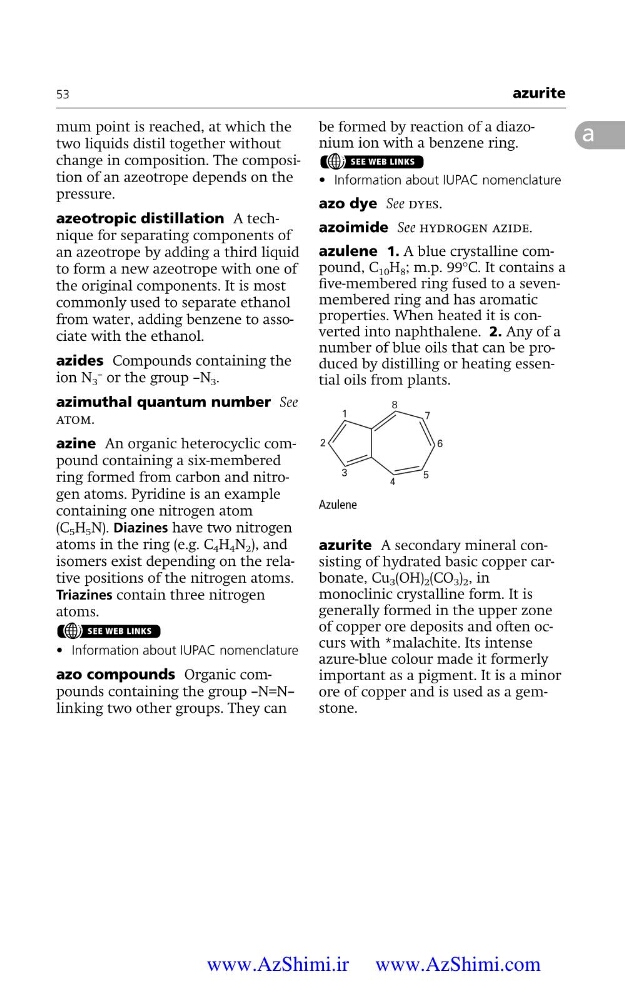
azulene 1. A blue crystalline compound, C 10 H 8 ; m.p. 99°C. It contains a
Üve-membered ring fused to a sevenmembered ring and has aromatic
properties. When heated it is converted into naphthalene. 2. Any of a
number of blue oils that can be produced by distilling or heating essential oils from plants.
53
azurite
a
1
2
3
4
5
6
7
8
Azulene
azurite A secondary mineral consisting of hydrated basic copper carbonate, Cu 3 (OH) 2 (CO 3 ) 2 , in
monoclinic crystalline form. It is
generally formed in the upper zone
of copper ore deposits and often occurs with *malachite. Its intense
azure-blue colour made it formerly
important as a pigment. It is a minor
ore of copper and is used as a gemstone.
www.AzShimi.ir www.AzShimi.com
two liquids distil together without
change in composition. The composition of an azeotrope depends on the
pressure.
azeotropic distillation A technique for separating components of
an azeotrope by adding a third liquid
to form a new azeotrope with one of
the original components. It is most
commonly used to separate ethanol
from water, adding benzene to associate with the ethanol.
azides Compounds containing the
ion N 3
– or the group –N 3 .
azimuthal quantum number See
atom.
azine An organic heterocyclic compound containing a six-membered
ring formed from carbon and nitrogen atoms. Pyridine is an example
containing one nitrogen atom
(C 5 H 5 N). Diazines have two nitrogen
atoms in the ring (e.g. C 4 H 4 N 2 ), and
isomers exist depending on the relative positions of the nitrogen atoms.
Triazines contain three nitrogen
atoms.
A
• Information about IUPAC nomenclature
azo compounds Organic compounds containing the group –N=N–
linking two other groups. They can
be formed by reaction of a diazonium ion with a benzene ring.
A
• Information about IUPAC nomenclature
azo dye See dyes.
azoimide See hydrogen azide.
azulene 1. A blue crystalline compound, C 10 H 8 ; m.p. 99°C. It contains a
Üve-membered ring fused to a sevenmembered ring and has aromatic
properties. When heated it is converted into naphthalene. 2. Any of a
number of blue oils that can be produced by distilling or heating essential oils from plants.
53
azurite
a
1
2
3
4
5
6
7
8
Azulene
azurite A secondary mineral consisting of hydrated basic copper carbonate, Cu 3 (OH) 2 (CO 3 ) 2 , in
monoclinic crystalline form. It is
generally formed in the upper zone
of copper ore deposits and often occurs with *malachite. Its intense
azure-blue colour made it formerly
important as a pigment. It is a minor
ore of copper and is used as a gemstone.
www.AzShimi.ir www.AzShimi.com