

adsorbed atom is removed as an ion
by a pulse of potential difference.
The atom then passes in the same direction as the gas ions, through the
hole in the screen. This enables the
atom to be identiÜed by a mass spectrometer behind the screen. Atomprobe FIM identiÜes both the type
and the position of the atom and can
be used to observe atomic processes,
such as evaporation, with the pulse
used for analysis lasting about 2
nanoseconds.
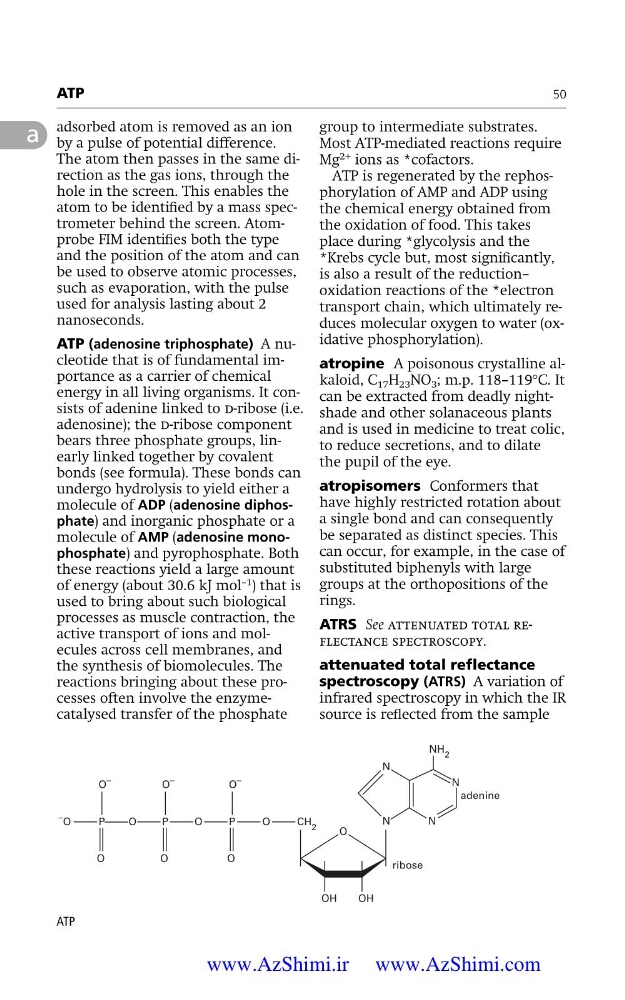
ATP (adenosine triphosphate) A nucleotide that is of fundamental importance as a carrier of chemical
energy in all living organisms. It consists of adenine linked to d-ribose (i.e.
adenosine); the d-ribose component
bears three phosphate groups, linearly linked together by covalent
bonds (see formula). These bonds can
undergo hydrolysis to yield either a
molecule of ADP (adenosine diphosphate) and inorganic phosphate or a
molecule of AMP (adenosine monophosphate) and pyrophosphate. Both
these reactions yield a large amount
of energy (about 30.6 kJ mol
–1
) that is
used to bring about such biological
processes as muscle contraction, the
active transport of ions and molecules across cell membranes, and
the synthesis of biomolecules. The
reactions bringing about these processes often involve the enzymecatalysed transfer of the phosphate
group to intermediate substrates.
Most ATP-mediated reactions require
Mg
2+ ions as *cofactors.
ATP is regenerated by the rephosphorylation of AMP and ADP using
the chemical energy obtained from
the oxidation of food. This takes
place during *glycolysis and the
*Krebs cycle but, most signiÜcantly,
is also a result of the reduction–
oxidation reactions of the *electron
transport chain, which ultimately reduces molecular oxygen to water (oxidative phosphorylation).
atropine A poisonous crystalline alkaloid, C 17 H 23 NO 3 ; m.p. 118–119°C. It
can be extracted from deadly nightshade and other solanaceous plants
and is used in medicine to treat colic,
to reduce secretions, and to dilate
the pupil of the eye.
atropisomers Conformers that
have highly restricted rotation about
a single bond and can consequently
be separated as distinct species. This
can occur, for example, in the case of
substituted biphenyls with large
groups at the orthopositions of the
rings.
ATRS See attenuated total reflectance spectroscopy.
attenuated total reÛectance
spectroscopy (ATRS) A variation of
infrared spectroscopy in which the IR
source is reÛected from the sample
ATP
50
a
– O
O
O
–
O
P
O
–
O
P
O
–
O
P
O
O
CH 2
O
OH
OH
ribose
N
N
N
N
NH 2
adenine
ATP
www.AzShimi.ir www.AzShimi.com
by a pulse of potential difference.
The atom then passes in the same direction as the gas ions, through the
hole in the screen. This enables the
atom to be identiÜed by a mass spectrometer behind the screen. Atomprobe FIM identiÜes both the type
and the position of the atom and can
be used to observe atomic processes,
such as evaporation, with the pulse
used for analysis lasting about 2
nanoseconds.
ATP (adenosine triphosphate) A nucleotide that is of fundamental importance as a carrier of chemical
energy in all living organisms. It consists of adenine linked to d-ribose (i.e.
adenosine); the d-ribose component
bears three phosphate groups, linearly linked together by covalent
bonds (see formula). These bonds can
undergo hydrolysis to yield either a
molecule of ADP (adenosine diphosphate) and inorganic phosphate or a
molecule of AMP (adenosine monophosphate) and pyrophosphate. Both
these reactions yield a large amount
of energy (about 30.6 kJ mol
–1
) that is
used to bring about such biological
processes as muscle contraction, the
active transport of ions and molecules across cell membranes, and
the synthesis of biomolecules. The
reactions bringing about these processes often involve the enzymecatalysed transfer of the phosphate
group to intermediate substrates.
Most ATP-mediated reactions require
Mg
2+ ions as *cofactors.
ATP is regenerated by the rephosphorylation of AMP and ADP using
the chemical energy obtained from
the oxidation of food. This takes
place during *glycolysis and the
*Krebs cycle but, most signiÜcantly,
is also a result of the reduction–
oxidation reactions of the *electron
transport chain, which ultimately reduces molecular oxygen to water (oxidative phosphorylation).
atropine A poisonous crystalline alkaloid, C 17 H 23 NO 3 ; m.p. 118–119°C. It
can be extracted from deadly nightshade and other solanaceous plants
and is used in medicine to treat colic,
to reduce secretions, and to dilate
the pupil of the eye.
atropisomers Conformers that
have highly restricted rotation about
a single bond and can consequently
be separated as distinct species. This
can occur, for example, in the case of
substituted biphenyls with large
groups at the orthopositions of the
rings.
ATRS See attenuated total reflectance spectroscopy.
attenuated total reÛectance
spectroscopy (ATRS) A variation of
infrared spectroscopy in which the IR
source is reÛected from the sample
ATP
50
a
– O
O
O
–
O
P
O
–
O
P
O
–
O
P
O
O
CH 2
O
OH
OH
ribose
N
N
N
N
NH 2
adenine
ATP
www.AzShimi.ir www.AzShimi.com