

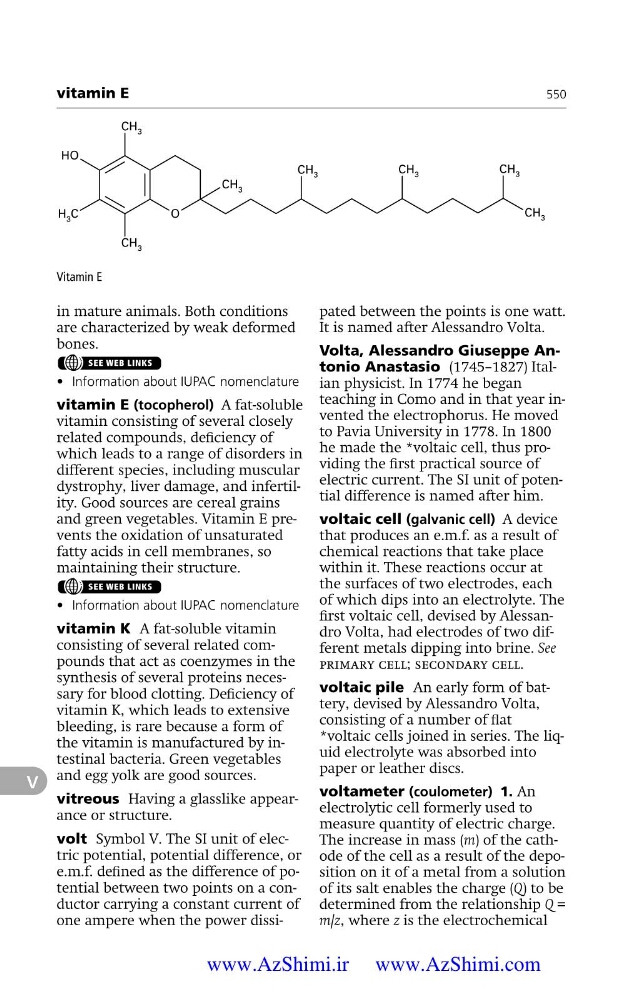
vitamin E
550
v
in mature animals. Both conditions
are characterized by weak deformed
bones.
A
• Information about IUPAC nomenclature
vitamin E (tocopherol) A fat-soluble
vitamin consisting of several closely
related compounds, deÜciency of
which leads to a range of disorders in
different species, including muscular
dystrophy, liver damage, and infertility. Good sources are cereal grains
and green vegetables. Vitamin E prevents the oxidation of unsaturated
fatty acids in cell membranes, so
maintaining their structure.
A
• Information about IUPAC nomenclature
vitamin K A fat-soluble vitamin
consisting of several related compounds that act as coenzymes in the
synthesis of several proteins necessary for blood clotting. DeÜciency of
vitamin K, which leads to extensive
bleeding, is rare because a form of
the vitamin is manufactured by intestinal bacteria. Green vegetables
and egg yolk are good sources.
vitreous Having a glasslike appearance or structure.
volt Symbol V. The SI unit of electric potential, potential difference, or
e.m.f. deÜned as the difference of potential between two points on a conductor carrying a constant current of
one ampere when the power dissipated between the points is one watt.
It is named after Alessandro Volta.
Volta, Alessandro Giuseppe Antonio Anastasio (1745–1827) Italian physicist. In 1774 he began
teaching in Como and in that year invented the electrophorus. He moved
to Pavia University in 1778. In 1800
he made the *voltaic cell, thus providing the Ürst practical source of
electric current. The SI unit of potential difference is named after him.
voltaic cell (galvanic cell) A device
that produces an e.m.f. as a result of
chemical reactions that take place
within it. These reactions occur at
the surfaces of two electrodes, each
of which dips into an electrolyte. The
Ürst voltaic cell, devised by Alessandro Volta, had electrodes of two different metals dipping into brine. See
primary cell; secondary cell.
voltaic pile An early form of battery, devised by Alessandro Volta,
consisting of a number of Ûat
*voltaic cells joined in series. The liquid electrolyte was absorbed into
paper or leather discs.
voltameter (coulometer) 1. An
electrolytic cell formerly used to
measure quantity of electric charge.
The increase in mass (m) of the cathode of the cell as a result of the deposition on it of a metal from a solution
of its salt enables the charge (Q) to be
determined from the relationship Q =
m/z, where z is the electrochemical
CH 3
O
CH 3
O
H
C
H 3
CH 3
CH 3
CH 3
CH 3
CH 3
Vitamin E
www.AzShimi.ir www.AzShimi.com