

or group approaches the molecule as
the other leaves. The transition state
is an intermediate state in which
both attacking and leaving groups
are partly bound to the molecule, e.g.
B + RA → B—-R—-A → BR + A
In the theory of reaction rates, the
reactants are assumed to be in equilibrium with this activated complex,
which decomposes to the products.
transmission electron microscope See electron microscope.
transmutation The transformation of one element into another by
bombardment of nuclei with particles. For example, plutonium is obtained by the neutron bombardment
of uranium.
transport coefÜcients Quantities
that characterize transport in a system. Examples of transport coefÜcients include electrical and thermal
conductivity. One of the main purposes of *nonequilibrium statistical
mechanics is to calculate such coefÜcients from Ürst principles. It is
difÜcult to calculate transport coefÜcients exactly for noninteracting systems and it is therefore necessary to
use approximation techniques. A
transport coefÜcient gives a measure
for Ûow in a system. An inverse
transport coefÜcient gives a measure
of resistance to Ûow in a system.
transport number Symbol t. The
fraction of the total charge carried by
a particular type of ion in the conduction of electricity through electrolytes.
transuranic elements Elements
with an atomic number greater than
92, i.e. elements above uranium in
the *periodic table. Most of these elements are unstable and have short
half-lives. See also transactinide elements.
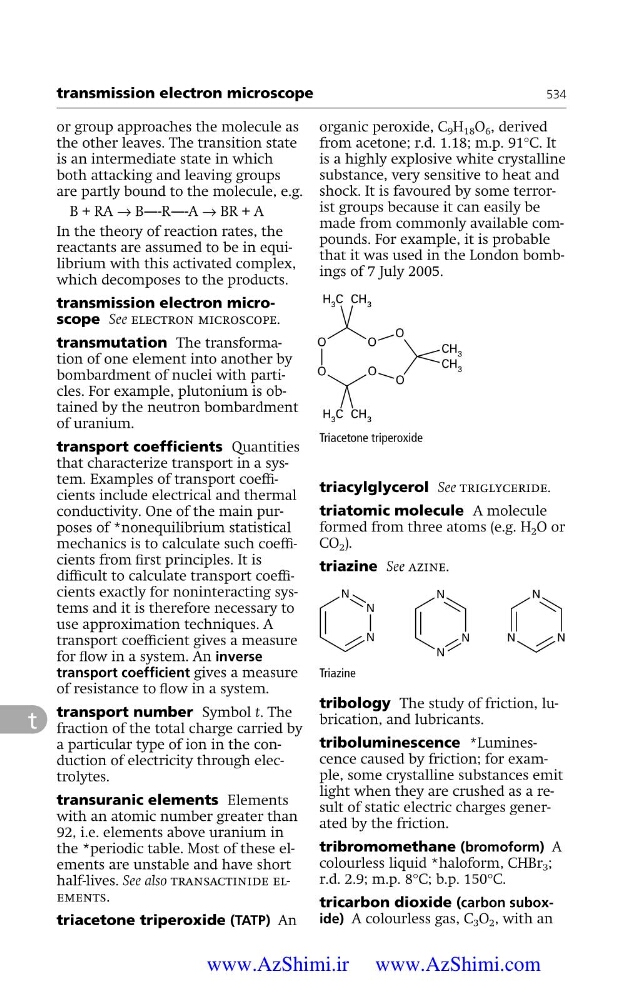
triacetone triperoxide (TATP) An
organic peroxide, C 9 H 18 O 6 , derived
from acetone; r.d. 1.18; m.p. 91°C. It
is a highly explosive white crystalline
substance, very sensitive to heat and
shock. It is favoured by some terrorist groups because it can easily be
made from commonly available compounds. For example, it is probable
that it was used in the London bombings of 7 July 2005.
triacylglycerol See triglyceride.
triatomic molecule A molecule
formed from three atoms (e.g. H 2 O or
CO 2 ).
triazine See azine.
transmission electron microscope
534
t
O
O
O
O
O
O
C
H 3 CH 3
C
H 3
CH 3
CH 3
CH 3
Triacetone triperoxide
0
0
0
0
0
0
0
0
0
Triazine
tribology The study of friction, lubrication, and lubricants.
triboluminescence *Luminescence caused by friction; for example, some crystalline substances emit
light when they are crushed as a result of static electric charges generated by the friction.
tribromomethane (bromoform) A
colourless liquid *haloform, CHBr 3 ;
r.d. 2.9; m.p. 8°C; b.p. 150°C.
tricarbon dioxide (carbon suboxide) A colourless gas, C 3 O 2 , with an
www.AzShimi.ir www.AzShimi.com
the other leaves. The transition state
is an intermediate state in which
both attacking and leaving groups
are partly bound to the molecule, e.g.
B + RA → B—-R—-A → BR + A
In the theory of reaction rates, the
reactants are assumed to be in equilibrium with this activated complex,
which decomposes to the products.
transmission electron microscope See electron microscope.
transmutation The transformation of one element into another by
bombardment of nuclei with particles. For example, plutonium is obtained by the neutron bombardment
of uranium.
transport coefÜcients Quantities
that characterize transport in a system. Examples of transport coefÜcients include electrical and thermal
conductivity. One of the main purposes of *nonequilibrium statistical
mechanics is to calculate such coefÜcients from Ürst principles. It is
difÜcult to calculate transport coefÜcients exactly for noninteracting systems and it is therefore necessary to
use approximation techniques. A
transport coefÜcient gives a measure
for Ûow in a system. An inverse
transport coefÜcient gives a measure
of resistance to Ûow in a system.
transport number Symbol t. The
fraction of the total charge carried by
a particular type of ion in the conduction of electricity through electrolytes.
transuranic elements Elements
with an atomic number greater than
92, i.e. elements above uranium in
the *periodic table. Most of these elements are unstable and have short
half-lives. See also transactinide elements.
triacetone triperoxide (TATP) An
organic peroxide, C 9 H 18 O 6 , derived
from acetone; r.d. 1.18; m.p. 91°C. It
is a highly explosive white crystalline
substance, very sensitive to heat and
shock. It is favoured by some terrorist groups because it can easily be
made from commonly available compounds. For example, it is probable
that it was used in the London bombings of 7 July 2005.
triacylglycerol See triglyceride.
triatomic molecule A molecule
formed from three atoms (e.g. H 2 O or
CO 2 ).
triazine See azine.
transmission electron microscope
534
t
O
O
O
O
O
O
C
H 3 CH 3
C
H 3
CH 3
CH 3
CH 3
Triacetone triperoxide
0
0
0
0
0
0
0
0
0
Triazine
tribology The study of friction, lubrication, and lubricants.
triboluminescence *Luminescence caused by friction; for example, some crystalline substances emit
light when they are crushed as a result of static electric charges generated by the friction.
tribromomethane (bromoform) A
colourless liquid *haloform, CHBr 3 ;
r.d. 2.9; m.p. 8°C; b.p. 150°C.
tricarbon dioxide (carbon suboxide) A colourless gas, C 3 O 2 , with an
www.AzShimi.ir www.AzShimi.com