

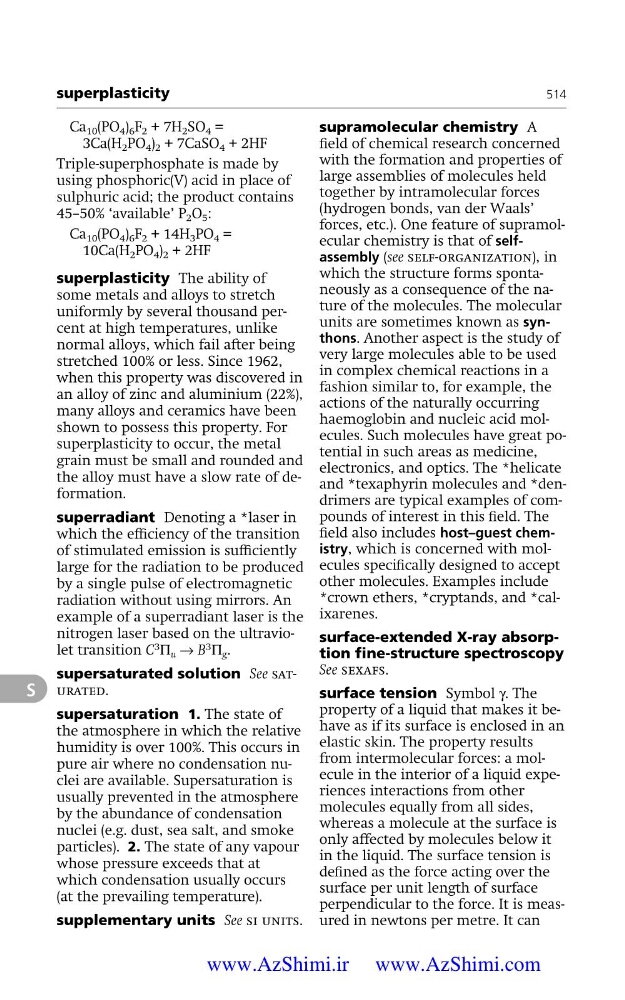
Ca 10 (PO 4 ) 6 F 2 + 7H 2 SO 4 =
3Ca(H 2 PO 4 ) 2 + 7CaSO 4 + 2HF
Triple-superphosphate is made by
using phosphoric(V) acid in place of
sulphuric acid; the product contains
45–50% ‘available’ P 2 O 5 :
Ca 10 (PO 4 ) 6 F 2 + 14H 3 PO 4 =
10Ca(H 2 PO 4 ) 2 + 2HF
superplasticity The ability of
some metals and alloys to stretch
uniformly by several thousand percent at high temperatures, unlike
normal alloys, which fail after being
stretched 100% or less. Since 1962,
when this property was discovered in
an alloy of zinc and aluminium (22%),
many alloys and ceramics have been
shown to possess this property. For
superplasticity to occur, the metal
grain must be small and rounded and
the alloy must have a slow rate of deformation.
superradiant Denoting a *laser in
which the efÜciency of the transition
of stimulated emission is sufÜciently
large for the radiation to be produced
by a single pulse of electromagnetic
radiation without using mirrors. An
example of a superradiant laser is the
nitrogen laser based on the ultraviolet transition C
3
Π u → B
3
Π g .
supersaturated solution See saturated.
supersaturation 1. The state of
the atmosphere in which the relative
humidity is over 100%. This occurs in
pure air where no condensation nuclei are available. Supersaturation is
usually prevented in the atmosphere
by the abundance of condensation
nuclei (e.g. dust, sea salt, and smoke
particles). 2. The state of any vapour
whose pressure exceeds that at
which condensation usually occurs
(at the prevailing temperature).
supplementary units See si units.
supramolecular chemistry A
Üeld of chemical research concerned
with the formation and properties of
large assemblies of molecules held
together by intramolecular forces
(hydrogen bonds, van der Waals’
forces, etc.). One feature of supramolecular chemistry is that of selfassembly (see self-organization), in
which the structure forms spontaneously as a consequence of the nature of the molecules. The molecular
units are sometimes known as synthons. Another aspect is the study of
very large molecules able to be used
in complex chemical reactions in a
fashion similar to, for example, the
actions of the naturally occurring
haemoglobin and nucleic acid molecules. Such molecules have great potential in such areas as medicine,
electronics, and optics. The *helicate
and *texaphyrin molecules and *dendrimers are typical examples of compounds of interest in this Üeld. The
Üeld also includes host–guest chemistry, which is concerned with molecules speciÜcally designed to accept
other molecules. Examples include
*crown ethers, *cryptands, and *calixarenes.
surface-extended X-ray absorption Üne-structure spectroscopy
See sexafs.
surface tension Symbol γ. The
property of a liquid that makes it behave as if its surface is enclosed in an
elastic skin. The property results
from intermolecular forces: a molecule in the interior of a liquid experiences interactions from other
molecules equally from all sides,
whereas a molecule at the surface is
only affected by molecules below it
in the liquid. The surface tension is
deÜned as the force acting over the
surface per unit length of surface
perpendicular to the force. It is measured in newtons per metre. It can
superplasticity
514
s
www.AzShimi.ir www.AzShimi.com
3Ca(H 2 PO 4 ) 2 + 7CaSO 4 + 2HF
Triple-superphosphate is made by
using phosphoric(V) acid in place of
sulphuric acid; the product contains
45–50% ‘available’ P 2 O 5 :
Ca 10 (PO 4 ) 6 F 2 + 14H 3 PO 4 =
10Ca(H 2 PO 4 ) 2 + 2HF
superplasticity The ability of
some metals and alloys to stretch
uniformly by several thousand percent at high temperatures, unlike
normal alloys, which fail after being
stretched 100% or less. Since 1962,
when this property was discovered in
an alloy of zinc and aluminium (22%),
many alloys and ceramics have been
shown to possess this property. For
superplasticity to occur, the metal
grain must be small and rounded and
the alloy must have a slow rate of deformation.
superradiant Denoting a *laser in
which the efÜciency of the transition
of stimulated emission is sufÜciently
large for the radiation to be produced
by a single pulse of electromagnetic
radiation without using mirrors. An
example of a superradiant laser is the
nitrogen laser based on the ultraviolet transition C
3
Π u → B
3
Π g .
supersaturated solution See saturated.
supersaturation 1. The state of
the atmosphere in which the relative
humidity is over 100%. This occurs in
pure air where no condensation nuclei are available. Supersaturation is
usually prevented in the atmosphere
by the abundance of condensation
nuclei (e.g. dust, sea salt, and smoke
particles). 2. The state of any vapour
whose pressure exceeds that at
which condensation usually occurs
(at the prevailing temperature).
supplementary units See si units.
supramolecular chemistry A
Üeld of chemical research concerned
with the formation and properties of
large assemblies of molecules held
together by intramolecular forces
(hydrogen bonds, van der Waals’
forces, etc.). One feature of supramolecular chemistry is that of selfassembly (see self-organization), in
which the structure forms spontaneously as a consequence of the nature of the molecules. The molecular
units are sometimes known as synthons. Another aspect is the study of
very large molecules able to be used
in complex chemical reactions in a
fashion similar to, for example, the
actions of the naturally occurring
haemoglobin and nucleic acid molecules. Such molecules have great potential in such areas as medicine,
electronics, and optics. The *helicate
and *texaphyrin molecules and *dendrimers are typical examples of compounds of interest in this Üeld. The
Üeld also includes host–guest chemistry, which is concerned with molecules speciÜcally designed to accept
other molecules. Examples include
*crown ethers, *cryptands, and *calixarenes.
surface-extended X-ray absorption Üne-structure spectroscopy
See sexafs.
surface tension Symbol γ. The
property of a liquid that makes it behave as if its surface is enclosed in an
elastic skin. The property results
from intermolecular forces: a molecule in the interior of a liquid experiences interactions from other
molecules equally from all sides,
whereas a molecule at the surface is
only affected by molecules below it
in the liquid. The surface tension is
deÜned as the force acting over the
surface per unit length of surface
perpendicular to the force. It is measured in newtons per metre. It can
superplasticity
514
s
www.AzShimi.ir www.AzShimi.com