

Spin–orbit coupling is large in many
nuclei, particularly heavy nuclei.
spirits of salt A name formerly
given to hydrogen chloride because
this compound can be made by
adding sulphuric acid to common
salt (sodium chloride).
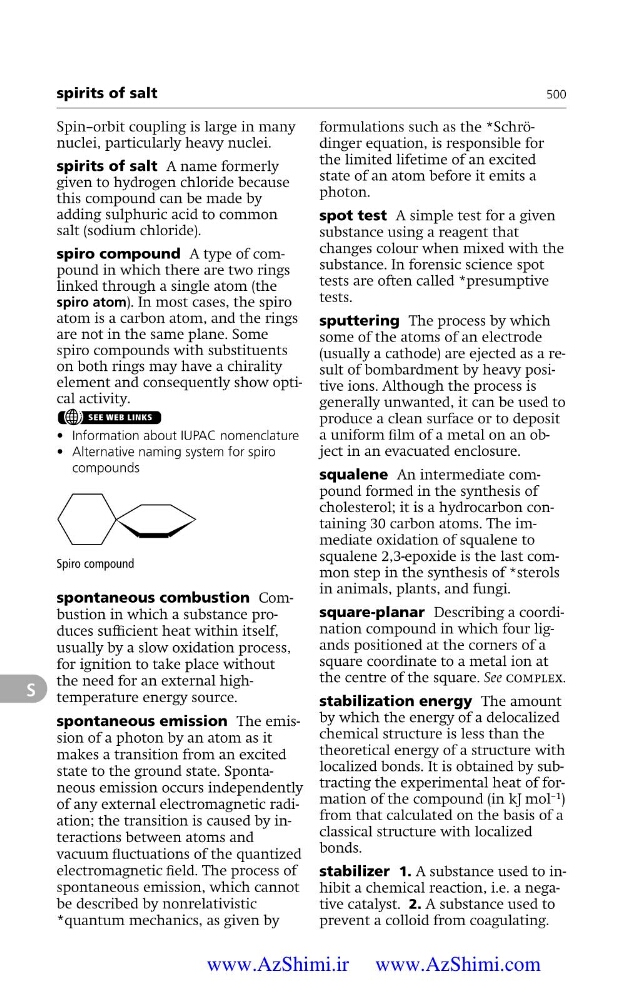
spiro compound A type of compound in which there are two rings
linked through a single atom (the
spiro atom). In most cases, the spiro
atom is a carbon atom, and the rings
are not in the same plane. Some
spiro compounds with substituents
on both rings may have a chirality
element and consequently show optical activity.
A
• Information about IUPAC nomenclature
• Alternative naming system for spiro
compounds
spirits of salt
500
s
Spiro compound
spontaneous combustion Combustion in which a substance produces sufÜcient heat within itself,
usually by a slow oxidation process,
for ignition to take place without
the need for an external hightemperature energy source.
spontaneous emission The emission of a photon by an atom as it
makes a transition from an excited
state to the ground state. Spontaneous emission occurs independently
of any external electromagnetic radiation; the transition is caused by interactions between atoms and
vacuum Ûuctuations of the quantized
electromagnetic Üeld. The process of
spontaneous emission, which cannot
be described by nonrelativistic
*quantum mechanics, as given by
formulations such as the *Schrödinger equation, is responsible for
the limited lifetime of an excited
state of an atom before it emits a
photon.
spot test A simple test for a given
substance using a reagent that
changes colour when mixed with the
substance. In forensic science spot
tests are often called *presumptive
tests.
sputtering The process by which
some of the atoms of an electrode
(usually a cathode) are ejected as a result of bombardment by heavy positive ions. Although the process is
generally unwanted, it can be used to
produce a clean surface or to deposit
a uniform Ülm of a metal on an object in an evacuated enclosure.
squalene An intermediate compound formed in the synthesis of
cholesterol; it is a hydrocarbon containing 30 carbon atoms. The immediate oxidation of squalene to
squalene 2,3-epoxide is the last common step in the synthesis of *sterols
in animals, plants, and fungi.
square-planar Describing a coordination compound in which four ligands positioned at the corners of a
square coordinate to a metal ion at
the centre of the square. See complex.
stabilization energy The amount
by which the energy of a delocalized
chemical structure is less than the
theoretical energy of a structure with
localized bonds. It is obtained by subtracting the experimental heat of formation of the compound (in kJ mol
–1
)
from that calculated on the basis of a
classical structure with localized
bonds.
stabilizer 1. A substance used to inhibit a chemical reaction, i.e. a negative catalyst. 2. A substance used to
prevent a colloid from coagulating.
www.AzShimi.ir www.AzShimi.com
nuclei, particularly heavy nuclei.
spirits of salt A name formerly
given to hydrogen chloride because
this compound can be made by
adding sulphuric acid to common
salt (sodium chloride).
spiro compound A type of compound in which there are two rings
linked through a single atom (the
spiro atom). In most cases, the spiro
atom is a carbon atom, and the rings
are not in the same plane. Some
spiro compounds with substituents
on both rings may have a chirality
element and consequently show optical activity.
A
• Information about IUPAC nomenclature
• Alternative naming system for spiro
compounds
spirits of salt
500
s
Spiro compound
spontaneous combustion Combustion in which a substance produces sufÜcient heat within itself,
usually by a slow oxidation process,
for ignition to take place without
the need for an external hightemperature energy source.
spontaneous emission The emission of a photon by an atom as it
makes a transition from an excited
state to the ground state. Spontaneous emission occurs independently
of any external electromagnetic radiation; the transition is caused by interactions between atoms and
vacuum Ûuctuations of the quantized
electromagnetic Üeld. The process of
spontaneous emission, which cannot
be described by nonrelativistic
*quantum mechanics, as given by
formulations such as the *Schrödinger equation, is responsible for
the limited lifetime of an excited
state of an atom before it emits a
photon.
spot test A simple test for a given
substance using a reagent that
changes colour when mixed with the
substance. In forensic science spot
tests are often called *presumptive
tests.
sputtering The process by which
some of the atoms of an electrode
(usually a cathode) are ejected as a result of bombardment by heavy positive ions. Although the process is
generally unwanted, it can be used to
produce a clean surface or to deposit
a uniform Ülm of a metal on an object in an evacuated enclosure.
squalene An intermediate compound formed in the synthesis of
cholesterol; it is a hydrocarbon containing 30 carbon atoms. The immediate oxidation of squalene to
squalene 2,3-epoxide is the last common step in the synthesis of *sterols
in animals, plants, and fungi.
square-planar Describing a coordination compound in which four ligands positioned at the corners of a
square coordinate to a metal ion at
the centre of the square. See complex.
stabilization energy The amount
by which the energy of a delocalized
chemical structure is less than the
theoretical energy of a structure with
localized bonds. It is obtained by subtracting the experimental heat of formation of the compound (in kJ mol
–1
)
from that calculated on the basis of a
classical structure with localized
bonds.
stabilizer 1. A substance used to inhibit a chemical reaction, i.e. a negative catalyst. 2. A substance used to
prevent a colloid from coagulating.
www.AzShimi.ir www.AzShimi.com