

497
spectrum
s
spectrophotometer See spectrometer.
spectroscope An optical instrument that produces a *spectrum for
visual observation. The Ürst such instrument was made by R. W. Bunsen;
in its simplest form it consists of a
hollow tube with a slit at one end by
which the light enters and a collimating lens at the other end to produce
a parallel beam, a prism to disperse
the light, and a telescope for viewing
the spectrum. In the spectrograph,
the spectroscope is provided with a
camera to record the spectrum.
For a broad range of spectroscopic
work, from the ultraviolet to the infrared, a diffraction grating is used
instead of a prism. See also spectrometer.
spectroscopy The study of methods of producing and analysing
*spectra using *spectroscopes, *spectrometers, spectrographs, and spectrophotometers. The interpretations
of the spectra so produced can be
used for chemical analysis, examining atomic and molecular energy levels and molecular structures, and for
determining the composition and
motions of celestial bodies.
A
• Original paper by Kirchoff and Bunsen
spectrum (pl. spectra) 1. A distribution of entities or properties arrayed
in order of increasing or decreasing
magnitude. For example, a beam of
ions passed through a mass spectrograph, in which they are deÛected according to their charge-to-mass
ratios, will have a range of masses
called a mass spectrum. A sound
spectrum is the distribution of energy over a range of frequencies of a
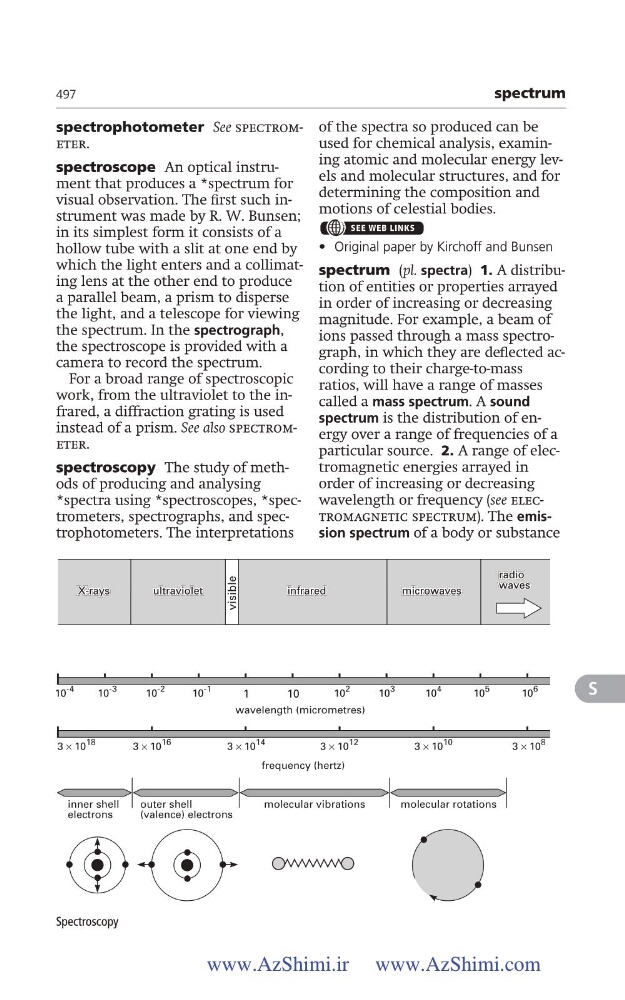
particular source. 2. A range of electromagnetic energies arrayed in
order of increasing or decreasing
wavelength or frequency (see electromagnetic spectrum). The emission spectrum of a body or substance
X-rays X-rays X-rays
ultraviolet ultraviolet ultraviolet
microwaves microwaves microwaves
radio radio radio
waves waves waves
10
-4
10
2
10
-2
10
-1
10
6
10
3
10
4
10
-3
wavelength (micrometres)
3 × 10
18
3 × 10
16
3 × 10
14
3 × 10
12
3 × 10
10
3 × 10
8
frequency (hertz)
inner shell
electrons
outer shell
(valence) electrons
molecular vibrations
molecular rotations
1
1 0
10
5
infrared infrared infrared
visible
Spectroscopy
www.AzShimi.ir www.AzShimi.com
spectrum
s
spectrophotometer See spectrometer.
spectroscope An optical instrument that produces a *spectrum for
visual observation. The Ürst such instrument was made by R. W. Bunsen;
in its simplest form it consists of a
hollow tube with a slit at one end by
which the light enters and a collimating lens at the other end to produce
a parallel beam, a prism to disperse
the light, and a telescope for viewing
the spectrum. In the spectrograph,
the spectroscope is provided with a
camera to record the spectrum.
For a broad range of spectroscopic
work, from the ultraviolet to the infrared, a diffraction grating is used
instead of a prism. See also spectrometer.
spectroscopy The study of methods of producing and analysing
*spectra using *spectroscopes, *spectrometers, spectrographs, and spectrophotometers. The interpretations
of the spectra so produced can be
used for chemical analysis, examining atomic and molecular energy levels and molecular structures, and for
determining the composition and
motions of celestial bodies.
A
• Original paper by Kirchoff and Bunsen
spectrum (pl. spectra) 1. A distribution of entities or properties arrayed
in order of increasing or decreasing
magnitude. For example, a beam of
ions passed through a mass spectrograph, in which they are deÛected according to their charge-to-mass
ratios, will have a range of masses
called a mass spectrum. A sound
spectrum is the distribution of energy over a range of frequencies of a
particular source. 2. A range of electromagnetic energies arrayed in
order of increasing or decreasing
wavelength or frequency (see electromagnetic spectrum). The emission spectrum of a body or substance
X-rays X-rays X-rays
ultraviolet ultraviolet ultraviolet
microwaves microwaves microwaves
radio radio radio
waves waves waves
10
-4
10
2
10
-2
10
-1
10
6
10
3
10
4
10
-3
wavelength (micrometres)
3 × 10
18
3 × 10
16
3 × 10
14
3 × 10
12
3 × 10
10
3 × 10
8
frequency (hertz)
inner shell
electrons
outer shell
(valence) electrons
molecular vibrations
molecular rotations
1
1 0
10
5
infrared infrared infrared
visible
Spectroscopy
www.AzShimi.ir www.AzShimi.com