

S
Sabatier–Senderens process A
method of organic synthesis employing hydrogenation and a heated
nickel catalyst. It is employed commercially for hydrogenating unsaturated vegetable oils to make
margarine. It is named after Paul
Sabatier (1854–1941) and Jean-Baptiste Senderens (1856–1937).
saccharide See sugar.
A
• Information about IUPAC nomenclature
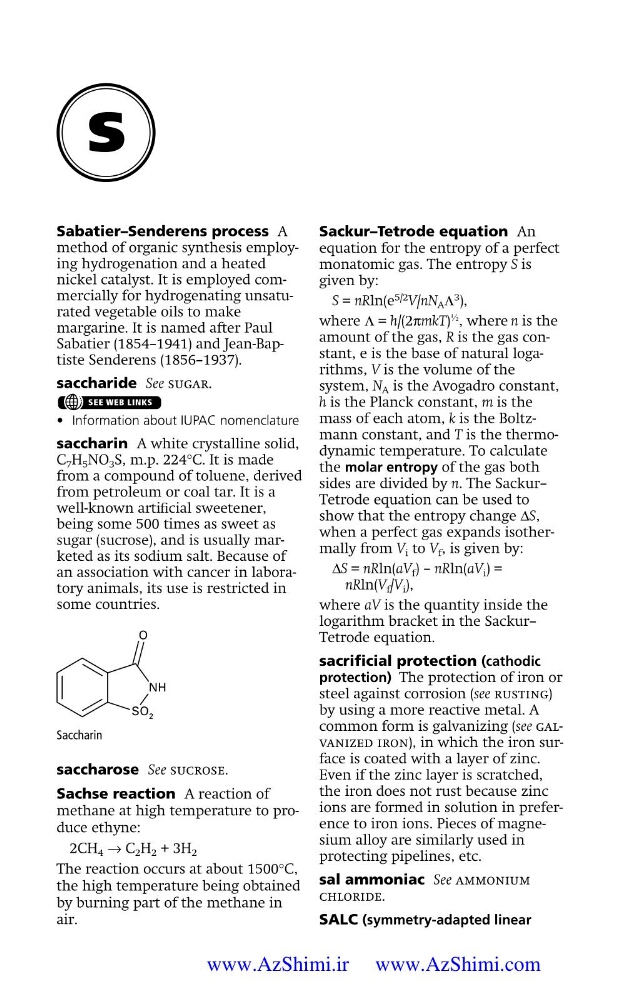
saccharin A white crystalline solid,
C 7 H 5 NO 3 S, m.p. 224°C. It is made
from a compound of toluene, derived
from petroleum or coal tar. It is a
well-known artiÜcial sweetener,
being some 500 times as sweet as
sugar (sucrose), and is usually marketed as its sodium salt. Because of
an association with cancer in laboratory animals, its use is restricted in
some countries.
SO 2
NH
O
Saccharin
saccharose See sucrose.
Sachse reaction A reaction of
methane at high temperature to produce ethyne:
2CH 4 → C 2 H 2 + 3H 2
The reaction occurs at about 1500°C,
the high temperature being obtained
by burning part of the methane in
air.
Sackur–Tetrode equation An
equation for the entropy of a perfect
monatomic gas. The entropy S is
given by:
S = nRln(e
5/2
V/nN A Λ
3 ),
where Λ = h/(2πmkT)
½ , where n is the
amount of the gas, R is the gas constant, e is the base of natural logarithms, V is the volume of the
system, N A is the Avogadro constant,
h is the Planck constant, m is the
mass of each atom, k is the Boltzmann constant, and T is the thermodynamic temperature. To calculate
the molar entropy of the gas both
sides are divided by n. The Sackur–
Tetrode equation can be used to
show that the entropy change ∆S,
when a perfect gas expands isothermally from V i to V f , is given by:
∆S = nRln(aV f ) – nRln(aV i ) =
nRln(V f /V i ),
where aV is the quantity inside the
logarithm bracket in the Sackur–
Tetrode equation.
sacriÜcial protection (cathodic
protection) The protection of iron or
steel against corrosion (see rusting)
by using a more reactive metal. A
common form is galvanizing (see galvanized iron), in which the iron surface is coated with a layer of zinc.
Even if the zinc layer is scratched,
the iron does not rust because zinc
ions are formed in solution in preference to iron ions. Pieces of magnesium alloy are similarly used in
protecting pipelines, etc.
sal ammoniac See ammonium
chloride.
SALC (symmetry-adapted linear
www.AzShimi.ir www.AzShimi.com
Sabatier–Senderens process A
method of organic synthesis employing hydrogenation and a heated
nickel catalyst. It is employed commercially for hydrogenating unsaturated vegetable oils to make
margarine. It is named after Paul
Sabatier (1854–1941) and Jean-Baptiste Senderens (1856–1937).
saccharide See sugar.
A
• Information about IUPAC nomenclature
saccharin A white crystalline solid,
C 7 H 5 NO 3 S, m.p. 224°C. It is made
from a compound of toluene, derived
from petroleum or coal tar. It is a
well-known artiÜcial sweetener,
being some 500 times as sweet as
sugar (sucrose), and is usually marketed as its sodium salt. Because of
an association with cancer in laboratory animals, its use is restricted in
some countries.
SO 2
NH
O
Saccharin
saccharose See sucrose.
Sachse reaction A reaction of
methane at high temperature to produce ethyne:
2CH 4 → C 2 H 2 + 3H 2
The reaction occurs at about 1500°C,
the high temperature being obtained
by burning part of the methane in
air.
Sackur–Tetrode equation An
equation for the entropy of a perfect
monatomic gas. The entropy S is
given by:
S = nRln(e
5/2
V/nN A Λ
3 ),
where Λ = h/(2πmkT)
½ , where n is the
amount of the gas, R is the gas constant, e is the base of natural logarithms, V is the volume of the
system, N A is the Avogadro constant,
h is the Planck constant, m is the
mass of each atom, k is the Boltzmann constant, and T is the thermodynamic temperature. To calculate
the molar entropy of the gas both
sides are divided by n. The Sackur–
Tetrode equation can be used to
show that the entropy change ∆S,
when a perfect gas expands isothermally from V i to V f , is given by:
∆S = nRln(aV f ) – nRln(aV i ) =
nRln(V f /V i ),
where aV is the quantity inside the
logarithm bracket in the Sackur–
Tetrode equation.
sacriÜcial protection (cathodic
protection) The protection of iron or
steel against corrosion (see rusting)
by using a more reactive metal. A
common form is galvanizing (see galvanized iron), in which the iron surface is coated with a layer of zinc.
Even if the zinc layer is scratched,
the iron does not rust because zinc
ions are formed in solution in preference to iron ions. Pieces of magnesium alloy are similarly used in
protecting pipelines, etc.
sal ammoniac See ammonium
chloride.
SALC (symmetry-adapted linear
www.AzShimi.ir www.AzShimi.com