

quinhydrone electrode
450
q
O
O
OH
OH
+ 2H
+
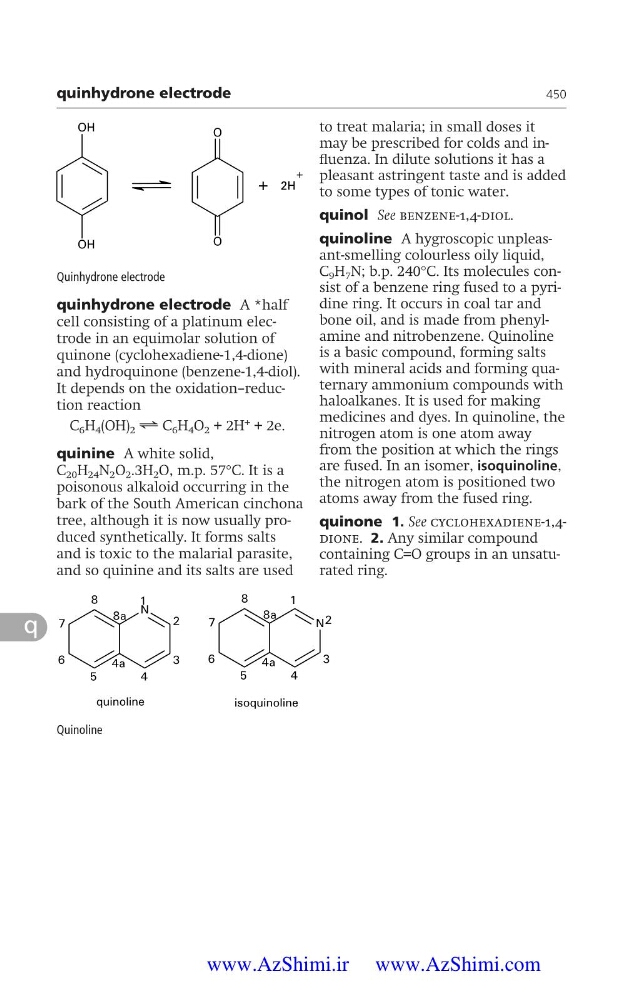
Quinhydrone electrode
0
0
C
C
C
C
SWKPQNKPG
KUQSWKPQNKPG
Quinoline
quinhydrone electrode A *half
cell consisting of a platinum electrode in an equimolar solution of
quinone (cyclohexadiene-1,4-dione)
and hydroquinone (benzene-1,4-diol).
It depends on the oxidation–reduction reaction
C 6 H 4 (OH) 2 ˆ C 6 H 4 O 2 + 2H
+ + 2e.
quinine A white solid,
C 20 H 24 N 2 O 2 .3H 2 O, m.p. 57°C. It is a
poisonous alkaloid occurring in the
bark of the South American cinchona
tree, although it is now usually produced synthetically. It forms salts
and is toxic to the malarial parasite,
and so quinine and its salts are used
to treat malaria; in small doses it
may be prescribed for colds and inÛuenza. In dilute solutions it has a
pleasant astringent taste and is added
to some types of tonic water.
quinol See benzene-1,4-diol.
quinoline A hygroscopic unpleasant-smelling colourless oily liquid,
C 9 H 7 N; b.p. 240°C. Its molecules consist of a benzene ring fused to a pyridine ring. It occurs in coal tar and
bone oil, and is made from phenylamine and nitrobenzene. Quinoline
is a basic compound, forming salts
with mineral acids and forming quaternary ammonium compounds with
haloalkanes. It is used for making
medicines and dyes. In quinoline, the
nitrogen atom is one atom away
from the position at which the rings
are fused. In an isomer, isoquinoline,
the nitrogen atom is positioned two
atoms away from the fused ring.
quinone 1. See cyclohexadiene-1,4dione. 2. Any similar compound
containing C=O groups in an unsaturated ring.
www.AzShimi.ir www.AzShimi.com
450
q
O
O
OH
OH
+ 2H
+
Quinhydrone electrode
0
0
C
C
C
C
SWKPQNKPG
KUQSWKPQNKPG
Quinoline
quinhydrone electrode A *half
cell consisting of a platinum electrode in an equimolar solution of
quinone (cyclohexadiene-1,4-dione)
and hydroquinone (benzene-1,4-diol).
It depends on the oxidation–reduction reaction
C 6 H 4 (OH) 2 ˆ C 6 H 4 O 2 + 2H
+ + 2e.
quinine A white solid,
C 20 H 24 N 2 O 2 .3H 2 O, m.p. 57°C. It is a
poisonous alkaloid occurring in the
bark of the South American cinchona
tree, although it is now usually produced synthetically. It forms salts
and is toxic to the malarial parasite,
and so quinine and its salts are used
to treat malaria; in small doses it
may be prescribed for colds and inÛuenza. In dilute solutions it has a
pleasant astringent taste and is added
to some types of tonic water.
quinol See benzene-1,4-diol.
quinoline A hygroscopic unpleasant-smelling colourless oily liquid,
C 9 H 7 N; b.p. 240°C. Its molecules consist of a benzene ring fused to a pyridine ring. It occurs in coal tar and
bone oil, and is made from phenylamine and nitrobenzene. Quinoline
is a basic compound, forming salts
with mineral acids and forming quaternary ammonium compounds with
haloalkanes. It is used for making
medicines and dyes. In quinoline, the
nitrogen atom is one atom away
from the position at which the rings
are fused. In an isomer, isoquinoline,
the nitrogen atom is positioned two
atoms away from the fused ring.
quinone 1. See cyclohexadiene-1,4dione. 2. Any similar compound
containing C=O groups in an unsaturated ring.
www.AzShimi.ir www.AzShimi.com