

tar. It is used in making other organic chemicals.
pyridoxine See vitamin b complex.
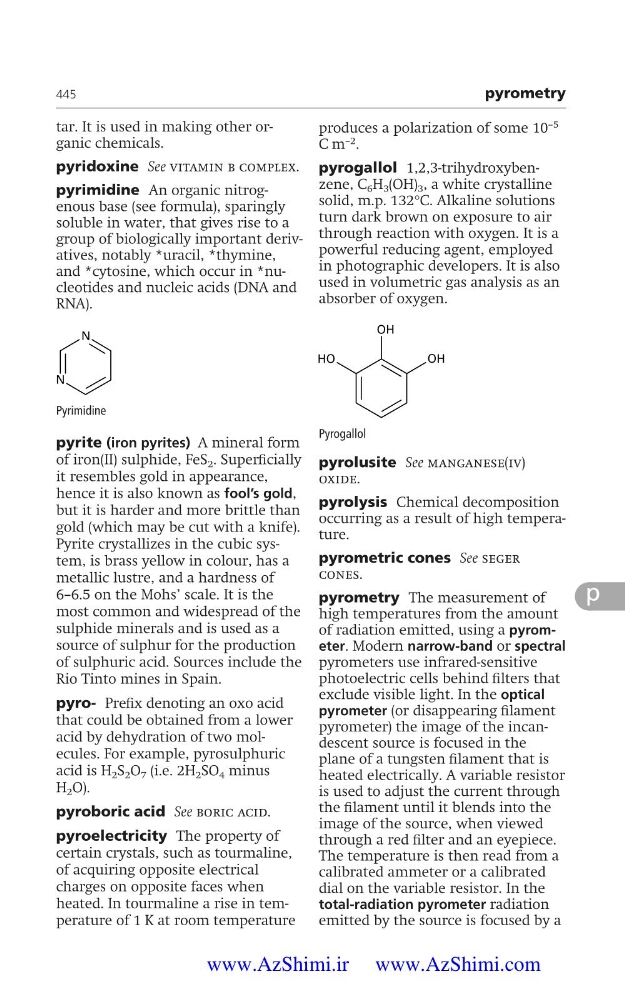
pyrimidine An organic nitrogenous base (see formula), sparingly
soluble in water, that gives rise to a
group of biologically important derivatives, notably *uracil, *thymine,
and *cytosine, which occur in *nucleotides and nucleic acids (DNA and
RNA).
445
pyrometry
p
O
H
OH
OH
Pyrogallol
N
N
Pyrimidine
pyrolusite See manganese(iv)
oxide.
pyrolysis Chemical decomposition
occurring as a result of high temperature.
pyrometric cones See seger
cones.
pyrometry The measurement of
high temperatures from the amount
of radiation emitted, using a pyrometer. Modern narrow-band or spectral
pyrometers use infrared-sensitive
photoelectric cells behind Ülters that
exclude visible light. In the optical
pyrometer (or disappearing Ülament
pyrometer) the image of the incandescent source is focused in the
plane of a tungsten Ülament that is
heated electrically. A variable resistor
is used to adjust the current through
the Ülament until it blends into the
image of the source, when viewed
through a red Ülter and an eyepiece.
The temperature is then read from a
calibrated ammeter or a calibrated
dial on the variable resistor. In the
total-radiation pyrometer radiation
emitted by the source is focused by a
produces a polarization of some 10
–5
C m
–2
.
pyrogallol 1,2,3-trihydroxybenzene, C 6 H 3 (OH) 3 , a white crystalline
solid, m.p. 132°C. Alkaline solutions
turn dark brown on exposure to air
through reaction with oxygen. It is a
powerful reducing agent, employed
in photographic developers. It is also
used in volumetric gas analysis as an
absorber of oxygen.
pyrite (iron pyrites) A mineral form
of iron(II) sulphide, FeS 2 . SuperÜcially
it resembles gold in appearance,
hence it is also known as fool’s gold,
but it is harder and more brittle than
gold (which may be cut with a knife).
Pyrite crystallizes in the cubic system, is brass yellow in colour, has a
metallic lustre, and a hardness of
6–6.5 on the Mohs’ scale. It is the
most common and widespread of the
sulphide minerals and is used as a
source of sulphur for the production
of sulphuric acid. Sources include the
Rio Tinto mines in Spain.
pyro- PreÜx denoting an oxo acid
that could be obtained from a lower
acid by dehydration of two molecules. For example, pyrosulphuric
acid is H 2 S 2 O 7 (i.e. 2H 2 SO 4 minus
H 2 O).
pyroboric acid See boric acid.
pyroelectricity The property of
certain crystals, such as tourmaline,
of acquiring opposite electrical
charges on opposite faces when
heated. In tourmaline a rise in temperature of 1 K at room temperature
www.AzShimi.ir www.AzShimi.com
pyridoxine See vitamin b complex.
pyrimidine An organic nitrogenous base (see formula), sparingly
soluble in water, that gives rise to a
group of biologically important derivatives, notably *uracil, *thymine,
and *cytosine, which occur in *nucleotides and nucleic acids (DNA and
RNA).
445
pyrometry
p
O
H
OH
OH
Pyrogallol
N
N
Pyrimidine
pyrolusite See manganese(iv)
oxide.
pyrolysis Chemical decomposition
occurring as a result of high temperature.
pyrometric cones See seger
cones.
pyrometry The measurement of
high temperatures from the amount
of radiation emitted, using a pyrometer. Modern narrow-band or spectral
pyrometers use infrared-sensitive
photoelectric cells behind Ülters that
exclude visible light. In the optical
pyrometer (or disappearing Ülament
pyrometer) the image of the incandescent source is focused in the
plane of a tungsten Ülament that is
heated electrically. A variable resistor
is used to adjust the current through
the Ülament until it blends into the
image of the source, when viewed
through a red Ülter and an eyepiece.
The temperature is then read from a
calibrated ammeter or a calibrated
dial on the variable resistor. In the
total-radiation pyrometer radiation
emitted by the source is focused by a
produces a polarization of some 10
–5
C m
–2
.
pyrogallol 1,2,3-trihydroxybenzene, C 6 H 3 (OH) 3 , a white crystalline
solid, m.p. 132°C. Alkaline solutions
turn dark brown on exposure to air
through reaction with oxygen. It is a
powerful reducing agent, employed
in photographic developers. It is also
used in volumetric gas analysis as an
absorber of oxygen.
pyrite (iron pyrites) A mineral form
of iron(II) sulphide, FeS 2 . SuperÜcially
it resembles gold in appearance,
hence it is also known as fool’s gold,
but it is harder and more brittle than
gold (which may be cut with a knife).
Pyrite crystallizes in the cubic system, is brass yellow in colour, has a
metallic lustre, and a hardness of
6–6.5 on the Mohs’ scale. It is the
most common and widespread of the
sulphide minerals and is used as a
source of sulphur for the production
of sulphuric acid. Sources include the
Rio Tinto mines in Spain.
pyro- PreÜx denoting an oxo acid
that could be obtained from a lower
acid by dehydration of two molecules. For example, pyrosulphuric
acid is H 2 S 2 O 7 (i.e. 2H 2 SO 4 minus
H 2 O).
pyroboric acid See boric acid.
pyroelectricity The property of
certain crystals, such as tourmaline,
of acquiring opposite electrical
charges on opposite faces when
heated. In tourmaline a rise in temperature of 1 K at room temperature
www.AzShimi.ir www.AzShimi.com