

gauge that reads zero at atmospheric
pressure.
pressure gauge Any device used
to measure *pressure. Three basic
types are in use: the liquid-column
gauge (e.g. the mercury barometer
and the manometer), the expandingelement gauge (e.g. the Bourdon
gauge and the aneroid barometer),
and the electrical transducer. In the
last category the strain gauge is an
example. Capacitor pressure gauges
also come into this category. In these
devices, the pressure to be measured
displaces one plate of a capacitor and
thus alters its capacitance.
presumptive test A simple test
for a given substance using a reagent
that changes colour when mixed
with the substance under investigation. Presumptive tests are not deÜnitive and further conÜrmatory tests
are always required. They are used
extensively in forensic science. Examples are the Duquenois–Levine
test for marijuana and Scott’s test for
cocaine. In general analytical chemistry, presumptive tests are often
called spot tests.
Priestley, Joseph (1733–1804)
British chemist, who in 1755 became
a Presbyterian minister. In Leeds, in
1767, he experimented with carbon
dioxide (‘Üxed air’) from a nearby
brewery; with it he invented soda
water. He moved to a ministry in
Birmingham in 1780, and in 1791 his
revolutionary views caused a mob to
burn his house, as a result of which
he emigrated to the USA in 1794. In
the early 1770s he experimented
with combustion and produced the
gases hydrogen chloride, sulphur
dioxide, and dinitrogen oxide (nitrous oxide). In 1774 he isolated oxygen (see also lavoisier, antoine).
primary alcohol See alcohols.
primary amine See amines.
primary cell A *voltaic cell in
which the chemical reaction producing the e.m.f. is not satisfactorily reversible and the cell cannot therefore
be recharged by the application of a
charging current. See daniell cell;
leclanché cell; weston cell; mercury cell. Compare secondary cell.
principal quantum number See
atom.
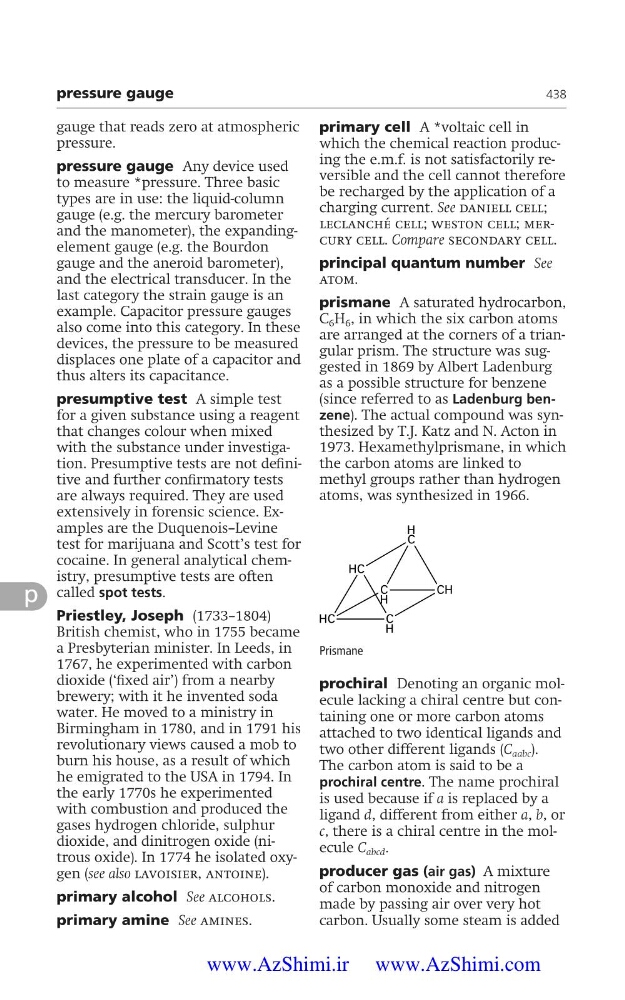
prismane A saturated hydrocarbon,
C 6 H 6 , in which the six carbon atoms
are arranged at the corners of a triangular prism. The structure was suggested in 1869 by Albert Ladenburg
as a possible structure for benzene
(since referred to as Ladenburg benzene). The actual compound was synthesized by T.J. Katz and N. Acton in
1973. Hexamethylprismane, in which
the carbon atoms are linked to
methyl groups rather than hydrogen
atoms, was synthesized in 1966.
pressure gauge
438
p
C
H
C
H
CH
C
H
C
H
C
H
Prismane
prochiral Denoting an organic molecule lacking a chiral centre but containing one or more carbon atoms
attached to two identical ligands and
two other different ligands (C aabc ).
The carbon atom is said to be a
prochiral centre. The name prochiral
is used because if a is replaced by a
ligand d, different from either a, b, or
c, there is a chiral centre in the molecule C abcd .
producer gas (air gas) A mixture
of carbon monoxide and nitrogen
made by passing air over very hot
carbon. Usually some steam is added
www.AzShimi.ir www.AzShimi.com
pressure.
pressure gauge Any device used
to measure *pressure. Three basic
types are in use: the liquid-column
gauge (e.g. the mercury barometer
and the manometer), the expandingelement gauge (e.g. the Bourdon
gauge and the aneroid barometer),
and the electrical transducer. In the
last category the strain gauge is an
example. Capacitor pressure gauges
also come into this category. In these
devices, the pressure to be measured
displaces one plate of a capacitor and
thus alters its capacitance.
presumptive test A simple test
for a given substance using a reagent
that changes colour when mixed
with the substance under investigation. Presumptive tests are not deÜnitive and further conÜrmatory tests
are always required. They are used
extensively in forensic science. Examples are the Duquenois–Levine
test for marijuana and Scott’s test for
cocaine. In general analytical chemistry, presumptive tests are often
called spot tests.
Priestley, Joseph (1733–1804)
British chemist, who in 1755 became
a Presbyterian minister. In Leeds, in
1767, he experimented with carbon
dioxide (‘Üxed air’) from a nearby
brewery; with it he invented soda
water. He moved to a ministry in
Birmingham in 1780, and in 1791 his
revolutionary views caused a mob to
burn his house, as a result of which
he emigrated to the USA in 1794. In
the early 1770s he experimented
with combustion and produced the
gases hydrogen chloride, sulphur
dioxide, and dinitrogen oxide (nitrous oxide). In 1774 he isolated oxygen (see also lavoisier, antoine).
primary alcohol See alcohols.
primary amine See amines.
primary cell A *voltaic cell in
which the chemical reaction producing the e.m.f. is not satisfactorily reversible and the cell cannot therefore
be recharged by the application of a
charging current. See daniell cell;
leclanché cell; weston cell; mercury cell. Compare secondary cell.
principal quantum number See
atom.
prismane A saturated hydrocarbon,
C 6 H 6 , in which the six carbon atoms
are arranged at the corners of a triangular prism. The structure was suggested in 1869 by Albert Ladenburg
as a possible structure for benzene
(since referred to as Ladenburg benzene). The actual compound was synthesized by T.J. Katz and N. Acton in
1973. Hexamethylprismane, in which
the carbon atoms are linked to
methyl groups rather than hydrogen
atoms, was synthesized in 1966.
pressure gauge
438
p
C
H
C
H
CH
C
H
C
H
C
H
Prismane
prochiral Denoting an organic molecule lacking a chiral centre but containing one or more carbon atoms
attached to two identical ligands and
two other different ligands (C aabc ).
The carbon atom is said to be a
prochiral centre. The name prochiral
is used because if a is replaced by a
ligand d, different from either a, b, or
c, there is a chiral centre in the molecule C abcd .
producer gas (air gas) A mixture
of carbon monoxide and nitrogen
made by passing air over very hot
carbon. Usually some steam is added
www.AzShimi.ir www.AzShimi.com