

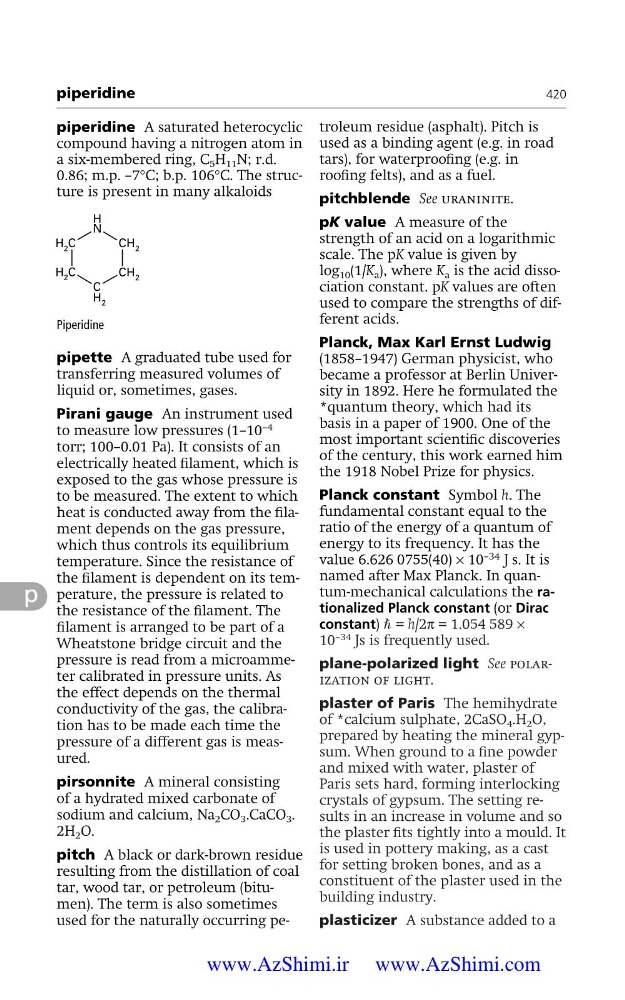
piperidine A saturated heterocyclic
compound having a nitrogen atom in
a six-membered ring, C 5 H 11 N; r.d.
0.86; m.p. –7°C; b.p. 106°C. The structure is present in many alkaloids
piperidine
420
p
N
H
C
H 2
C
H 2
C
H 2
CH 2
CH 2
Piperidine
pipette A graduated tube used for
transferring measured volumes of
liquid or, sometimes, gases.
Pirani gauge An instrument used
to measure low pressures (1–10
–4
torr; 100–0.01 Pa). It consists of an
electrically heated Ülament, which is
exposed to the gas whose pressure is
to be measured. The extent to which
heat is conducted away from the Ülament depends on the gas pressure,
which thus controls its equilibrium
temperature. Since the resistance of
the Ülament is dependent on its temperature, the pressure is related to
the resistance of the Ülament. The
Ülament is arranged to be part of a
Wheatstone bridge circuit and the
pressure is read from a microammeter calibrated in pressure units. As
the effect depends on the thermal
conductivity of the gas, the calibration has to be made each time the
pressure of a different gas is measured.
pirsonnite A mineral consisting
of a hydrated mixed carbonate of
sodium and calcium, Na 2 CO 3 .CaCO 3 .
2H 2 O.
pitch A black or dark-brown residue
resulting from the distillation of coal
tar, wood tar, or petroleum (bitumen). The term is also sometimes
used for the naturally occurring petroleum residue (asphalt). Pitch is
used as a binding agent (e.g. in road
tars), for waterprooÜng (e.g. in
rooÜng felts), and as a fuel.
pitchblende See uraninite.
pK value A measure of the
strength of an acid on a logarithmic
scale. The pK value is given by
log 10 (1/K a ), where K a is the acid dissociation constant. pK values are often
used to compare the strengths of different acids.
Planck, Max Karl Ernst Ludwig
(1858–1947) German physicist, who
became a professor at Berlin University in 1892. Here he formulated the
*quantum theory, which had its
basis in a paper of 1900. One of the
most important scientiÜc discoveries
of the century, this work earned him
the 1918 Nobel Prize for physics.
Planck constant Symbol h. The
fundamental constant equal to the
ratio of the energy of a quantum of
energy to its frequency. It has the
value 6.626 0755(40) × 10
–34 J s. It is
named after Max Planck. In quantum-mechanical calculations the rationalized Planck constant (or Dirac
constant) ប = h/2π = 1.054 589 ×
10
–34 Js is frequently used.
plane-polarized light See polarization of light.
plaster of Paris The hemihydrate
of *calcium sulphate, 2CaSO 4 .H 2 O,
prepared by heating the mineral gypsum. When ground to a Üne powder
and mixed with water, plaster of
Paris sets hard, forming interlocking
crystals of gypsum. The setting results in an increase in volume and so
the plaster Üts tightly into a mould. It
is used in pottery making, as a cast
for setting broken bones, and as a
constituent of the plaster used in the
building industry.
plasticizer A substance added to a
www.AzShimi.ir www.AzShimi.com
compound having a nitrogen atom in
a six-membered ring, C 5 H 11 N; r.d.
0.86; m.p. –7°C; b.p. 106°C. The structure is present in many alkaloids
piperidine
420
p
N
H
C
H 2
C
H 2
C
H 2
CH 2
CH 2
Piperidine
pipette A graduated tube used for
transferring measured volumes of
liquid or, sometimes, gases.
Pirani gauge An instrument used
to measure low pressures (1–10
–4
torr; 100–0.01 Pa). It consists of an
electrically heated Ülament, which is
exposed to the gas whose pressure is
to be measured. The extent to which
heat is conducted away from the Ülament depends on the gas pressure,
which thus controls its equilibrium
temperature. Since the resistance of
the Ülament is dependent on its temperature, the pressure is related to
the resistance of the Ülament. The
Ülament is arranged to be part of a
Wheatstone bridge circuit and the
pressure is read from a microammeter calibrated in pressure units. As
the effect depends on the thermal
conductivity of the gas, the calibration has to be made each time the
pressure of a different gas is measured.
pirsonnite A mineral consisting
of a hydrated mixed carbonate of
sodium and calcium, Na 2 CO 3 .CaCO 3 .
2H 2 O.
pitch A black or dark-brown residue
resulting from the distillation of coal
tar, wood tar, or petroleum (bitumen). The term is also sometimes
used for the naturally occurring petroleum residue (asphalt). Pitch is
used as a binding agent (e.g. in road
tars), for waterprooÜng (e.g. in
rooÜng felts), and as a fuel.
pitchblende See uraninite.
pK value A measure of the
strength of an acid on a logarithmic
scale. The pK value is given by
log 10 (1/K a ), where K a is the acid dissociation constant. pK values are often
used to compare the strengths of different acids.
Planck, Max Karl Ernst Ludwig
(1858–1947) German physicist, who
became a professor at Berlin University in 1892. Here he formulated the
*quantum theory, which had its
basis in a paper of 1900. One of the
most important scientiÜc discoveries
of the century, this work earned him
the 1918 Nobel Prize for physics.
Planck constant Symbol h. The
fundamental constant equal to the
ratio of the energy of a quantum of
energy to its frequency. It has the
value 6.626 0755(40) × 10
–34 J s. It is
named after Max Planck. In quantum-mechanical calculations the rationalized Planck constant (or Dirac
constant) ប = h/2π = 1.054 589 ×
10
–34 Js is frequently used.
plane-polarized light See polarization of light.
plaster of Paris The hemihydrate
of *calcium sulphate, 2CaSO 4 .H 2 O,
prepared by heating the mineral gypsum. When ground to a Üne powder
and mixed with water, plaster of
Paris sets hard, forming interlocking
crystals of gypsum. The setting results in an increase in volume and so
the plaster Üts tightly into a mould. It
is used in pottery making, as a cast
for setting broken bones, and as a
constituent of the plaster used in the
building industry.
plasticizer A substance added to a
www.AzShimi.ir www.AzShimi.com