

2H
+ + 2e
– + NADP
+
→ NADPH + H
+ .
The ATP and NADPH produced during the light-dependent reactions
provide energy and reducing power,
respectively, for the ensuing lightindependent reactions (formerly
called the ‘dark reaction’), which
nevertheless cannot be sustained
without the ATP generated by the
light-dependent reactions. During
these reactions carbon dioxide is reduced to carbohydrate in a metabolic
pathway known as the *Calvin cycle.
Photosynthesis can be summarized
by the equation:
CO 2 + 2H 2 O → [CH 2 O] + H 2 O + O 2 .
Since virtually all other forms of
life are directly or indirectly dependent on plants for food, photosynthesis is the basis for all life on earth.
Furthermore virtually all the atmospheric oxygen has originated from
oxygen released during photosynthesis.
photosynthetic pigments The
plant pigments responsible for the
capture of light energy during the
light-dependent reactions of *photosynthesis. The green pigment
*chlorophyll is the principal light receptor, absorbing blue and red light.
pH scale A logarithmic scale for expressing the acidity or alkalinity of a
solution. To a Ürst approximation,
the pH of a solution can be deÜned as
–log 10 c, where c is the concentration
of hydrogen ions in moles per cubic
decimetre. A neutral solution at 25°C
has a hydrogen-ion concentration of
10
–7 mol dm
–3
, so the pH is 7. A pH
below 7 indicates an acid solution;
one above 7 indicates an alkaline solution. More accurately, the pH depends not on the concentration of
hydrogen ions but on their *activity,
which cannot be measured experimentally. For practical purposes, the
pH scale is deÜned by using a hydrogen electrode in the solution of interest as one half of a cell, with a
reference electrode (e.g. a calomel
electrode) as the other half cell. The
pH is then given by (E – E R )F/2.303RT,
where E is the e.m.f. of the cell and
E R the standard electrode potential of
the reference electrode, and F the
Faraday constant. In practice, a glass
electrode is more convenient than a
hydrogen electrode.
pH stands for ‘potential of hydrogen’. The scale was introduced by
Søren Sørensen (1868–1939) in 1909.
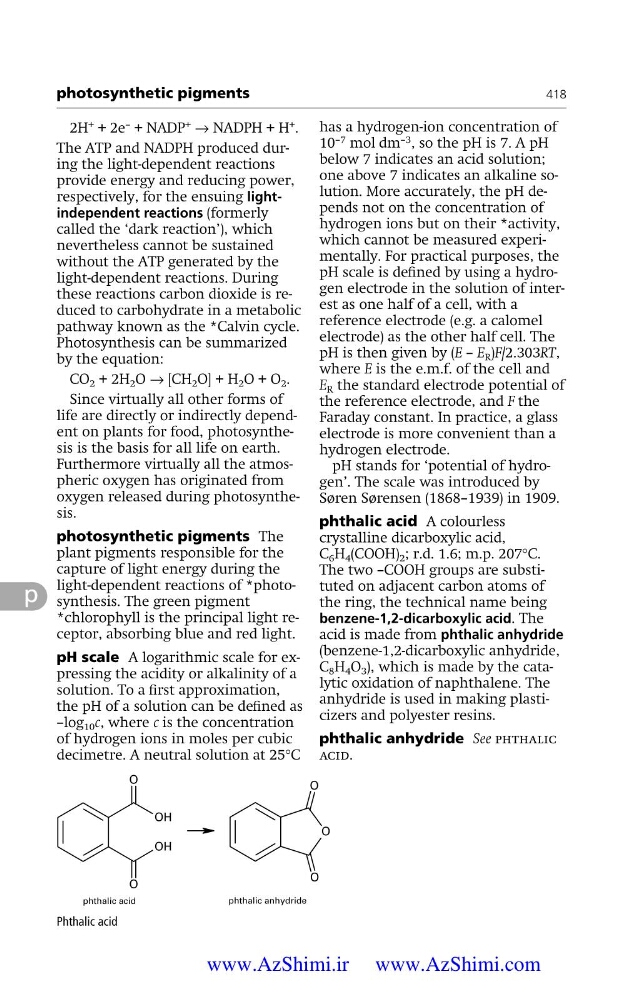
phthalic acid A colourless
crystalline dicarboxylic acid,
C 6 H 4 (COOH) 2 ; r.d. 1.6; m.p. 207°C.
The two –COOH groups are substituted on adjacent carbon atoms of
the ring, the technical name being
benzene-1,2-dicarboxylic acid. The
acid is made from phthalic anhydride
(benzene-1,2-dicarboxylic anhydride,
C 8 H 4 O 3 ), which is made by the catalytic oxidation of naphthalene. The
anhydride is used in making plasticizers and polyester resins.
phthalic anhydride See phthalic
acid.
photosynthetic pigments
418
p
O
O
OH
OH
O
O
O
phthalic acid
phthalic anhydride
Phthalic acid
www.AzShimi.ir www.AzShimi.com
+ + 2e
– + NADP
+
→ NADPH + H
+ .
The ATP and NADPH produced during the light-dependent reactions
provide energy and reducing power,
respectively, for the ensuing lightindependent reactions (formerly
called the ‘dark reaction’), which
nevertheless cannot be sustained
without the ATP generated by the
light-dependent reactions. During
these reactions carbon dioxide is reduced to carbohydrate in a metabolic
pathway known as the *Calvin cycle.
Photosynthesis can be summarized
by the equation:
CO 2 + 2H 2 O → [CH 2 O] + H 2 O + O 2 .
Since virtually all other forms of
life are directly or indirectly dependent on plants for food, photosynthesis is the basis for all life on earth.
Furthermore virtually all the atmospheric oxygen has originated from
oxygen released during photosynthesis.
photosynthetic pigments The
plant pigments responsible for the
capture of light energy during the
light-dependent reactions of *photosynthesis. The green pigment
*chlorophyll is the principal light receptor, absorbing blue and red light.
pH scale A logarithmic scale for expressing the acidity or alkalinity of a
solution. To a Ürst approximation,
the pH of a solution can be deÜned as
–log 10 c, where c is the concentration
of hydrogen ions in moles per cubic
decimetre. A neutral solution at 25°C
has a hydrogen-ion concentration of
10
–7 mol dm
–3
, so the pH is 7. A pH
below 7 indicates an acid solution;
one above 7 indicates an alkaline solution. More accurately, the pH depends not on the concentration of
hydrogen ions but on their *activity,
which cannot be measured experimentally. For practical purposes, the
pH scale is deÜned by using a hydrogen electrode in the solution of interest as one half of a cell, with a
reference electrode (e.g. a calomel
electrode) as the other half cell. The
pH is then given by (E – E R )F/2.303RT,
where E is the e.m.f. of the cell and
E R the standard electrode potential of
the reference electrode, and F the
Faraday constant. In practice, a glass
electrode is more convenient than a
hydrogen electrode.
pH stands for ‘potential of hydrogen’. The scale was introduced by
Søren Sørensen (1868–1939) in 1909.
phthalic acid A colourless
crystalline dicarboxylic acid,
C 6 H 4 (COOH) 2 ; r.d. 1.6; m.p. 207°C.
The two –COOH groups are substituted on adjacent carbon atoms of
the ring, the technical name being
benzene-1,2-dicarboxylic acid. The
acid is made from phthalic anhydride
(benzene-1,2-dicarboxylic anhydride,
C 8 H 4 O 3 ), which is made by the catalytic oxidation of naphthalene. The
anhydride is used in making plasticizers and polyester resins.
phthalic anhydride See phthalic
acid.
photosynthetic pigments
418
p
O
O
OH
OH
O
O
O
phthalic acid
phthalic anhydride
Phthalic acid
www.AzShimi.ir www.AzShimi.com