

tering such variables as temperature
and pressure.
Phase transitions can be classiÜed
by their order. If there is non-zero
*latent heat at the transition it is
said to be a Ürst-order transition. If
the latent heat is zero it is said to be
a second-order transition.
Some models describing phase
transitions, particularly in lowdimensional systems, are amenable
to exact mathematical solutions.
Techniques for investigating transitions may include the feature of universality, in which very different
physical systems behave in the same
way near a phase transition.
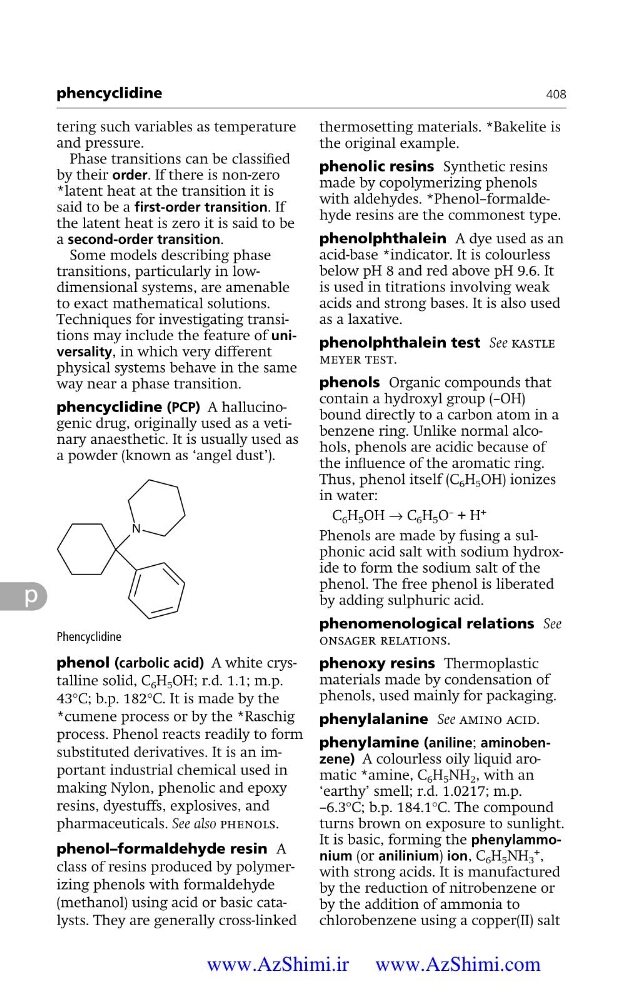
phencyclidine (PCP) A hallucinogenic drug, originally used as a vetinary anaesthetic. It is usually used as
a powder (known as ‘angel dust’).
phencyclidine
408
p
N
Phencyclidine
phenol (carbolic acid) A white crystalline solid, C 6 H 5 OH; r.d. 1.1; m.p.
43°C; b.p. 182°C. It is made by the
*cumene process or by the *Raschig
process. Phenol reacts readily to form
substituted derivatives. It is an important industrial chemical used in
making Nylon, phenolic and epoxy
resins, dyestuffs, explosives, and
pharmaceuticals. See also phenols.
phenol–formaldehyde resin A
class of resins produced by polymerizing phenols with formaldehyde
(methanol) using acid or basic catalysts. They are generally cross-linked
thermosetting materials. *Bakelite is
the original example.
phenolic resins Synthetic resins
made by copolymerizing phenols
with aldehydes. *Phenol–formaldehyde resins are the commonest type.
phenolphthalein A dye used as an
acid-base *indicator. It is colourless
below pH 8 and red above pH 9.6. It
is used in titrations involving weak
acids and strong bases. It is also used
as a laxative.
phenolphthalein test See kastle
meyer test.
phenols Organic compounds that
contain a hydroxyl group (–OH)
bound directly to a carbon atom in a
benzene ring. Unlike normal alcohols, phenols are acidic because of
the inÛuence of the aromatic ring.
Thus, phenol itself (C 6 H 5 OH) ionizes
in water:
C 6 H 5 OH → C 6 H 5 O
– + H
+
Phenols are made by fusing a sulphonic acid salt with sodium hydroxide to form the sodium salt of the
phenol. The free phenol is liberated
by adding sulphuric acid.
phenomenological relations See
onsager relations.
phenoxy resins Thermoplastic
materials made by condensation of
phenols, used mainly for packaging.
phenylalanine See amino acid.
phenylamine (aniline; aminobenzene) A colourless oily liquid aromatic *amine, C 6 H 5 NH 2 , with an
‘earthy’ smell; r.d. 1.0217; m.p.
–6.3°C; b.p. 184.1°C. The compound
turns brown on exposure to sunlight.
It is basic, forming the phenylammonium (or anilinium) ion, C 6 H 5 NH 3
+ ,
with strong acids. It is manufactured
by the reduction of nitrobenzene or
by the addition of ammonia to
chlorobenzene using a copper(II) salt
www.AzShimi.ir www.AzShimi.com
and pressure.
Phase transitions can be classiÜed
by their order. If there is non-zero
*latent heat at the transition it is
said to be a Ürst-order transition. If
the latent heat is zero it is said to be
a second-order transition.
Some models describing phase
transitions, particularly in lowdimensional systems, are amenable
to exact mathematical solutions.
Techniques for investigating transitions may include the feature of universality, in which very different
physical systems behave in the same
way near a phase transition.
phencyclidine (PCP) A hallucinogenic drug, originally used as a vetinary anaesthetic. It is usually used as
a powder (known as ‘angel dust’).
phencyclidine
408
p
N
Phencyclidine
phenol (carbolic acid) A white crystalline solid, C 6 H 5 OH; r.d. 1.1; m.p.
43°C; b.p. 182°C. It is made by the
*cumene process or by the *Raschig
process. Phenol reacts readily to form
substituted derivatives. It is an important industrial chemical used in
making Nylon, phenolic and epoxy
resins, dyestuffs, explosives, and
pharmaceuticals. See also phenols.
phenol–formaldehyde resin A
class of resins produced by polymerizing phenols with formaldehyde
(methanol) using acid or basic catalysts. They are generally cross-linked
thermosetting materials. *Bakelite is
the original example.
phenolic resins Synthetic resins
made by copolymerizing phenols
with aldehydes. *Phenol–formaldehyde resins are the commonest type.
phenolphthalein A dye used as an
acid-base *indicator. It is colourless
below pH 8 and red above pH 9.6. It
is used in titrations involving weak
acids and strong bases. It is also used
as a laxative.
phenolphthalein test See kastle
meyer test.
phenols Organic compounds that
contain a hydroxyl group (–OH)
bound directly to a carbon atom in a
benzene ring. Unlike normal alcohols, phenols are acidic because of
the inÛuence of the aromatic ring.
Thus, phenol itself (C 6 H 5 OH) ionizes
in water:
C 6 H 5 OH → C 6 H 5 O
– + H
+
Phenols are made by fusing a sulphonic acid salt with sodium hydroxide to form the sodium salt of the
phenol. The free phenol is liberated
by adding sulphuric acid.
phenomenological relations See
onsager relations.
phenoxy resins Thermoplastic
materials made by condensation of
phenols, used mainly for packaging.
phenylalanine See amino acid.
phenylamine (aniline; aminobenzene) A colourless oily liquid aromatic *amine, C 6 H 5 NH 2 , with an
‘earthy’ smell; r.d. 1.0217; m.p.
–6.3°C; b.p. 184.1°C. The compound
turns brown on exposure to sunlight.
It is basic, forming the phenylammonium (or anilinium) ion, C 6 H 5 NH 3
+ ,
with strong acids. It is manufactured
by the reduction of nitrobenzene or
by the addition of ammonia to
chlorobenzene using a copper(II) salt
www.AzShimi.ir www.AzShimi.com