

pentlandite A mineral consisting
of a mixed iron–nickel sulphide,
(Fe,Ni) 9 S 8 , crystallizing in the cubic
system; the chief ore of nickel. It is
yellowish-bronze in colour with a
metallic lustre. The chief occurrence
of the mineral is at Sudbury in Ontario, Canada.
pentose A sugar that has Üve carbon atoms per molecule. See monosaccharide.
pentose phosphate pathway
(pentose shunt) A series of biochemical reactions that results in the conversion of glucose 6-phosphate to
ribose 5-phosphate and generates
NADPH, which provides reducing
power for other metabolic reactions,
such as synthesis of fatty acids. Ribose 5-phosphate and its derivatives
are components of such molecules as
ATP, coenzyme A, NAD, FAD, DNA,
and RNA. In plants the pentose phosphate pathway also plays a role in
the synthesis of sugars from carbon
dioxide. In animals the pathway occurs at various sites, including the
liver and adipose tissue.
pentyl group (pentyl radical) The
organic group CH 3 CH 2 CH 2 CH 2 CH 2 –,
derived from pentane.
pepsin An enzyme that catalyses
the breakdown of proteins to
polypeptides in the vertebrate stomach. It is secreted as an inactive precursor, pepsinogen.
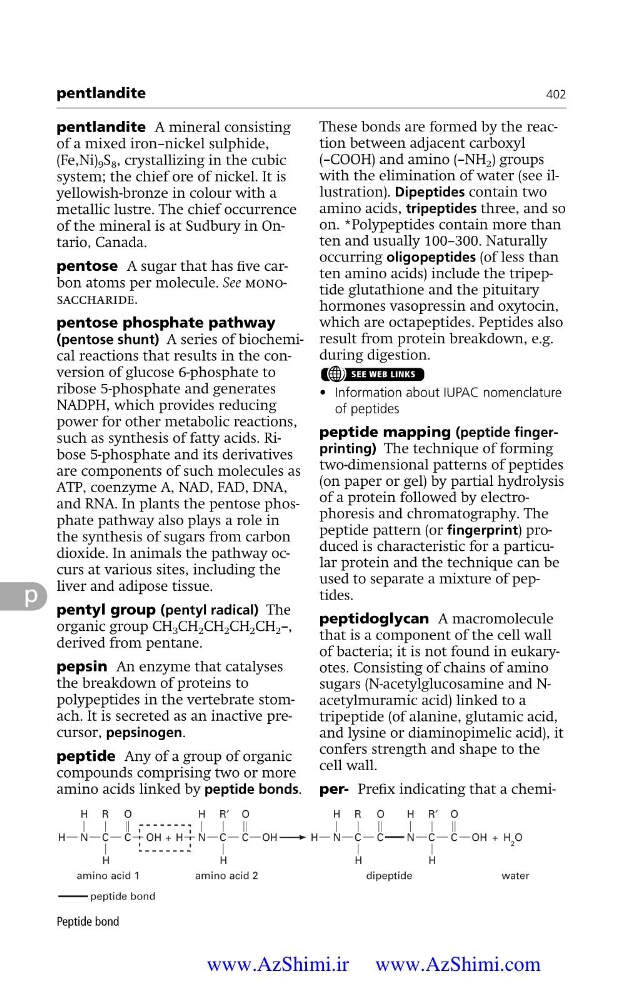
peptide Any of a group of organic
compounds comprising two or more
amino acids linked by peptide bonds.
These bonds are formed by the reaction between adjacent carboxyl
(–COOH) and amino (–NH 2 ) groups
with the elimination of water (see illustration). Dipeptides contain two
amino acids, tripeptides three, and so
on. *Polypeptides contain more than
ten and usually 100–300. Naturally
occurring oligopeptides (of less than
ten amino acids) include the tripeptide glutathione and the pituitary
hormones vasopressin and oxytocin,
which are octapeptides. Peptides also
result from protein breakdown, e.g.
during digestion.
A
• Information about IUPAC nomenclature
of peptides
peptide mapping (peptide Üngerprinting) The technique of forming
two-dimensional patterns of peptides
(on paper or gel) by partial hydrolysis
of a protein followed by electrophoresis and chromatography. The
peptide pattern (or Üngerprint) produced is characteristic for a particular protein and the technique can be
used to separate a mixture of peptides.
peptidoglycan A macromolecule
that is a component of the cell wall
of bacteria; it is not found in eukaryotes. Consisting of chains of amino
sugars (N-acetylglucosamine and Nacetylmuramic acid) linked to a
tripeptide (of alanine, glutamic acid,
and lysine or diaminopimelic acid), it
confers strength and shape to the
cell wall.
per- PreÜx indicating that a chemipentlandite
402
p
amino acid 1
amino acid 2
dipeptide
peptide bond
H R O
H N C C OH
H
+
H R′ O
H N C C
H
OH
H R O
H N C C
H
H R′ O
N C C
H
OH + H 2 O
water
Peptide bond
www.AzShimi.ir www.AzShimi.com
of a mixed iron–nickel sulphide,
(Fe,Ni) 9 S 8 , crystallizing in the cubic
system; the chief ore of nickel. It is
yellowish-bronze in colour with a
metallic lustre. The chief occurrence
of the mineral is at Sudbury in Ontario, Canada.
pentose A sugar that has Üve carbon atoms per molecule. See monosaccharide.
pentose phosphate pathway
(pentose shunt) A series of biochemical reactions that results in the conversion of glucose 6-phosphate to
ribose 5-phosphate and generates
NADPH, which provides reducing
power for other metabolic reactions,
such as synthesis of fatty acids. Ribose 5-phosphate and its derivatives
are components of such molecules as
ATP, coenzyme A, NAD, FAD, DNA,
and RNA. In plants the pentose phosphate pathway also plays a role in
the synthesis of sugars from carbon
dioxide. In animals the pathway occurs at various sites, including the
liver and adipose tissue.
pentyl group (pentyl radical) The
organic group CH 3 CH 2 CH 2 CH 2 CH 2 –,
derived from pentane.
pepsin An enzyme that catalyses
the breakdown of proteins to
polypeptides in the vertebrate stomach. It is secreted as an inactive precursor, pepsinogen.
peptide Any of a group of organic
compounds comprising two or more
amino acids linked by peptide bonds.
These bonds are formed by the reaction between adjacent carboxyl
(–COOH) and amino (–NH 2 ) groups
with the elimination of water (see illustration). Dipeptides contain two
amino acids, tripeptides three, and so
on. *Polypeptides contain more than
ten and usually 100–300. Naturally
occurring oligopeptides (of less than
ten amino acids) include the tripeptide glutathione and the pituitary
hormones vasopressin and oxytocin,
which are octapeptides. Peptides also
result from protein breakdown, e.g.
during digestion.
A
• Information about IUPAC nomenclature
of peptides
peptide mapping (peptide Üngerprinting) The technique of forming
two-dimensional patterns of peptides
(on paper or gel) by partial hydrolysis
of a protein followed by electrophoresis and chromatography. The
peptide pattern (or Üngerprint) produced is characteristic for a particular protein and the technique can be
used to separate a mixture of peptides.
peptidoglycan A macromolecule
that is a component of the cell wall
of bacteria; it is not found in eukaryotes. Consisting of chains of amino
sugars (N-acetylglucosamine and Nacetylmuramic acid) linked to a
tripeptide (of alanine, glutamic acid,
and lysine or diaminopimelic acid), it
confers strength and shape to the
cell wall.
per- PreÜx indicating that a chemipentlandite
402
p
amino acid 1
amino acid 2
dipeptide
peptide bond
H R O
H N C C OH
H
+
H R′ O
H N C C
H
OH
H R O
H N C C
H
H R′ O
N C C
H
OH + H 2 O
water
Peptide bond
www.AzShimi.ir www.AzShimi.com