

2HNO 3 + Cu → CuO + H 2 O + 2NO 2
This is followed by reaction between
the acid and the oxide:
2HNO 3 + CuO → Cu(NO 3 ) 2 + H 2 O
oxidizing agent (oxidant) A substance that brings about oxidation in
other substances. It achieves this by
being itself reduced. Oxidizing agents
contain atoms with high oxidation
numbers; that is the atoms have suffered electron loss. In oxidizing other
substances these atoms gain electrons.
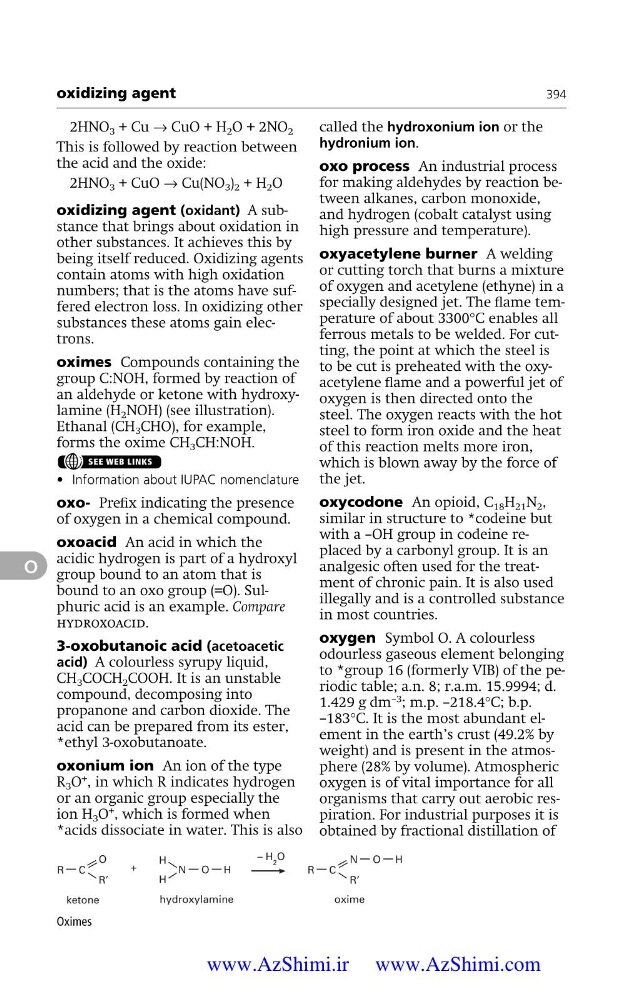
oximes Compounds containing the
group C:NOH, formed by reaction of
an aldehyde or ketone with hydroxylamine (H 2 NOH) (see illustration).
Ethanal (CH 3 CHO), for example,
forms the oxime CH 3 CH:NOH.
A
• Information about IUPAC nomenclature
oxo- PreÜx indicating the presence
of oxygen in a chemical compound.
oxoacid An acid in which the
acidic hydrogen is part of a hydroxyl
group bound to an atom that is
bound to an oxo group (=O). Sulphuric acid is an example. Compare
hydroxoacid.
3-oxobutanoic acid (acetoacetic
acid) A colourless syrupy liquid,
CH 3 COCH 2 COOH. It is an unstable
compound, decomposing into
propanone and carbon dioxide. The
acid can be prepared from its ester,
*ethyl 3-oxobutanoate.
oxonium ion An ion of the type
R 3 O
+
, in which R indicates hydrogen
or an organic group especially the
ion H 3 O
+ , which is formed when
*acids dissociate in water. This is also
called the hydroxonium ion or the
hydronium ion.
oxo process An industrial process
for making aldehydes by reaction between alkanes, carbon monoxide,
and hydrogen (cobalt catalyst using
high pressure and temperature).
oxyacetylene burner A welding
or cutting torch that burns a mixture
of oxygen and acetylene (ethyne) in a
specially designed jet. The Ûame temperature of about 3300°C enables all
ferrous metals to be welded. For cutting, the point at which the steel is
to be cut is preheated with the oxyacetylene Ûame and a powerful jet of
oxygen is then directed onto the
steel. The oxygen reacts with the hot
steel to form iron oxide and the heat
of this reaction melts more iron,
which is blown away by the force of
the jet.
oxycodone An opioid, C 18 H 21 N 2 ,
similar in structure to *codeine but
with a –OH group in codeine replaced by a carbonyl group. It is an
analgesic often used for the treatment of chronic pain. It is also used
illegally and is a controlled substance
in most countries.
oxygen Symbol O. A colourless
odourless gaseous element belonging
to *group 16 (formerly VIB) of the periodic table; a.n. 8; r.a.m. 15.9994; d.
1.429 g dm
–3
; m.p. –218.4°C; b.p.
–183°C. It is the most abundant element in the earth’s crust (49.2% by
weight) and is present in the atmosphere (28% by volume). Atmospheric
oxygen is of vital importance for all
organisms that carry out aerobic respiration. For industrial purposes it is
obtained by fractional distillation of
oxidizing agent
394
o
R
R′
O
C
+
H
H
N O H
ketone
hydroxylamine
– H 2 O
oxime
R
R′
C
N O H
Oximes
www.AzShimi.ir www.AzShimi.com
This is followed by reaction between
the acid and the oxide:
2HNO 3 + CuO → Cu(NO 3 ) 2 + H 2 O
oxidizing agent (oxidant) A substance that brings about oxidation in
other substances. It achieves this by
being itself reduced. Oxidizing agents
contain atoms with high oxidation
numbers; that is the atoms have suffered electron loss. In oxidizing other
substances these atoms gain electrons.
oximes Compounds containing the
group C:NOH, formed by reaction of
an aldehyde or ketone with hydroxylamine (H 2 NOH) (see illustration).
Ethanal (CH 3 CHO), for example,
forms the oxime CH 3 CH:NOH.
A
• Information about IUPAC nomenclature
oxo- PreÜx indicating the presence
of oxygen in a chemical compound.
oxoacid An acid in which the
acidic hydrogen is part of a hydroxyl
group bound to an atom that is
bound to an oxo group (=O). Sulphuric acid is an example. Compare
hydroxoacid.
3-oxobutanoic acid (acetoacetic
acid) A colourless syrupy liquid,
CH 3 COCH 2 COOH. It is an unstable
compound, decomposing into
propanone and carbon dioxide. The
acid can be prepared from its ester,
*ethyl 3-oxobutanoate.
oxonium ion An ion of the type
R 3 O
+
, in which R indicates hydrogen
or an organic group especially the
ion H 3 O
+ , which is formed when
*acids dissociate in water. This is also
called the hydroxonium ion or the
hydronium ion.
oxo process An industrial process
for making aldehydes by reaction between alkanes, carbon monoxide,
and hydrogen (cobalt catalyst using
high pressure and temperature).
oxyacetylene burner A welding
or cutting torch that burns a mixture
of oxygen and acetylene (ethyne) in a
specially designed jet. The Ûame temperature of about 3300°C enables all
ferrous metals to be welded. For cutting, the point at which the steel is
to be cut is preheated with the oxyacetylene Ûame and a powerful jet of
oxygen is then directed onto the
steel. The oxygen reacts with the hot
steel to form iron oxide and the heat
of this reaction melts more iron,
which is blown away by the force of
the jet.
oxycodone An opioid, C 18 H 21 N 2 ,
similar in structure to *codeine but
with a –OH group in codeine replaced by a carbonyl group. It is an
analgesic often used for the treatment of chronic pain. It is also used
illegally and is a controlled substance
in most countries.
oxygen Symbol O. A colourless
odourless gaseous element belonging
to *group 16 (formerly VIB) of the periodic table; a.n. 8; r.a.m. 15.9994; d.
1.429 g dm
–3
; m.p. –218.4°C; b.p.
–183°C. It is the most abundant element in the earth’s crust (49.2% by
weight) and is present in the atmosphere (28% by volume). Atmospheric
oxygen is of vital importance for all
organisms that carry out aerobic respiration. For industrial purposes it is
obtained by fractional distillation of
oxidizing agent
394
o
R
R′
O
C
+
H
H
N O H
ketone
hydroxylamine
– H 2 O
oxime
R
R′
C
N O H
Oximes
www.AzShimi.ir www.AzShimi.com