

the dissociation constant K a is given
by
K a = α
2
n/(1 – α)V
where α is the degree of dissociation,
n the initial amount of substance (before dissociation), and V the volume.
If α is small compared with 1, then
α
2 = KV/n; i.e. the degree of dissociation is proportional to the square
root of the dilution. The law was Ürst
put forward by Wilhelm Ostwald to
account for electrical conductivities
of electrolyte solutions.
outer-sphere mechanism See
electron-transfer reaction.
overpotential (overvoltage) A potential that must be applied in an
electrolytic cell in addition to the
theoretical potential required to liberate a given substance at an electrode. The value depends on the
electrode material and on the current density. It is a kinetic effect occurring because of the signiÜcant
activation energy for electron transfer at the electrodes, and is particularly important for the liberation of
such gases as hydrogen and oxygen.
For example, in the electrolysis of a
solution of zinc ions, hydrogen (EŠ =
0.00 V) would be expected to be liberated at the cathode in preference to
zinc (EŠ = –0.76 V). In fact, the high
overpotential of hydrogen on zinc
(about 1 V under suitable conditions)
means that zinc can be deposited instead. The relation between the current and the overpotential is given by
the *Butler–Volmer equation.
overtones See harmonic.
oxalate A salt or ester of *oxalic
acid.
oxalic acid (ethanedioic acid) A
crystalline solid, (COOH) 2 , that is
slightly soluble in water. Oxalic acid
is strongly acidic and very poisonous.
It occurs in certain plants, e.g. sorrel
and the leaf blades of rhubarb.
oxaloacetic acid A compound,
HO 2 CCH 2 COCO 2 H, that plays an integral role in the *Krebs cycle. The
anion, oxaloacetate, reacts with the
acetyl group from acetyl coenzyme A
to form citrate.
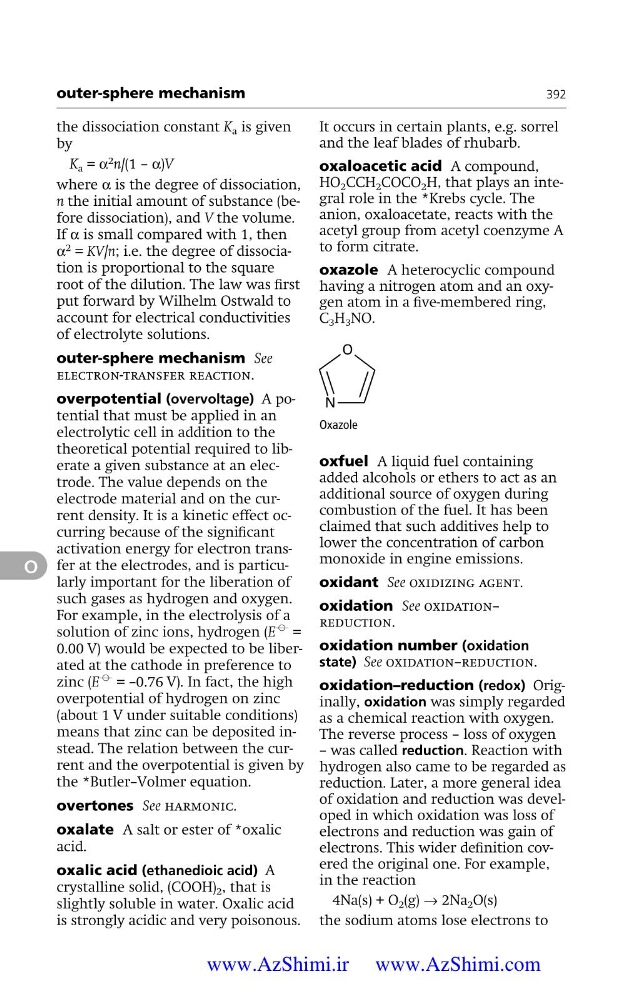
oxazole A heterocyclic compound
having a nitrogen atom and an oxygen atom in a Üve-membered ring,
C 3 H 3 NO.
outer-sphere mechanism
392
o
O
N
Oxazole
oxfuel A liquid fuel containing
added alcohols or ethers to act as an
additional source of oxygen during
combustion of the fuel. It has been
claimed that such additives help to
lower the concentration of carbon
monoxide in engine emissions.
oxidant See oxidizing agent.
oxidation See oxidation–
reduction.
oxidation number (oxidation
state) See oxidation–reduction.
oxidation–reduction (redox) Originally, oxidation was simply regarded
as a chemical reaction with oxygen.
The reverse process – loss of oxygen
– was called reduction. Reaction with
hydrogen also came to be regarded as
reduction. Later, a more general idea
of oxidation and reduction was developed in which oxidation was loss of
electrons and reduction was gain of
electrons. This wider deÜnition covered the original one. For example,
in the reaction
4Na(s) + O 2 (g) → 2Na 2 O(s)
the sodium atoms lose electrons to
www.AzShimi.ir www.AzShimi.com
by
K a = α
2
n/(1 – α)V
where α is the degree of dissociation,
n the initial amount of substance (before dissociation), and V the volume.
If α is small compared with 1, then
α
2 = KV/n; i.e. the degree of dissociation is proportional to the square
root of the dilution. The law was Ürst
put forward by Wilhelm Ostwald to
account for electrical conductivities
of electrolyte solutions.
outer-sphere mechanism See
electron-transfer reaction.
overpotential (overvoltage) A potential that must be applied in an
electrolytic cell in addition to the
theoretical potential required to liberate a given substance at an electrode. The value depends on the
electrode material and on the current density. It is a kinetic effect occurring because of the signiÜcant
activation energy for electron transfer at the electrodes, and is particularly important for the liberation of
such gases as hydrogen and oxygen.
For example, in the electrolysis of a
solution of zinc ions, hydrogen (EŠ =
0.00 V) would be expected to be liberated at the cathode in preference to
zinc (EŠ = –0.76 V). In fact, the high
overpotential of hydrogen on zinc
(about 1 V under suitable conditions)
means that zinc can be deposited instead. The relation between the current and the overpotential is given by
the *Butler–Volmer equation.
overtones See harmonic.
oxalate A salt or ester of *oxalic
acid.
oxalic acid (ethanedioic acid) A
crystalline solid, (COOH) 2 , that is
slightly soluble in water. Oxalic acid
is strongly acidic and very poisonous.
It occurs in certain plants, e.g. sorrel
and the leaf blades of rhubarb.
oxaloacetic acid A compound,
HO 2 CCH 2 COCO 2 H, that plays an integral role in the *Krebs cycle. The
anion, oxaloacetate, reacts with the
acetyl group from acetyl coenzyme A
to form citrate.
oxazole A heterocyclic compound
having a nitrogen atom and an oxygen atom in a Üve-membered ring,
C 3 H 3 NO.
outer-sphere mechanism
392
o
O
N
Oxazole
oxfuel A liquid fuel containing
added alcohols or ethers to act as an
additional source of oxygen during
combustion of the fuel. It has been
claimed that such additives help to
lower the concentration of carbon
monoxide in engine emissions.
oxidant See oxidizing agent.
oxidation See oxidation–
reduction.
oxidation number (oxidation
state) See oxidation–reduction.
oxidation–reduction (redox) Originally, oxidation was simply regarded
as a chemical reaction with oxygen.
The reverse process – loss of oxygen
– was called reduction. Reaction with
hydrogen also came to be regarded as
reduction. Later, a more general idea
of oxidation and reduction was developed in which oxidation was loss of
electrons and reduction was gain of
electrons. This wider deÜnition covered the original one. For example,
in the reaction
4Na(s) + O 2 (g) → 2Na 2 O(s)
the sodium atoms lose electrons to
www.AzShimi.ir www.AzShimi.com