

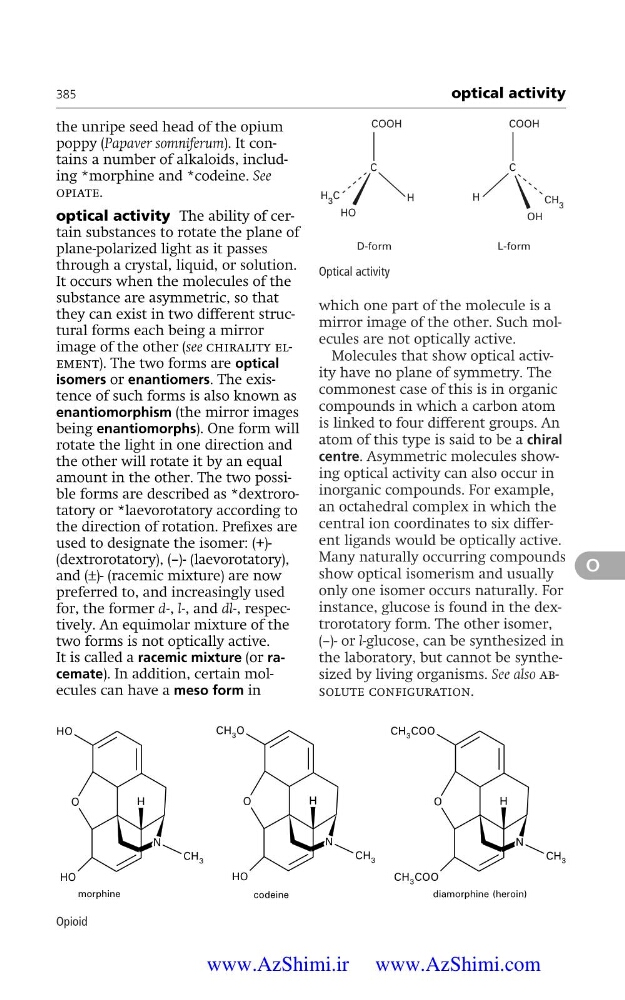
the unripe seed head of the opium
poppy (Papaver somniferum). It contains a number of alkaloids, including *morphine and *codeine. See
opiate.
optical activity The ability of certain substances to rotate the plane of
plane-polarized light as it passes
through a crystal, liquid, or solution.
It occurs when the molecules of the
substance are asymmetric, so that
they can exist in two different structural forms each being a mirror
image of the other (see chirality element). The two forms are optical
isomers or enantiomers. The existence of such forms is also known as
enantiomorphism (the mirror images
being enantiomorphs). One form will
rotate the light in one direction and
the other will rotate it by an equal
amount in the other. The two possible forms are described as *dextrorotatory or *laevorotatory according to
the direction of rotation. PreÜxes are
used to designate the isomer: (+)(dextrorotatory), (–)- (laevorotatory),
and (±)- (racemic mixture) are now
preferred to, and increasingly used
for, the former d-, l-, and dl-, respectively. An equimolar mixture of the
two forms is not optically active.
It is called a racemic mixture (or racemate). In addition, certain molecules can have a meso form in
385
optical activity
o
COOH
C
H
H 3 C
HO
D-form
COOH
C
CH 3
OH
H
L-form
Optical activity
%* %11
%* %11
0
%*
*
1
1
*
1
*
0
%*
*
1
%* 1
1
*
0
%*
*
1
OQTRJKPG
EQFGKPG
FKCOQTRJKPGG
JGTQKP
Opioid
which one part of the molecule is a
mirror image of the other. Such molecules are not optically active.
Molecules that show optical activity have no plane of symmetry. The
commonest case of this is in organic
compounds in which a carbon atom
is linked to four different groups. An
atom of this type is said to be a chiral
centre. Asymmetric molecules showing optical activity can also occur in
inorganic compounds. For example,
an octahedral complex in which the
central ion coordinates to six different ligands would be optically active.
Many naturally occurring compounds
show optical isomerism and usually
only one isomer occurs naturally. For
instance, glucose is found in the dextrorotatory form. The other isomer,
(–)- or l-glucose, can be synthesized in
the laboratory, but cannot be synthesized by living organisms. See also absolute configuration.
www.AzShimi.ir www.AzShimi.com
poppy (Papaver somniferum). It contains a number of alkaloids, including *morphine and *codeine. See
opiate.
optical activity The ability of certain substances to rotate the plane of
plane-polarized light as it passes
through a crystal, liquid, or solution.
It occurs when the molecules of the
substance are asymmetric, so that
they can exist in two different structural forms each being a mirror
image of the other (see chirality element). The two forms are optical
isomers or enantiomers. The existence of such forms is also known as
enantiomorphism (the mirror images
being enantiomorphs). One form will
rotate the light in one direction and
the other will rotate it by an equal
amount in the other. The two possible forms are described as *dextrorotatory or *laevorotatory according to
the direction of rotation. PreÜxes are
used to designate the isomer: (+)(dextrorotatory), (–)- (laevorotatory),
and (±)- (racemic mixture) are now
preferred to, and increasingly used
for, the former d-, l-, and dl-, respectively. An equimolar mixture of the
two forms is not optically active.
It is called a racemic mixture (or racemate). In addition, certain molecules can have a meso form in
385
optical activity
o
COOH
C
H
H 3 C
HO
D-form
COOH
C
CH 3
OH
H
L-form
Optical activity
%* %11
%* %11
0
%*
*
1
1
*
1
*
0
%*
*
1
%* 1
1
*
0
%*
*
1
OQTRJKPG
EQFGKPG
FKCOQTRJKPGG
JGTQKP
Opioid
which one part of the molecule is a
mirror image of the other. Such molecules are not optically active.
Molecules that show optical activity have no plane of symmetry. The
commonest case of this is in organic
compounds in which a carbon atom
is linked to four different groups. An
atom of this type is said to be a chiral
centre. Asymmetric molecules showing optical activity can also occur in
inorganic compounds. For example,
an octahedral complex in which the
central ion coordinates to six different ligands would be optically active.
Many naturally occurring compounds
show optical isomerism and usually
only one isomer occurs naturally. For
instance, glucose is found in the dextrorotatory form. The other isomer,
(–)- or l-glucose, can be synthesized in
the laboratory, but cannot be synthesized by living organisms. See also absolute configuration.
www.AzShimi.ir www.AzShimi.com