

atom. Nitro compounds are made by
*nitration reactions. They can be reduced to aromatic amines (e.g. nitrobenzene can be reduced to
phenylamine). See also explosive.
nitrogen Symbol N. A colourless
gaseous element belonging to *group
15 (formerly VB) of the periodic
table; a.n. 7; r.a.m. 14.0067; d. 1.2506
g dm
–3 ; m.p. –209.86°C; b.p. –195.8°C.
It occurs in air (about 78% by volume)
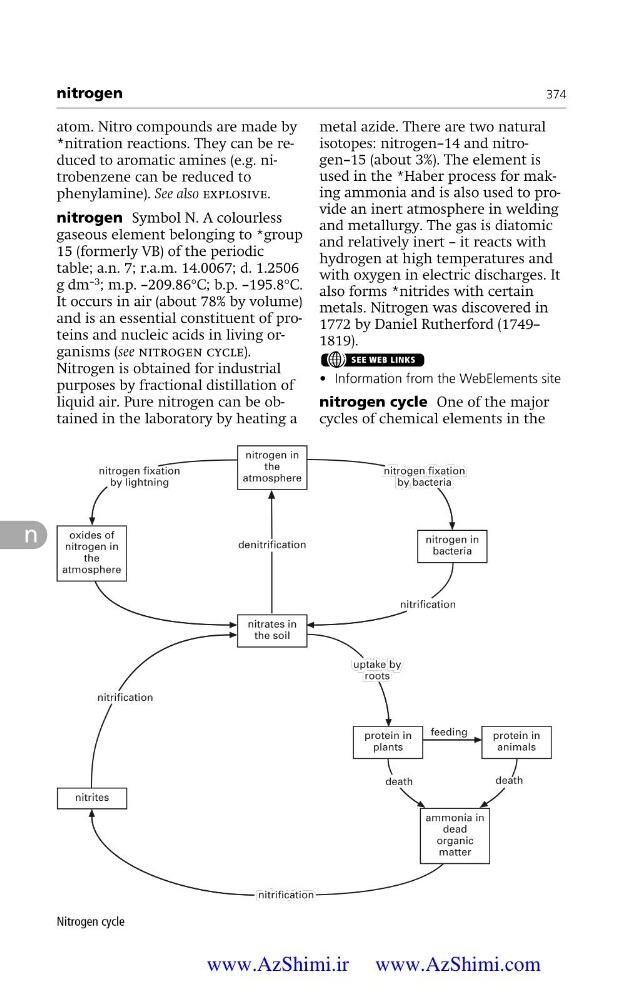
and is an essential constituent of proteins and nucleic acids in living organisms (see nitrogen cycle).
Nitrogen is obtained for industrial
purposes by fractional distillation of
liquid air. Pure nitrogen can be obtained in the laboratory by heating a
metal azide. There are two natural
isotopes: nitrogen–14 and nitrogen–15 (about 3%). The element is
used in the *Haber process for making ammonia and is also used to provide an inert atmosphere in welding
and metallurgy. The gas is diatomic
and relatively inert – it reacts with
hydrogen at high temperatures and
with oxygen in electric discharges. It
also forms *nitrides with certain
metals. Nitrogen was discovered in
1772 by Daniel Rutherford (1749–
1819).
A
• Information from the WebElements site
nitrogen cycle One of the major
cycles of chemical elements in the
nitrogen
374
n
nitrogen fixation
by lightning
protein in
plants
protein in
animals
nitrites
nitrification
feeding
death
death
nitrogen in
bacteria
nitrogen in
the
atmosphere
nitrates in
the soil
denitrification
nitrification
nitrogen fixation
nitrogen fixation
nitrogen fixation
by bacteria
by bacteria
by bacteria
oxides of
nitrogen in
the
atmosphere
nitrification nitrification nitrification
ammonia in
dead
organic
matter
uptake by
uptake by
uptake by
roots roots roots
Nitrogen cycle
www.AzShimi.ir www.AzShimi.com
*nitration reactions. They can be reduced to aromatic amines (e.g. nitrobenzene can be reduced to
phenylamine). See also explosive.
nitrogen Symbol N. A colourless
gaseous element belonging to *group
15 (formerly VB) of the periodic
table; a.n. 7; r.a.m. 14.0067; d. 1.2506
g dm
–3 ; m.p. –209.86°C; b.p. –195.8°C.
It occurs in air (about 78% by volume)
and is an essential constituent of proteins and nucleic acids in living organisms (see nitrogen cycle).
Nitrogen is obtained for industrial
purposes by fractional distillation of
liquid air. Pure nitrogen can be obtained in the laboratory by heating a
metal azide. There are two natural
isotopes: nitrogen–14 and nitrogen–15 (about 3%). The element is
used in the *Haber process for making ammonia and is also used to provide an inert atmosphere in welding
and metallurgy. The gas is diatomic
and relatively inert – it reacts with
hydrogen at high temperatures and
with oxygen in electric discharges. It
also forms *nitrides with certain
metals. Nitrogen was discovered in
1772 by Daniel Rutherford (1749–
1819).
A
• Information from the WebElements site
nitrogen cycle One of the major
cycles of chemical elements in the
nitrogen
374
n
nitrogen fixation
by lightning
protein in
plants
protein in
animals
nitrites
nitrification
feeding
death
death
nitrogen in
bacteria
nitrogen in
the
atmosphere
nitrates in
the soil
denitrification
nitrification
nitrogen fixation
nitrogen fixation
nitrogen fixation
by bacteria
by bacteria
by bacteria
oxides of
nitrogen in
the
atmosphere
nitrification nitrification nitrification
ammonia in
dead
organic
matter
uptake by
uptake by
uptake by
roots roots roots
Nitrogen cycle
www.AzShimi.ir www.AzShimi.com