

potassium hydroxide. The reaction
on discharge is
2NiOOH.H 2 O + Fe → 2Ni(OH) 2 +
Fe(OH) 2 ,
the reverse occurring during charging. Each cell gives an e.m.f. of about
1.2 volts and produces about 100 kJ
per kilogram during each discharge.
The nickel–cadmium cell is a similar
device with a negative cadmium electrode. It is often used as a *dry cell.
Compare lead–acid accumulator.
nickelous compounds Compounds of nickel in its +2 oxidation
state; e.g. nickelous oxide is nickel(II)
oxide (NiO).
nickel(II) oxide A green powder,
NiO; r.d. 6.6. It can be made by heating nickel(II) nitrate or carbonate
with air excluded.
nickel(III) oxide (nickel peroxide;
nickel sesquioxide) A black or grey
powder, Ni 2 O 3 ; r.d. 4.8. It is made by
heating nickel(II) oxide in air and
used in *nickel–iron accumulators.
nickel silver See german silver.
Nicol prism A device for producing
plane-polarized light (see polarizer).
It consists of two pieces of calcite cut
with a 68° angle and stuck together
with Canada balsam. The extraordinary ray (see double refraction)
passes through the prism while the
ordinary ray suffers total internal
reÛection at the interface between
the two crystals, as the refractive
index of the calcite is 1.66 for the ordinary ray and that of the Canada
balsam is 1.53. ModiÜcations of the
prism using different shapes and cements are used for special purposes.
It was devised in 1828 by William
Nicol (1768–1851).
nicotinamide See nicotinic acid.
nicotinamide adenine dinucleotide See nad.
nicotinamide adenine dinucleotide phosphate (NADP) See
nad.
nicotine A colourless poisonous
*alkaloid present in tobacco. It is
used as an insecticide.
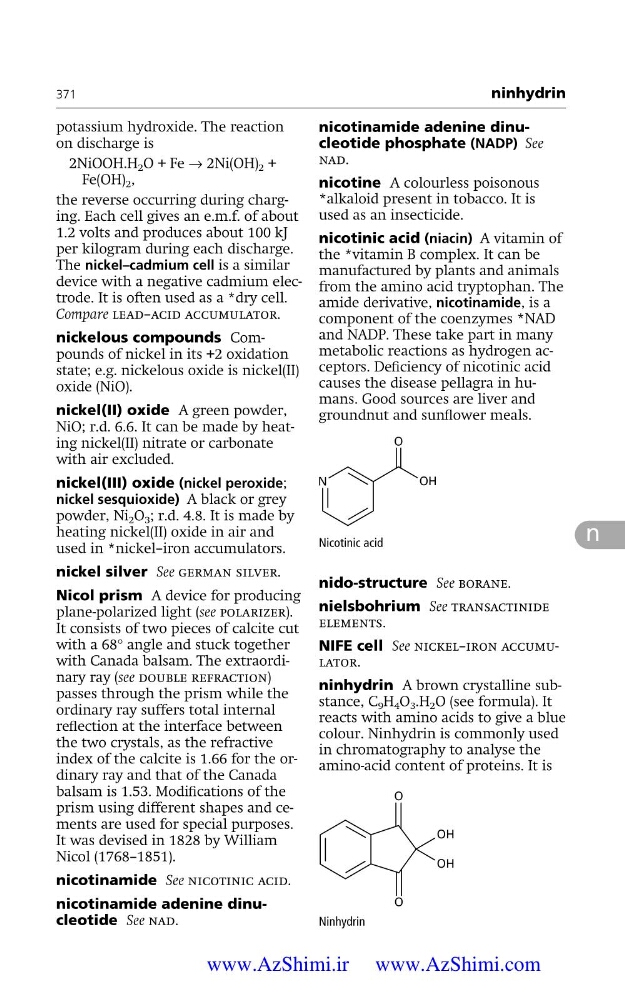
nicotinic acid (niacin) A vitamin of
the *vitamin B complex. It can be
manufactured by plants and animals
from the amino acid tryptophan. The
amide derivative, nicotinamide, is a
component of the coenzymes *NAD
and NADP. These take part in many
metabolic reactions as hydrogen acceptors. DeÜciency of nicotinic acid
causes the disease pellagra in humans. Good sources are liver and
groundnut and sunÛower meals.
nido-structure See borane.
nielsbohrium See transactinide
elements.
NIFE cell See nickel–iron accumulator.
ninhydrin A brown crystalline substance, C 9 H 4 O 3 .H 2 O (see formula). It
reacts with amino acids to give a blue
colour. Ninhydrin is commonly used
in chromatography to analyse the
amino-acid content of proteins. It is
371
ninhydrin
n
N
O
OH
Nicotinic acid
O
O
OH
OH
Ninhydrin
www.AzShimi.ir www.AzShimi.com
on discharge is
2NiOOH.H 2 O + Fe → 2Ni(OH) 2 +
Fe(OH) 2 ,
the reverse occurring during charging. Each cell gives an e.m.f. of about
1.2 volts and produces about 100 kJ
per kilogram during each discharge.
The nickel–cadmium cell is a similar
device with a negative cadmium electrode. It is often used as a *dry cell.
Compare lead–acid accumulator.
nickelous compounds Compounds of nickel in its +2 oxidation
state; e.g. nickelous oxide is nickel(II)
oxide (NiO).
nickel(II) oxide A green powder,
NiO; r.d. 6.6. It can be made by heating nickel(II) nitrate or carbonate
with air excluded.
nickel(III) oxide (nickel peroxide;
nickel sesquioxide) A black or grey
powder, Ni 2 O 3 ; r.d. 4.8. It is made by
heating nickel(II) oxide in air and
used in *nickel–iron accumulators.
nickel silver See german silver.
Nicol prism A device for producing
plane-polarized light (see polarizer).
It consists of two pieces of calcite cut
with a 68° angle and stuck together
with Canada balsam. The extraordinary ray (see double refraction)
passes through the prism while the
ordinary ray suffers total internal
reÛection at the interface between
the two crystals, as the refractive
index of the calcite is 1.66 for the ordinary ray and that of the Canada
balsam is 1.53. ModiÜcations of the
prism using different shapes and cements are used for special purposes.
It was devised in 1828 by William
Nicol (1768–1851).
nicotinamide See nicotinic acid.
nicotinamide adenine dinucleotide See nad.
nicotinamide adenine dinucleotide phosphate (NADP) See
nad.
nicotine A colourless poisonous
*alkaloid present in tobacco. It is
used as an insecticide.
nicotinic acid (niacin) A vitamin of
the *vitamin B complex. It can be
manufactured by plants and animals
from the amino acid tryptophan. The
amide derivative, nicotinamide, is a
component of the coenzymes *NAD
and NADP. These take part in many
metabolic reactions as hydrogen acceptors. DeÜciency of nicotinic acid
causes the disease pellagra in humans. Good sources are liver and
groundnut and sunÛower meals.
nido-structure See borane.
nielsbohrium See transactinide
elements.
NIFE cell See nickel–iron accumulator.
ninhydrin A brown crystalline substance, C 9 H 4 O 3 .H 2 O (see formula). It
reacts with amino acids to give a blue
colour. Ninhydrin is commonly used
in chromatography to analyse the
amino-acid content of proteins. It is
371
ninhydrin
n
N
O
OH
Nicotinic acid
O
O
OH
OH
Ninhydrin
www.AzShimi.ir www.AzShimi.com