

hertz; i.e. having a wavelength in the
range 100–1000 metres.
mega- Symbol M. A preÜx used in
the metric system to denote one million times. For example, 10
6 volts = 1
megavolt (MV).
Meitner, Lise (1878–1968) Austrian-born Swedish physicist and radiochemist who worked in Berlin
with Otto *Hahn. Together they discovered protactinium. Meitner and
Hahn worked together on neutron
bombardment of uranium. In the
1930s, she escaped from Austria to
Sweden to avoid Nazi persecution. In
Stockholm, along with her nephew
Otto Frisch (1904–79), she formulated
the theory of nuclear Üssion.
meitnerium Symbol Mt. A radioactive *transactinide element; a.n.
109. It was Ürst made in 1982 by
Peter Armbruster and a team in
Darmstadt, Germany, by bombarding
bismuth-209 nuclei with iron-58 nuclei. Only a few atoms have ever
been detected.
A
• Information from the WebElements site
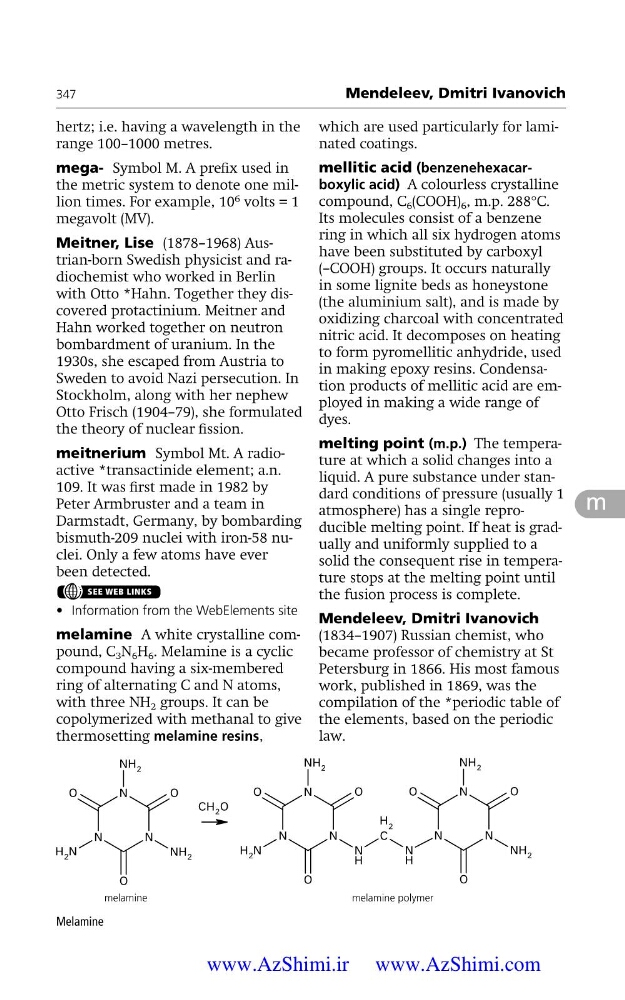
melamine A white crystalline compound, C 3 N 6 H 6 . Melamine is a cyclic
compound having a six-membered
ring of alternating C and N atoms,
with three NH 2 groups. It can be
copolymerized with methanal to give
thermosetting melamine resins,
which are used particularly for laminated coatings.
mellitic acid (benzenehexacarboxylic acid) A colourless crystalline
compound, C 6 (COOH) 6 , m.p. 288°C.
Its molecules consist of a benzene
ring in which all six hydrogen atoms
have been substituted by carboxyl
(–COOH) groups. It occurs naturally
in some lignite beds as honeystone
(the aluminium salt), and is made by
oxidizing charcoal with concentrated
nitric acid. It decomposes on heating
to form pyromellitic anhydride, used
in making epoxy resins. Condensation products of mellitic acid are employed in making a wide range of
dyes.
melting point (m.p.) The temperature at which a solid changes into a
liquid. A pure substance under standard conditions of pressure (usually 1
atmosphere) has a single reproducible melting point. If heat is gradually and uniformly supplied to a
solid the consequent rise in temperature stops at the melting point until
the fusion process is complete.
Mendeleev, Dmitri Ivanovich
(1834–1907) Russian chemist, who
became professor of chemistry at St
Petersburg in 1866. His most famous
work, published in 1869, was the
compilation of the *periodic table of
the elements, based on the periodic
law.
347
Mendeleev, Dmitri Ivanovich
m
0
0
0
0*
0*
1
1
1
0
*
0
0
0
0*
0*
1
1
1
0
0
0
0*
0
*
1
1
1
0
*
%
*
0
*
%* 1
melamine
melamine polymer
Melamine
www.AzShimi.ir www.AzShimi.com
range 100–1000 metres.
mega- Symbol M. A preÜx used in
the metric system to denote one million times. For example, 10
6 volts = 1
megavolt (MV).
Meitner, Lise (1878–1968) Austrian-born Swedish physicist and radiochemist who worked in Berlin
with Otto *Hahn. Together they discovered protactinium. Meitner and
Hahn worked together on neutron
bombardment of uranium. In the
1930s, she escaped from Austria to
Sweden to avoid Nazi persecution. In
Stockholm, along with her nephew
Otto Frisch (1904–79), she formulated
the theory of nuclear Üssion.
meitnerium Symbol Mt. A radioactive *transactinide element; a.n.
109. It was Ürst made in 1982 by
Peter Armbruster and a team in
Darmstadt, Germany, by bombarding
bismuth-209 nuclei with iron-58 nuclei. Only a few atoms have ever
been detected.
A
• Information from the WebElements site
melamine A white crystalline compound, C 3 N 6 H 6 . Melamine is a cyclic
compound having a six-membered
ring of alternating C and N atoms,
with three NH 2 groups. It can be
copolymerized with methanal to give
thermosetting melamine resins,
which are used particularly for laminated coatings.
mellitic acid (benzenehexacarboxylic acid) A colourless crystalline
compound, C 6 (COOH) 6 , m.p. 288°C.
Its molecules consist of a benzene
ring in which all six hydrogen atoms
have been substituted by carboxyl
(–COOH) groups. It occurs naturally
in some lignite beds as honeystone
(the aluminium salt), and is made by
oxidizing charcoal with concentrated
nitric acid. It decomposes on heating
to form pyromellitic anhydride, used
in making epoxy resins. Condensation products of mellitic acid are employed in making a wide range of
dyes.
melting point (m.p.) The temperature at which a solid changes into a
liquid. A pure substance under standard conditions of pressure (usually 1
atmosphere) has a single reproducible melting point. If heat is gradually and uniformly supplied to a
solid the consequent rise in temperature stops at the melting point until
the fusion process is complete.
Mendeleev, Dmitri Ivanovich
(1834–1907) Russian chemist, who
became professor of chemistry at St
Petersburg in 1866. His most famous
work, published in 1869, was the
compilation of the *periodic table of
the elements, based on the periodic
law.
347
Mendeleev, Dmitri Ivanovich
m
0
0
0
0*
0*
1
1
1
0
*
0
0
0
0*
0*
1
1
1
0
0
0
0*
0
*
1
1
1
0
*
%
*
0
*
%* 1
melamine
melamine polymer
Melamine
www.AzShimi.ir www.AzShimi.com