

long period
332
l
H
H
H
N
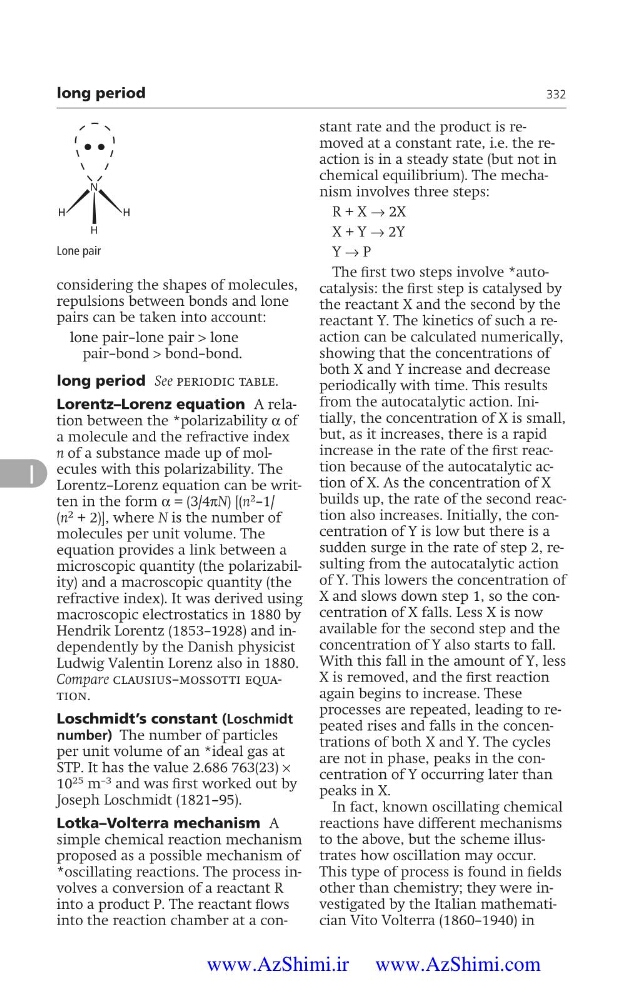
Lone pair
considering the shapes of molecules,
repulsions between bonds and lone
pairs can be taken into account:
lone pair–lone pair > lone
pair–bond > bond–bond.
long period See periodic table.
Lorentz–Lorenz equation A relation between the *polarizability α of
a molecule and the refractive index
n of a substance made up of molecules with this polarizability. The
Lorentz–Lorenz equation can be written in the form α = (3/4πN) [(n
2 –1/
(n
2 + 2)], where N is the number of
molecules per unit volume. The
equation provides a link between a
microscopic quantity (the polarizability) and a macroscopic quantity (the
refractive index). It was derived using
macroscopic electrostatics in 1880 by
Hendrik Lorentz (1853–1928) and independently by the Danish physicist
Ludwig Valentin Lorenz also in 1880.
Compare clausius–mossotti equation.
Loschmidt’s constant (Loschmidt
number) The number of particles
per unit volume of an *ideal gas at
STP. It has the value 2.686 763(23) ×
10
25 m
–3 and was Ürst worked out by
Joseph Loschmidt (1821–95).
Lotka–Volterra mechanism A
simple chemical reaction mechanism
proposed as a possible mechanism of
*oscillating reactions. The process involves a conversion of a reactant R
into a product P. The reactant Ûows
into the reaction chamber at a constant rate and the product is removed at a constant rate, i.e. the reaction is in a steady state (but not in
chemical equilibrium). The mechanism involves three steps:
R + X → 2X
X + Y → 2Y
Y → P
The Ürst two steps involve *autocatalysis: the Ürst step is catalysed by
the reactant X and the second by the
reactant Y. The kinetics of such a reaction can be calculated numerically,
showing that the concentrations of
both X and Y increase and decrease
periodically with time. This results
from the autocatalytic action. Initially, the concentration of X is small,
but, as it increases, there is a rapid
increase in the rate of the Ürst reaction because of the autocatalytic action of X. As the concentration of X
builds up, the rate of the second reaction also increases. Initially, the concentration of Y is low but there is a
sudden surge in the rate of step 2, resulting from the autocatalytic action
of Y. This lowers the concentration of
X and slows down step 1, so the concentration of X falls. Less X is now
available for the second step and the
concentration of Y also starts to fall.
With this fall in the amount of Y, less
X is removed, and the Ürst reaction
again begins to increase. These
processes are repeated, leading to repeated rises and falls in the concentrations of both X and Y. The cycles
are not in phase, peaks in the concentration of Y occurring later than
peaks in X.
In fact, known oscillating chemical
reactions have different mechanisms
to the above, but the scheme illustrates how oscillation may occur.
This type of process is found in Üelds
other than chemistry; they were investigated by the Italian mathematician Vito Volterra (1860–1940) in
www.AzShimi.ir www.AzShimi.com
332
l
H
H
H
N
Lone pair
considering the shapes of molecules,
repulsions between bonds and lone
pairs can be taken into account:
lone pair–lone pair > lone
pair–bond > bond–bond.
long period See periodic table.
Lorentz–Lorenz equation A relation between the *polarizability α of
a molecule and the refractive index
n of a substance made up of molecules with this polarizability. The
Lorentz–Lorenz equation can be written in the form α = (3/4πN) [(n
2 –1/
(n
2 + 2)], where N is the number of
molecules per unit volume. The
equation provides a link between a
microscopic quantity (the polarizability) and a macroscopic quantity (the
refractive index). It was derived using
macroscopic electrostatics in 1880 by
Hendrik Lorentz (1853–1928) and independently by the Danish physicist
Ludwig Valentin Lorenz also in 1880.
Compare clausius–mossotti equation.
Loschmidt’s constant (Loschmidt
number) The number of particles
per unit volume of an *ideal gas at
STP. It has the value 2.686 763(23) ×
10
25 m
–3 and was Ürst worked out by
Joseph Loschmidt (1821–95).
Lotka–Volterra mechanism A
simple chemical reaction mechanism
proposed as a possible mechanism of
*oscillating reactions. The process involves a conversion of a reactant R
into a product P. The reactant Ûows
into the reaction chamber at a constant rate and the product is removed at a constant rate, i.e. the reaction is in a steady state (but not in
chemical equilibrium). The mechanism involves three steps:
R + X → 2X
X + Y → 2Y
Y → P
The Ürst two steps involve *autocatalysis: the Ürst step is catalysed by
the reactant X and the second by the
reactant Y. The kinetics of such a reaction can be calculated numerically,
showing that the concentrations of
both X and Y increase and decrease
periodically with time. This results
from the autocatalytic action. Initially, the concentration of X is small,
but, as it increases, there is a rapid
increase in the rate of the Ürst reaction because of the autocatalytic action of X. As the concentration of X
builds up, the rate of the second reaction also increases. Initially, the concentration of Y is low but there is a
sudden surge in the rate of step 2, resulting from the autocatalytic action
of Y. This lowers the concentration of
X and slows down step 1, so the concentration of X falls. Less X is now
available for the second step and the
concentration of Y also starts to fall.
With this fall in the amount of Y, less
X is removed, and the Ürst reaction
again begins to increase. These
processes are repeated, leading to repeated rises and falls in the concentrations of both X and Y. The cycles
are not in phase, peaks in the concentration of Y occurring later than
peaks in X.
In fact, known oscillating chemical
reactions have different mechanisms
to the above, but the scheme illustrates how oscillation may occur.
This type of process is found in Üelds
other than chemistry; they were investigated by the Italian mathematician Vito Volterra (1860–1940) in
www.AzShimi.ir www.AzShimi.com