

gree of overlap between the three
concepts.
layer lattice A crystal structure in
which the atoms are chemically
bonded in plane layers, with relatively weak forces between atoms in
adjacent layers. Graphite and micas
are examples of substances having
layer lattices (i.e. they are *lamellar
solids).
lazurite See lapis lazuli.
LCAO (linear combination of atomic
orbitals) A molecular *orbital
formed by the linear combination of
atomic orbitals. The LCAO approximation arises because with an electron that is very close to a nucleus,
the potential energy of the electron
is dominated by the interaction between the electron and the nucleus.
Thus, very close to the nucleus of an
atom, A, in a molecule, the *wave
function of the molecule is very similar to the wave function of the atom
A. The LCAO approximation shows
the increase in electron density associated with chemical bonding. The
LCAO method takes account of the
symmetry of the molecule using symmetry-adapted linear combinations
(SALC).
LCP See liquid-crystal polymer.
L-dopa See dopa.
L–D process See basic-oxygen
process.
leaching Extraction of soluble components of a solid mixture by percolating a solvent through it.
lead Symbol Pb. A heavy dull grey
soft ductile metallic element belonging to *group 14 (formerly IVB) of
the periodic table; a.n. 82; r.a.m.
207.19; r.d. 11.35; m.p. 327.5°C; b.p.
1740°C. The main ore is the sulphide
galena (PbS); other minor sources include anglesite (PbSO 4 ), cerussite
(PbCO 3 ), and litharge (PbO). The
metal is extracted by roasting the ore
to give the oxide, followed by reduction with carbon. Silver is also recovered from the ores. Lead has a variety
of uses including building construction, lead-plate accumulators, bullets,
and shot, and is a constituent of such
alloys as solder, pewter, bearing metals, type metals, and fusible alloys.
Chemically, it forms compounds
with the +2 and +4 oxidation states,
the lead(II) state being the more stable.
A
• Information from the WebElements site
lead(II) acetate See lead(ii)
ethanoate.
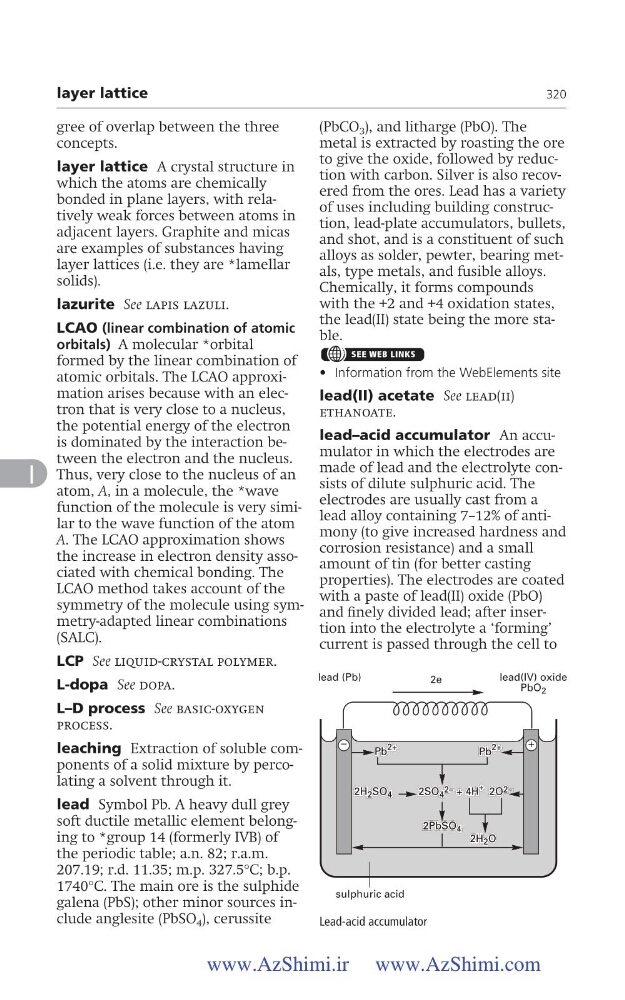
lead–acid accumulator An accumulator in which the electrodes are
made of lead and the electrolyte consists of dilute sulphuric acid. The
electrodes are usually cast from a
lead alloy containing 7–12% of antimony (to give increased hardness and
corrosion resistance) and a small
amount of tin (for better casting
properties). The electrodes are coated
with a paste of lead(II) oxide (PbO)
and Ünely divided lead; after insertion into the electrolyte a ‘forming’
current is passed through the cell to
layer lattice
320
l
2e
Pb
2+
Pb
2+
Pb
2+
Pb
2+
Pb
2+
Pb
2+
2H 2 SO 4
2H 2 SO 4
2H 2 SO 4
+ 4H
+
+ 4H
+
+ 4H
+ 2O 2–
2O 2–
2O 2–
2PbSO 4
2PbSO 4
2PbSO 4
2H 2 O
2H 2 O
2H 2 O
sulphuric acid
2SO 4
2–
2SO 4
2–
2SO 4
2–
+
–
lead (Pb)
lead(IV) oxide
PbO 2
Lead-acid accumulator
www.AzShimi.ir www.AzShimi.com
concepts.
layer lattice A crystal structure in
which the atoms are chemically
bonded in plane layers, with relatively weak forces between atoms in
adjacent layers. Graphite and micas
are examples of substances having
layer lattices (i.e. they are *lamellar
solids).
lazurite See lapis lazuli.
LCAO (linear combination of atomic
orbitals) A molecular *orbital
formed by the linear combination of
atomic orbitals. The LCAO approximation arises because with an electron that is very close to a nucleus,
the potential energy of the electron
is dominated by the interaction between the electron and the nucleus.
Thus, very close to the nucleus of an
atom, A, in a molecule, the *wave
function of the molecule is very similar to the wave function of the atom
A. The LCAO approximation shows
the increase in electron density associated with chemical bonding. The
LCAO method takes account of the
symmetry of the molecule using symmetry-adapted linear combinations
(SALC).
LCP See liquid-crystal polymer.
L-dopa See dopa.
L–D process See basic-oxygen
process.
leaching Extraction of soluble components of a solid mixture by percolating a solvent through it.
lead Symbol Pb. A heavy dull grey
soft ductile metallic element belonging to *group 14 (formerly IVB) of
the periodic table; a.n. 82; r.a.m.
207.19; r.d. 11.35; m.p. 327.5°C; b.p.
1740°C. The main ore is the sulphide
galena (PbS); other minor sources include anglesite (PbSO 4 ), cerussite
(PbCO 3 ), and litharge (PbO). The
metal is extracted by roasting the ore
to give the oxide, followed by reduction with carbon. Silver is also recovered from the ores. Lead has a variety
of uses including building construction, lead-plate accumulators, bullets,
and shot, and is a constituent of such
alloys as solder, pewter, bearing metals, type metals, and fusible alloys.
Chemically, it forms compounds
with the +2 and +4 oxidation states,
the lead(II) state being the more stable.
A
• Information from the WebElements site
lead(II) acetate See lead(ii)
ethanoate.
lead–acid accumulator An accumulator in which the electrodes are
made of lead and the electrolyte consists of dilute sulphuric acid. The
electrodes are usually cast from a
lead alloy containing 7–12% of antimony (to give increased hardness and
corrosion resistance) and a small
amount of tin (for better casting
properties). The electrodes are coated
with a paste of lead(II) oxide (PbO)
and Ünely divided lead; after insertion into the electrolyte a ‘forming’
current is passed through the cell to
layer lattice
320
l
2e
Pb
2+
Pb
2+
Pb
2+
Pb
2+
Pb
2+
Pb
2+
2H 2 SO 4
2H 2 SO 4
2H 2 SO 4
+ 4H
+
+ 4H
+
+ 4H
+ 2O 2–
2O 2–
2O 2–
2PbSO 4
2PbSO 4
2PbSO 4
2H 2 O
2H 2 O
2H 2 O
sulphuric acid
2SO 4
2–
2SO 4
2–
2SO 4
2–
+
–
lead (Pb)
lead(IV) oxide
PbO 2
Lead-acid accumulator
www.AzShimi.ir www.AzShimi.com