

dation of propan-1,2-diol using dilute
nitric acid. Lactic acid is manufactured by the fermentation of lactose
(from milk) and used in the dyeing
and tanning industries. It is an alpha
hydroxy *carboxylic acid. See also optical activity.
Lactic acid is produced from pyruvic acid in active muscle tissue when
oxygen is limited and subsequently
removed for conversion to glucose by
the liver. During strenuous exercise
it may build up in the muscles, causing cramplike pains. It is also produced by fermentation in certain
bacteria and is characteristic of sour
milk.
lactims See lactams.
A
• Information about IUPAC nomenclature
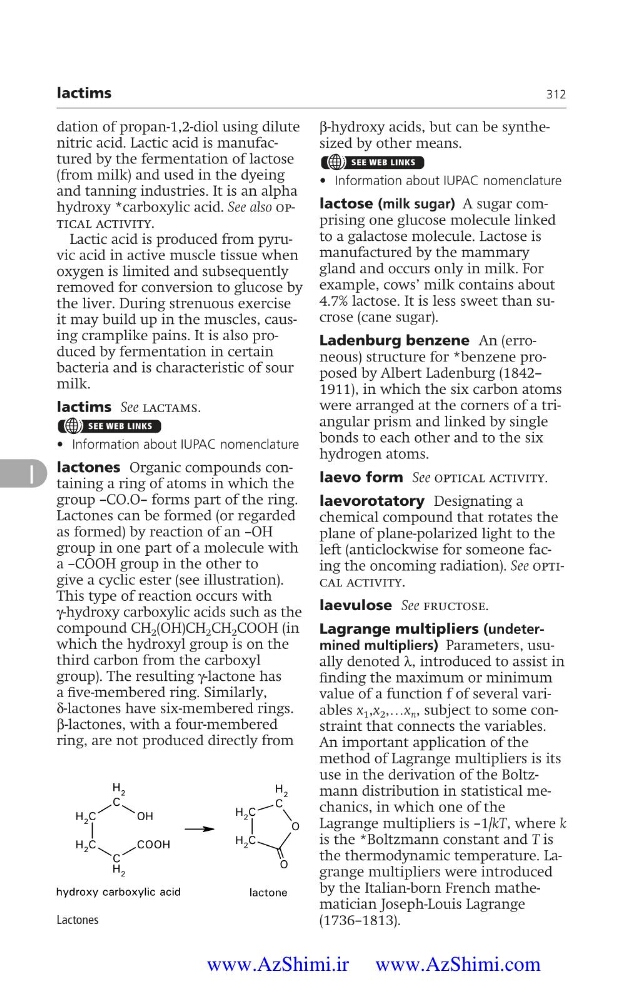
lactones Organic compounds containing a ring of atoms in which the
group –CO.O– forms part of the ring.
Lactones can be formed (or regarded
as formed) by reaction of an –OH
group in one part of a molecule with
a –COOH group in the other to
give a cyclic ester (see illustration).
This type of reaction occurs with
γ-hydroxy carboxylic acids such as the
compound CH 2 (OH)CH 2 CH 2 COOH (in
which the hydroxyl group is on the
third carbon from the carboxyl
group). The resulting γ-lactone has
a Üve-membered ring. Similarly,
δ-lactones have six-membered rings.
β-lactones, with a four-membered
ring, are not produced directly from
β-hydroxy acids, but can be synthesized by other means.
A
• Information about IUPAC nomenclature
lactose (milk sugar) A sugar comprising one glucose molecule linked
to a galactose molecule. Lactose is
manufactured by the mammary
gland and occurs only in milk. For
example, cows’ milk contains about
4.7% lactose. It is less sweet than sucrose (cane sugar).
Ladenburg benzene An (erroneous) structure for *benzene proposed by Albert Ladenburg (1842–
1911), in which the six carbon atoms
were arranged at the corners of a triangular prism and linked by single
bonds to each other and to the six
hydrogen atoms.
laevo form See optical activity.
laevorotatory Designating a
chemical compound that rotates the
plane of plane-polarized light to the
left (anticlockwise for someone facing the oncoming radiation). See optical activity.
laevulose See fructose.
Lagrange multipliers (undetermined multipliers) Parameters, usually denoted λ, introduced to assist in
Ünding the maximum or minimum
value of a function f of several variables x 1 ,x 2 ,…x n , subject to some constraint that connects the variables.
An important application of the
method of Lagrange multipliers is its
use in the derivation of the Boltzmann distribution in statistical mechanics, in which one of the
Lagrange multipliers is –1/kT, where k
is the *Boltzmann constant and T is
the thermodynamic temperature. Lagrange multipliers were introduced
by the Italian-born French mathematician Joseph-Louis Lagrange
(1736–1813).
lactims
312
l
%
*
%
*
%
*
1*
%
*
%11*
%
*
%
*
%
*
1
1
J[FTQZ[[ECTDQZ[NKEECEKF
NCEVQPG
Lactones
www.AzShimi.ir www.AzShimi.com
nitric acid. Lactic acid is manufactured by the fermentation of lactose
(from milk) and used in the dyeing
and tanning industries. It is an alpha
hydroxy *carboxylic acid. See also optical activity.
Lactic acid is produced from pyruvic acid in active muscle tissue when
oxygen is limited and subsequently
removed for conversion to glucose by
the liver. During strenuous exercise
it may build up in the muscles, causing cramplike pains. It is also produced by fermentation in certain
bacteria and is characteristic of sour
milk.
lactims See lactams.
A
• Information about IUPAC nomenclature
lactones Organic compounds containing a ring of atoms in which the
group –CO.O– forms part of the ring.
Lactones can be formed (or regarded
as formed) by reaction of an –OH
group in one part of a molecule with
a –COOH group in the other to
give a cyclic ester (see illustration).
This type of reaction occurs with
γ-hydroxy carboxylic acids such as the
compound CH 2 (OH)CH 2 CH 2 COOH (in
which the hydroxyl group is on the
third carbon from the carboxyl
group). The resulting γ-lactone has
a Üve-membered ring. Similarly,
δ-lactones have six-membered rings.
β-lactones, with a four-membered
ring, are not produced directly from
β-hydroxy acids, but can be synthesized by other means.
A
• Information about IUPAC nomenclature
lactose (milk sugar) A sugar comprising one glucose molecule linked
to a galactose molecule. Lactose is
manufactured by the mammary
gland and occurs only in milk. For
example, cows’ milk contains about
4.7% lactose. It is less sweet than sucrose (cane sugar).
Ladenburg benzene An (erroneous) structure for *benzene proposed by Albert Ladenburg (1842–
1911), in which the six carbon atoms
were arranged at the corners of a triangular prism and linked by single
bonds to each other and to the six
hydrogen atoms.
laevo form See optical activity.
laevorotatory Designating a
chemical compound that rotates the
plane of plane-polarized light to the
left (anticlockwise for someone facing the oncoming radiation). See optical activity.
laevulose See fructose.
Lagrange multipliers (undetermined multipliers) Parameters, usually denoted λ, introduced to assist in
Ünding the maximum or minimum
value of a function f of several variables x 1 ,x 2 ,…x n , subject to some constraint that connects the variables.
An important application of the
method of Lagrange multipliers is its
use in the derivation of the Boltzmann distribution in statistical mechanics, in which one of the
Lagrange multipliers is –1/kT, where k
is the *Boltzmann constant and T is
the thermodynamic temperature. Lagrange multipliers were introduced
by the Italian-born French mathematician Joseph-Louis Lagrange
(1736–1813).
lactims
312
l
%
*
%
*
%
*
1*
%
*
%11*
%
*
%
*
%
*
1
1
J[FTQZ[[ECTDQZ[NKEECEKF
NCEVQPG
Lactones
www.AzShimi.ir www.AzShimi.com