

Joule–Kelvin) effect. His main theoretical work was in {thermodynamics}, in which he stressed the
importance of the conservation of
energy. He also introduced the concept of absolute zero and the Kelvin
temperature scale based on it; the
unit of thermodynamic temperature
is named after him. In 1896 he was
created Baron Kelvin of Largs.
keratin Any of a group of Übrous
*proteins occurring in hair, feathers,
hooves, and horns. Keratins have
coiled polypeptide chains that combine to form supercoils of several
polypeptides linked by disulphide
bonds between adjacent cysteine
amino acids.
kerosine See petroleum.
Kerr effect The ability of certain
substances to refract differently light
waves whose vibrations are in two directions (see double refraction)
when the substance is placed in an
electric Üeld. The effect, discovered
in 1875 by John Kerr (1824–1907), is
caused by the fact that certain molecules have electric *dipoles, which
tend to be orientated by the applied
Üeld; the normal random motions of
the molecules tends to destroy this
orientation and the balance is struck
by the relative magnitudes of the
Üeld strength, the temperature, and
the magnitudes of the dipole moments.
The Kerr effect is observed in a
Kerr cell, which consists of a glass
cell containing the liquid or gaseous
substance; two capacitor plates are
inserted into the cell and light is
passed through it at right angles to
the electric Üeld. There are two
principal indexes of refraction:
n o (the ordinary index) and n e (the
extraordinary index). The difference
in the velocity of propagation in the
cell causes a phase difference, δ, between the two waves formed from a
beam of monochromatic light, wavelength λ, such that
δ = (n o – n e )x/λ,
where x is the length of the light
path in the cell. Kerr also showed
empirically that the ratio
(n o – n e )λ = BE
2 ,
where E is the Üeld strength and B is
a constant, called the Kerr constant,
which is characteristic of the substance and approximately inversely
proportional to the thermodynamic
temperature.
The Kerr shutter consists of a Kerr
cell Ülled with a liquid, such as nitrobenzene, placed between two
crossed polarizers; the electric Üeld is
arranged to be perpendicular to the
axis of the light beam and at 45° to
the axis of the polarizers. In the absence of a Üeld there is no optical
path through the device. When the
Üeld is switched on the nitrobenzene
becomes doubly refracting and a
path opens between the crossed polarizers.
ketals Organic compounds, similar
to *acetals, formed by addition of an
alcohol to a ketone. If one molecule
of ketone (RR′CO) reacts with one
molecule of alcohol R″OH, then a
hemiketal is formed. The rings of ketose sugars are hemiketals. Further
reaction produces a full ketal
(RR′C(OR″) 2 ).
A
• Information about IUPAC nomenclature
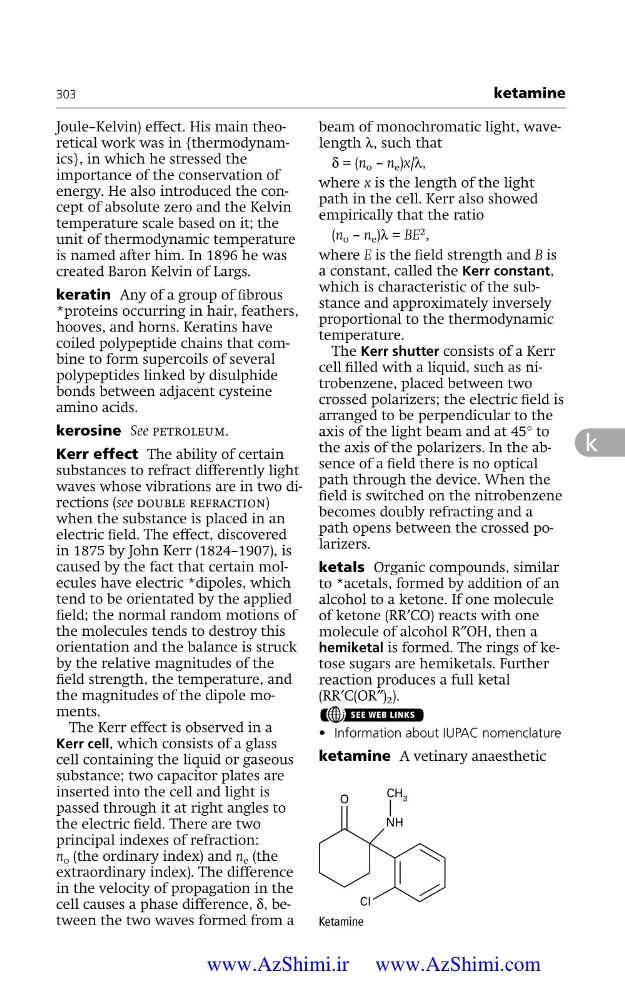
ketamine A vetinary anaesthetic
303
ketamine
k
O
Cl
NH
CH 3
Ketamine
www.AzShimi.ir www.AzShimi.com
importance of the conservation of
energy. He also introduced the concept of absolute zero and the Kelvin
temperature scale based on it; the
unit of thermodynamic temperature
is named after him. In 1896 he was
created Baron Kelvin of Largs.
keratin Any of a group of Übrous
*proteins occurring in hair, feathers,
hooves, and horns. Keratins have
coiled polypeptide chains that combine to form supercoils of several
polypeptides linked by disulphide
bonds between adjacent cysteine
amino acids.
kerosine See petroleum.
Kerr effect The ability of certain
substances to refract differently light
waves whose vibrations are in two directions (see double refraction)
when the substance is placed in an
electric Üeld. The effect, discovered
in 1875 by John Kerr (1824–1907), is
caused by the fact that certain molecules have electric *dipoles, which
tend to be orientated by the applied
Üeld; the normal random motions of
the molecules tends to destroy this
orientation and the balance is struck
by the relative magnitudes of the
Üeld strength, the temperature, and
the magnitudes of the dipole moments.
The Kerr effect is observed in a
Kerr cell, which consists of a glass
cell containing the liquid or gaseous
substance; two capacitor plates are
inserted into the cell and light is
passed through it at right angles to
the electric Üeld. There are two
principal indexes of refraction:
n o (the ordinary index) and n e (the
extraordinary index). The difference
in the velocity of propagation in the
cell causes a phase difference, δ, between the two waves formed from a
beam of monochromatic light, wavelength λ, such that
δ = (n o – n e )x/λ,
where x is the length of the light
path in the cell. Kerr also showed
empirically that the ratio
(n o – n e )λ = BE
2 ,
where E is the Üeld strength and B is
a constant, called the Kerr constant,
which is characteristic of the substance and approximately inversely
proportional to the thermodynamic
temperature.
The Kerr shutter consists of a Kerr
cell Ülled with a liquid, such as nitrobenzene, placed between two
crossed polarizers; the electric Üeld is
arranged to be perpendicular to the
axis of the light beam and at 45° to
the axis of the polarizers. In the absence of a Üeld there is no optical
path through the device. When the
Üeld is switched on the nitrobenzene
becomes doubly refracting and a
path opens between the crossed polarizers.
ketals Organic compounds, similar
to *acetals, formed by addition of an
alcohol to a ketone. If one molecule
of ketone (RR′CO) reacts with one
molecule of alcohol R″OH, then a
hemiketal is formed. The rings of ketose sugars are hemiketals. Further
reaction produces a full ketal
(RR′C(OR″) 2 ).
A
• Information about IUPAC nomenclature
ketamine A vetinary anaesthetic
303
ketamine
k
O
Cl
NH
CH 3
Ketamine
www.AzShimi.ir www.AzShimi.com