

[(HO) 3 AlOAl(OH) 3 ]
2– , are also present.
See also aluminium hydroxide.
aluminium Symbol Al. A silverywhite lustrous metallic element belonging to *group 3 (formerly IIIB) of
the periodic table; a.n. 13; r.a.m.
26.98; r.d. 2.7; m.p. 660°C; b.p.
2467°C. The metal itself is highly reactive but is protected by a thin
transparent layer of the oxide, which
forms quickly in air. Aluminium and
its oxide are amphoteric. The metal
is extracted from puriÜed bauxite
(Al 2 O 3 ) by electrolysis; the main
process uses a *Hall–Heroult cell but
other electrolytic methods are under
development, including conversion
of bauxite with chlorine and electrolysis of the molten chloride. Pure aluminium is soft and ductile but its
strength can be increased by workhardening. A large number of alloys
are manufactured; alloying elements
include copper, manganese, silicon,
zinc, and magnesium. Its lightness,
strength (when alloyed), corrosion resistance, and electrical conductivity
(62% of that of copper) make it suitable for a variety of uses, including
vehicle and aircraft construction,
building (window and door frames),
and overhead power cables. Although it is the third most abundant
element in the earth’s crust (8.1% by
weight) it was not isolated until 1825
by H. C. *Oersted.
A
• Information from the WebElements site
aluminium acetate See aluminium ethanoate.
aluminium chloride A whitish
solid, AlCl 3 , which fumes in moist air
and reacts violently with water (to
give hydrogen chloride). It is known
as the anhydrous salt (hexagonal; r.d.
2.44 (fused solid); m.p. 190°C (2.5
atm.); sublimes at 178°C) or the hexahydrate AlCl 3 .6H 2 O (rhombic; r.d.
aluminium
24
a
Cl
Cl
Cl
Cl
Al
Al
Cl
Cl
Aluminium chloride
2.398; loses water at 100°C), both of
which are deliquescent. Aluminium
chloride may be prepared by passing
hydrogen chloride or chlorine over
hot aluminium or (industrially) by
passing chlorine over heated aluminium oxide and carbon. The chloride ion is polarized by the small
positive aluminium ion and the
bonding in the solid is intermediate
between covalent and ionic. In the
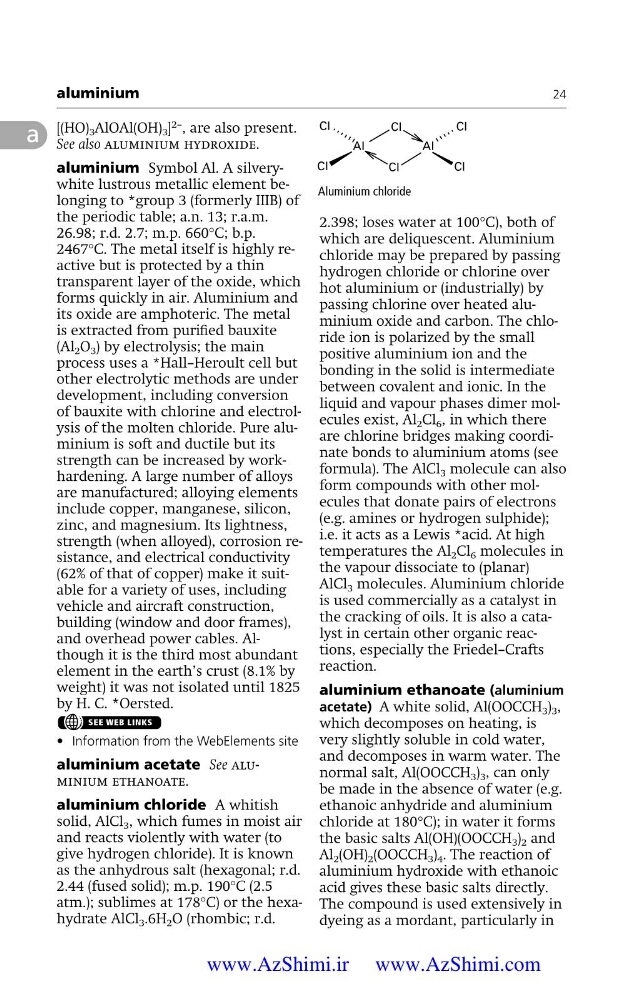
liquid and vapour phases dimer molecules exist, Al 2 Cl 6 , in which there
are chlorine bridges making coordinate bonds to aluminium atoms (see
formula). The AlCl 3 molecule can also
form compounds with other molecules that donate pairs of electrons
(e.g. amines or hydrogen sulphide);
i.e. it acts as a Lewis *acid. At high
temperatures the Al 2 Cl 6 molecules in
the vapour dissociate to (planar)
AlCl 3 molecules. Aluminium chloride
is used commercially as a catalyst in
the cracking of oils. It is also a catalyst in certain other organic reactions, especially the Friedel–Crafts
reaction.
aluminium ethanoate (aluminium
acetate) A white solid, Al(OOCCH 3 ) 3 ,
which decomposes on heating, is
very slightly soluble in cold water,
and decomposes in warm water. The
normal salt, Al(OOCCH 3 ) 3 , can only
be made in the absence of water (e.g.
ethanoic anhydride and aluminium
chloride at 180°C); in water it forms
the basic salts Al(OH)(OOCCH 3 ) 2 and
Al 2 (OH) 2 (OOCCH 3 ) 4 . The reaction of
aluminium hydroxide with ethanoic
acid gives these basic salts directly.
The compound is used extensively in
dyeing as a mordant, particularly in
www.AzShimi.ir www.AzShimi.com
2– , are also present.
See also aluminium hydroxide.
aluminium Symbol Al. A silverywhite lustrous metallic element belonging to *group 3 (formerly IIIB) of
the periodic table; a.n. 13; r.a.m.
26.98; r.d. 2.7; m.p. 660°C; b.p.
2467°C. The metal itself is highly reactive but is protected by a thin
transparent layer of the oxide, which
forms quickly in air. Aluminium and
its oxide are amphoteric. The metal
is extracted from puriÜed bauxite
(Al 2 O 3 ) by electrolysis; the main
process uses a *Hall–Heroult cell but
other electrolytic methods are under
development, including conversion
of bauxite with chlorine and electrolysis of the molten chloride. Pure aluminium is soft and ductile but its
strength can be increased by workhardening. A large number of alloys
are manufactured; alloying elements
include copper, manganese, silicon,
zinc, and magnesium. Its lightness,
strength (when alloyed), corrosion resistance, and electrical conductivity
(62% of that of copper) make it suitable for a variety of uses, including
vehicle and aircraft construction,
building (window and door frames),
and overhead power cables. Although it is the third most abundant
element in the earth’s crust (8.1% by
weight) it was not isolated until 1825
by H. C. *Oersted.
A
• Information from the WebElements site
aluminium acetate See aluminium ethanoate.
aluminium chloride A whitish
solid, AlCl 3 , which fumes in moist air
and reacts violently with water (to
give hydrogen chloride). It is known
as the anhydrous salt (hexagonal; r.d.
2.44 (fused solid); m.p. 190°C (2.5
atm.); sublimes at 178°C) or the hexahydrate AlCl 3 .6H 2 O (rhombic; r.d.
aluminium
24
a
Cl
Cl
Cl
Cl
Al
Al
Cl
Cl
Aluminium chloride
2.398; loses water at 100°C), both of
which are deliquescent. Aluminium
chloride may be prepared by passing
hydrogen chloride or chlorine over
hot aluminium or (industrially) by
passing chlorine over heated aluminium oxide and carbon. The chloride ion is polarized by the small
positive aluminium ion and the
bonding in the solid is intermediate
between covalent and ionic. In the
liquid and vapour phases dimer molecules exist, Al 2 Cl 6 , in which there
are chlorine bridges making coordinate bonds to aluminium atoms (see
formula). The AlCl 3 molecule can also
form compounds with other molecules that donate pairs of electrons
(e.g. amines or hydrogen sulphide);
i.e. it acts as a Lewis *acid. At high
temperatures the Al 2 Cl 6 molecules in
the vapour dissociate to (planar)
AlCl 3 molecules. Aluminium chloride
is used commercially as a catalyst in
the cracking of oils. It is also a catalyst in certain other organic reactions, especially the Friedel–Crafts
reaction.
aluminium ethanoate (aluminium
acetate) A white solid, Al(OOCCH 3 ) 3 ,
which decomposes on heating, is
very slightly soluble in cold water,
and decomposes in warm water. The
normal salt, Al(OOCCH 3 ) 3 , can only
be made in the absence of water (e.g.
ethanoic anhydride and aluminium
chloride at 180°C); in water it forms
the basic salts Al(OH)(OOCCH 3 ) 2 and
Al 2 (OH) 2 (OOCCH 3 ) 4 . The reaction of
aluminium hydroxide with ethanoic
acid gives these basic salts directly.
The compound is used extensively in
dyeing as a mordant, particularly in
www.AzShimi.ir www.AzShimi.com