

2 pH units. In titration, the point at
which the reaction is complete is the
equivalence point (i.e. the point at
which equivalent quantities of acid
and base are added). The end point is
the point at which the indicator just
changes colour. For accuracy, the two
must be the same. During a titration
the pH changes sharply close to the
equivalence point, and the indicator
used must change colour over the
same range.
Other types of indicator can be
used for other reactions. Starch, for
example, is used in iodine titrations
because of the deep blue complex it
forms. Oxidation–reduction indicators are substances that show a reversible colour change between
oxidized and reduced forms. See also
adsorption indicator.
indigo A blue vat dye, C 16 H 10 N 2 O 2 .
It occurs as the glucoside indican in
the leaves of plants of the genus Indigofera, from which it was formerly
extracted. It is now made synthetically.
indium Symbol In. A soft silvery element belonging to group 13 (formerly IIIB) of the periodic table; a.n.
49; r.a.m. 114.82; r.d. 7.31 (20°C);
m.p. 156.6°C; b.p. 2080±2°C. It occurs
in zinc blende and some iron ores
and is obtained from zinc Ûue dust in
total quantities of about 40 tonnes
per annum. Naturally occurring indium consists of 4.23% indium–113
(stable) and 95.77% indium–115 (halflife 6 × 10
14 years). There are a further Üve short-lived radioisotopes.
The uses of the metal are small –
some special-purpose electroplates
and some special fusible alloys. Several semiconductor compounds are
used, such as InAs, InP, and InSb.
With only three electrons in its valency shell, indium is an electron acceptor and is used to dope pure
germanium and silicon; it forms stable indium(I), indium(II), and indium(III) compounds. The element
was discovered in 1863 by Ferdinand
Reich (1799–1882) and Hieronymus
Richter (1824–90).
A
• Information from the WebElements site
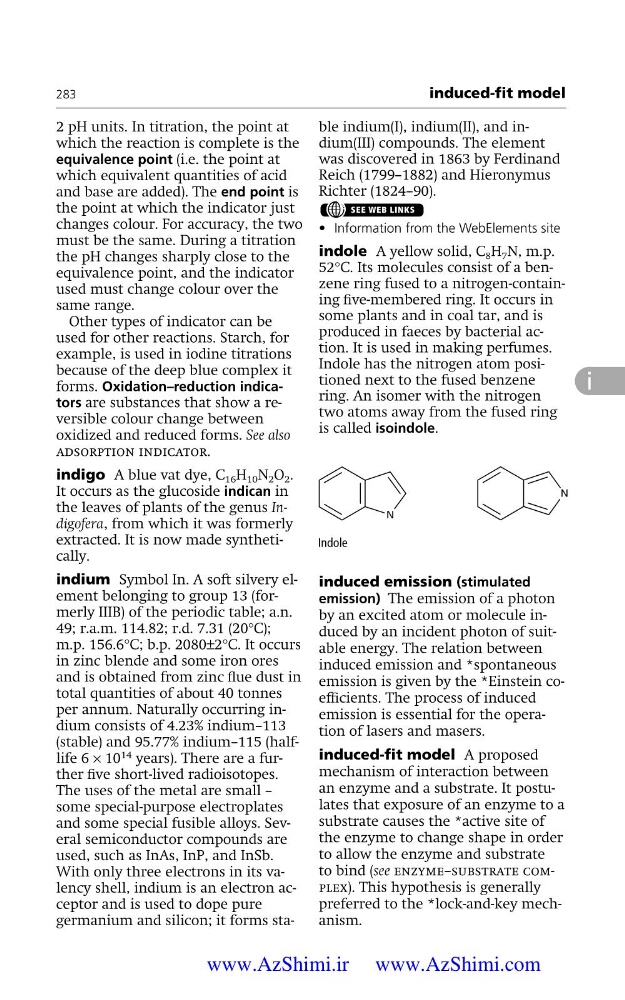
indole A yellow solid, C 8 H 7 N, m.p.
52°C. Its molecules consist of a benzene ring fused to a nitrogen-containing Üve-membered ring. It occurs in
some plants and in coal tar, and is
produced in faeces by bacterial action. It is used in making perfumes.
Indole has the nitrogen atom positioned next to the fused benzene
ring. An isomer with the nitrogen
two atoms away from the fused ring
is called isoindole.
283
induced-fit model
i
0
0
Indole
induced emission (stimulated
emission) The emission of a photon
by an excited atom or molecule induced by an incident photon of suitable energy. The relation between
induced emission and *spontaneous
emission is given by the *Einstein coefÜcients. The process of induced
emission is essential for the operation of lasers and masers.
induced-Üt model A proposed
mechanism of interaction between
an enzyme and a substrate. It postulates that exposure of an enzyme to a
substrate causes the *active site of
the enzyme to change shape in order
to allow the enzyme and substrate
to bind (see enzyme–substrate complex). This hypothesis is generally
preferred to the *lock-and-key mechanism.
www.AzShimi.ir www.AzShimi.com
which the reaction is complete is the
equivalence point (i.e. the point at
which equivalent quantities of acid
and base are added). The end point is
the point at which the indicator just
changes colour. For accuracy, the two
must be the same. During a titration
the pH changes sharply close to the
equivalence point, and the indicator
used must change colour over the
same range.
Other types of indicator can be
used for other reactions. Starch, for
example, is used in iodine titrations
because of the deep blue complex it
forms. Oxidation–reduction indicators are substances that show a reversible colour change between
oxidized and reduced forms. See also
adsorption indicator.
indigo A blue vat dye, C 16 H 10 N 2 O 2 .
It occurs as the glucoside indican in
the leaves of plants of the genus Indigofera, from which it was formerly
extracted. It is now made synthetically.
indium Symbol In. A soft silvery element belonging to group 13 (formerly IIIB) of the periodic table; a.n.
49; r.a.m. 114.82; r.d. 7.31 (20°C);
m.p. 156.6°C; b.p. 2080±2°C. It occurs
in zinc blende and some iron ores
and is obtained from zinc Ûue dust in
total quantities of about 40 tonnes
per annum. Naturally occurring indium consists of 4.23% indium–113
(stable) and 95.77% indium–115 (halflife 6 × 10
14 years). There are a further Üve short-lived radioisotopes.
The uses of the metal are small –
some special-purpose electroplates
and some special fusible alloys. Several semiconductor compounds are
used, such as InAs, InP, and InSb.
With only three electrons in its valency shell, indium is an electron acceptor and is used to dope pure
germanium and silicon; it forms stable indium(I), indium(II), and indium(III) compounds. The element
was discovered in 1863 by Ferdinand
Reich (1799–1882) and Hieronymus
Richter (1824–90).
A
• Information from the WebElements site
indole A yellow solid, C 8 H 7 N, m.p.
52°C. Its molecules consist of a benzene ring fused to a nitrogen-containing Üve-membered ring. It occurs in
some plants and in coal tar, and is
produced in faeces by bacterial action. It is used in making perfumes.
Indole has the nitrogen atom positioned next to the fused benzene
ring. An isomer with the nitrogen
two atoms away from the fused ring
is called isoindole.
283
induced-fit model
i
0
0
Indole
induced emission (stimulated
emission) The emission of a photon
by an excited atom or molecule induced by an incident photon of suitable energy. The relation between
induced emission and *spontaneous
emission is given by the *Einstein coefÜcients. The process of induced
emission is essential for the operation of lasers and masers.
induced-Üt model A proposed
mechanism of interaction between
an enzyme and a substrate. It postulates that exposure of an enzyme to a
substrate causes the *active site of
the enzyme to change shape in order
to allow the enzyme and substrate
to bind (see enzyme–substrate complex). This hypothesis is generally
preferred to the *lock-and-key mechanism.
www.AzShimi.ir www.AzShimi.com