

*inhibition, binding of the inhibitor
to an allosteric site inhibits the activity of the enzyme. In an *allosteric
enzyme, the binding of a regulatory
molecule to the allosteric site
changes the overall shape of the enzyme, either enabling the substrate
to bind to the active site or preventing the binding of the substrate.
allotropy The existence of elements in two or more different
forms (allotropes). In the case of oxygen, there are two forms: ‘normal’
dioxygen (O 2 ) and ozone, or trioxygen (O 3 ). These two allotropes have
different molecular conÜgurations.
More commonly, allotropy occurs because of different crystal structures
in the solid, and is particularly prevalent in groups 14, 15, and 16 of the
periodic table. In some cases, the allotropes are stable over a temperature range, with a deÜnite transition
point at which one changes into the
other. For instance, tin has two allotropes: white (metallic) tin stable
above 13.2°C and grey (nonmetallic)
tin stable below 13.2°C. This form of
allotropy is called enantiotropy. Carbon also has two allotropes – diamond and graphite – although
graphite is the stable form at all temperatures. This form of allotropy, in
which there is no transition temperature at which the two are in equilibrium, is called monotropy. See also
polymorphism.
allowed bands See energy bands.
allowed transition A transition
between two electronic states allowed according to *selection rules
associated with group theory. The
probability of a transition between
states m and n produced by the interaction of electromagnetic radiation
with an atomic system is proportional to the square of the magnitude
of the matrix elements of the electric
allotropy
22
a
dipole moment. If this quantity is not
zero, the transition is an allowed
transition; if it is zero the transition
is a *forbidden transition as a dipole
transition. It may, however, be an allowed transition for magnetic dipole
or quadrupole-moment transitions,
which have much smaller transition
probabilities and consequently give
much weaker lines in the spectrum.
alloy A material consisting of two
or more metals (e.g. brass is an alloy
of copper and zinc) or a metal and a
nonmetal (e.g. steel is an alloy of iron
and carbon, sometimes with other
metals included). Alloys may be compounds, *solid solutions, or mixtures
of the components.
alloy steels See steel.
allyl alcohol See propenol.
allyl group See propenyl group.
Alnico A tradename for a series of
alloys, containing iron, aluminium,
nickel, cobalt, and copper, used to
make permanent magnets.
alpha helix The most common
form of secondary structure in *proteins, in which the polypeptide chain
is coiled into a helix. The helical
structure is held in place by weak hydrogen bonds between the N–H and
C=O groups in successive turns of the
helix (see illustration). Compare beta
sheet.
alpha-iron See iron.
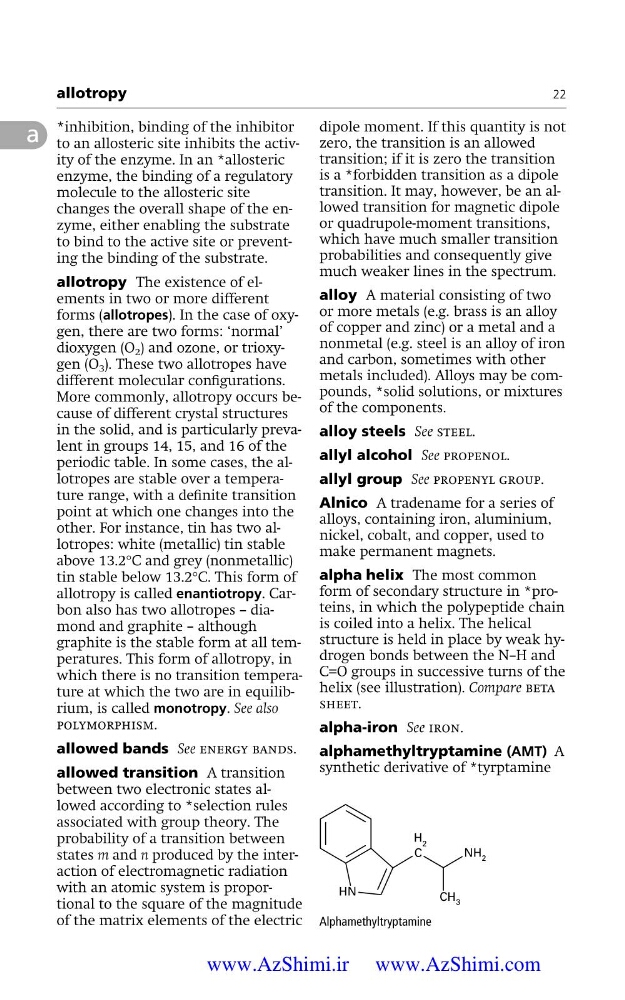
alphamethyltryptamine (AMT) A
synthetic derivative of *tyrptamine
N
H
C
H 2
NH 2
CH 3
Alphamethyltryptamine
www.AzShimi.ir www.AzShimi.com
to an allosteric site inhibits the activity of the enzyme. In an *allosteric
enzyme, the binding of a regulatory
molecule to the allosteric site
changes the overall shape of the enzyme, either enabling the substrate
to bind to the active site or preventing the binding of the substrate.
allotropy The existence of elements in two or more different
forms (allotropes). In the case of oxygen, there are two forms: ‘normal’
dioxygen (O 2 ) and ozone, or trioxygen (O 3 ). These two allotropes have
different molecular conÜgurations.
More commonly, allotropy occurs because of different crystal structures
in the solid, and is particularly prevalent in groups 14, 15, and 16 of the
periodic table. In some cases, the allotropes are stable over a temperature range, with a deÜnite transition
point at which one changes into the
other. For instance, tin has two allotropes: white (metallic) tin stable
above 13.2°C and grey (nonmetallic)
tin stable below 13.2°C. This form of
allotropy is called enantiotropy. Carbon also has two allotropes – diamond and graphite – although
graphite is the stable form at all temperatures. This form of allotropy, in
which there is no transition temperature at which the two are in equilibrium, is called monotropy. See also
polymorphism.
allowed bands See energy bands.
allowed transition A transition
between two electronic states allowed according to *selection rules
associated with group theory. The
probability of a transition between
states m and n produced by the interaction of electromagnetic radiation
with an atomic system is proportional to the square of the magnitude
of the matrix elements of the electric
allotropy
22
a
dipole moment. If this quantity is not
zero, the transition is an allowed
transition; if it is zero the transition
is a *forbidden transition as a dipole
transition. It may, however, be an allowed transition for magnetic dipole
or quadrupole-moment transitions,
which have much smaller transition
probabilities and consequently give
much weaker lines in the spectrum.
alloy A material consisting of two
or more metals (e.g. brass is an alloy
of copper and zinc) or a metal and a
nonmetal (e.g. steel is an alloy of iron
and carbon, sometimes with other
metals included). Alloys may be compounds, *solid solutions, or mixtures
of the components.
alloy steels See steel.
allyl alcohol See propenol.
allyl group See propenyl group.
Alnico A tradename for a series of
alloys, containing iron, aluminium,
nickel, cobalt, and copper, used to
make permanent magnets.
alpha helix The most common
form of secondary structure in *proteins, in which the polypeptide chain
is coiled into a helix. The helical
structure is held in place by weak hydrogen bonds between the N–H and
C=O groups in successive turns of the
helix (see illustration). Compare beta
sheet.
alpha-iron See iron.
alphamethyltryptamine (AMT) A
synthetic derivative of *tyrptamine
N
H
C
H 2
NH 2
CH 3
Alphamethyltryptamine
www.AzShimi.ir www.AzShimi.com