

(see kipp’s apparatus). Solutions in
water (known as hydrosulphuric acid)
contain the anions HS
– and minute
traces of S
2– and are weakly acidic.
Acid salts (those containing the HS
–
ion) are known as hydrogensulphides
(formerly hydrosulphides). In acid solution hydrogen sulphide is a mild
reducing agent. Hydrogen sulphide
has an important role in traditional
qualitative chemical analysis, where
it precipitates metals with insoluble
sulphides. Hydrogen sulphide is exceedingly poisonous (more toxic than
hydrogen cyanide). See also claus
process.
hydrogensulphite (bisulphite) A
salt containing the ion
–
HSO 3 or an
ester of the type RHSO 3 , where R is
an organic group.
hydroiodic acid See hydrogen iodide.
hydrolysis A chemical reaction of a
compound with water. For instance,
salts of weak acids or bases hydrolyse
in aqueous solution, as in
Na
+– CH 3 COO
– + H 2 O ˆ Na
+ + OH
– +
CH 3 COOH
The reverse reaction of *esteriÜcation is another example. See also
solvolysis.
hydromagnesite A mineral form
of basic *magnesium carbonate,
3MgCO 3 .Mg(OH) 2 .3H 2 O.
hydron The positive ion H
+ . The
name is used when it is not relevant
to specify the isotope, as is usually
the case in compounds in which the
hydrogen is in natural abundance.
When the isotope is relevant then
proton (
1
H
+ ), deuteron (
2
H
+ ), or triton
(
3 H
+ ) should be used.
hydronium ion See oxonium ion.
hydrophilic Having an afÜnity for
water. See lyophilic.
hydrophobic Lacking afÜnity for
water. See lyophobic.
hydroquinone See benzene-1,4diol.
hydrosol A sol in which the continuous phase is water. See colloids.
hydrosulphate See hydrogensulphate.
hydrosulphide See hydrogen sulphide.
hydrosulphuric acid See hydrogen sulphide.
hydroxide A metallic compound
containing the ion OH
– (hydroxide
ion) or containing the group –OH (hydroxyl group) bound to a metal atom.
Hydroxides of typical metals are
basic; those of *metalloids are amphoteric.
hydroxoacid A type of acid in
which the acidic hydrogen is on a hydroxyl group attached to an atom
that is not attached to an oxo (=O)
group. An example is
Si(OH 4 ) + H 2 O → Si(OH) 3 (O)
– + H 3 O
+
Compare oxoacid.
hydroxonium ion See oxonium
ion.
4-hydroxybutanoic acid
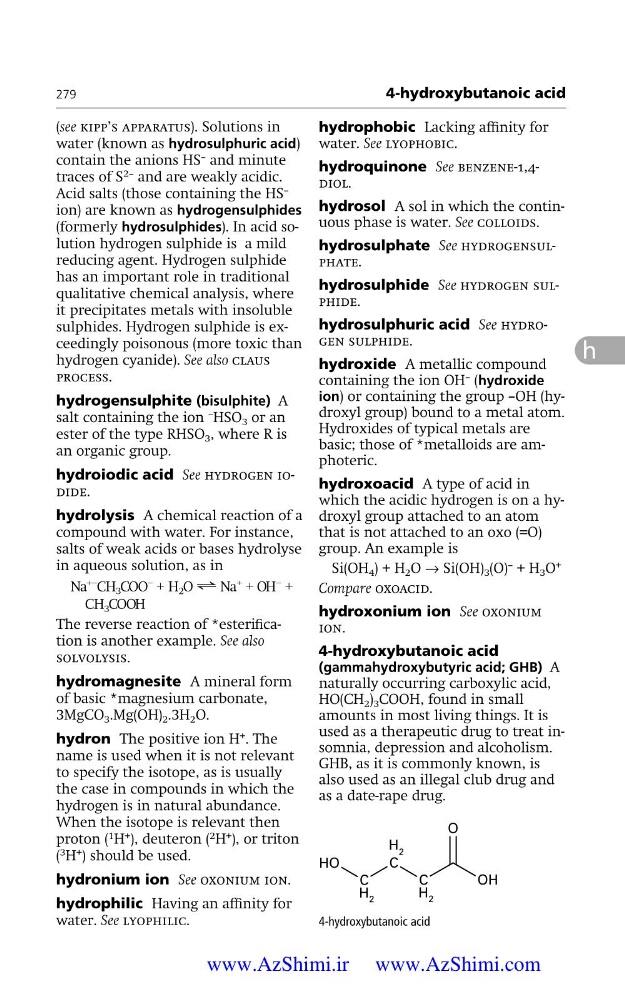
(gammahydroxybutyric acid; GHB) A
naturally occurring carboxylic acid,
HO(CH 2 ) 3 COOH, found in small
amounts in most living things. It is
used as a therapeutic drug to treat insomnia, depression and alcoholism.
GHB, as it is commonly known, is
also used as an illegal club drug and
as a date-rape drug.
279
4-hydroxybutanoic acid
h
O
H
C
H 2
C
H 2
C
H 2
OH
O
4-hydroxybutanoic acid
www.AzShimi.ir www.AzShimi.com
water (known as hydrosulphuric acid)
contain the anions HS
– and minute
traces of S
2– and are weakly acidic.
Acid salts (those containing the HS
–
ion) are known as hydrogensulphides
(formerly hydrosulphides). In acid solution hydrogen sulphide is a mild
reducing agent. Hydrogen sulphide
has an important role in traditional
qualitative chemical analysis, where
it precipitates metals with insoluble
sulphides. Hydrogen sulphide is exceedingly poisonous (more toxic than
hydrogen cyanide). See also claus
process.
hydrogensulphite (bisulphite) A
salt containing the ion
–
HSO 3 or an
ester of the type RHSO 3 , where R is
an organic group.
hydroiodic acid See hydrogen iodide.
hydrolysis A chemical reaction of a
compound with water. For instance,
salts of weak acids or bases hydrolyse
in aqueous solution, as in
Na
+– CH 3 COO
– + H 2 O ˆ Na
+ + OH
– +
CH 3 COOH
The reverse reaction of *esteriÜcation is another example. See also
solvolysis.
hydromagnesite A mineral form
of basic *magnesium carbonate,
3MgCO 3 .Mg(OH) 2 .3H 2 O.
hydron The positive ion H
+ . The
name is used when it is not relevant
to specify the isotope, as is usually
the case in compounds in which the
hydrogen is in natural abundance.
When the isotope is relevant then
proton (
1
H
+ ), deuteron (
2
H
+ ), or triton
(
3 H
+ ) should be used.
hydronium ion See oxonium ion.
hydrophilic Having an afÜnity for
water. See lyophilic.
hydrophobic Lacking afÜnity for
water. See lyophobic.
hydroquinone See benzene-1,4diol.
hydrosol A sol in which the continuous phase is water. See colloids.
hydrosulphate See hydrogensulphate.
hydrosulphide See hydrogen sulphide.
hydrosulphuric acid See hydrogen sulphide.
hydroxide A metallic compound
containing the ion OH
– (hydroxide
ion) or containing the group –OH (hydroxyl group) bound to a metal atom.
Hydroxides of typical metals are
basic; those of *metalloids are amphoteric.
hydroxoacid A type of acid in
which the acidic hydrogen is on a hydroxyl group attached to an atom
that is not attached to an oxo (=O)
group. An example is
Si(OH 4 ) + H 2 O → Si(OH) 3 (O)
– + H 3 O
+
Compare oxoacid.
hydroxonium ion See oxonium
ion.
4-hydroxybutanoic acid
(gammahydroxybutyric acid; GHB) A
naturally occurring carboxylic acid,
HO(CH 2 ) 3 COOH, found in small
amounts in most living things. It is
used as a therapeutic drug to treat insomnia, depression and alcoholism.
GHB, as it is commonly known, is
also used as an illegal club drug and
as a date-rape drug.
279
4-hydroxybutanoic acid
h
O
H
C
H 2
C
H 2
C
H 2
OH
O
4-hydroxybutanoic acid
www.AzShimi.ir www.AzShimi.com