

industrial processes, such as the
reduction of oxide ores, the reÜning
of petroleum, the production of
hydrocarbons from coal, and the hydrogenation of vegetable oils. Considerable interest has also been shown
in its potential use in a ‘hydrogen
fuel economy’ in which primary energy sources not based on fossil fuels
(e.g. nuclear, solar, or geothermal energy) are used to produce electricity,
which is employed in electrolysing
water. The hydrogen formed is
stored as liquid hydrogen or as metal
hydrides. Chemically, hydrogen reacts with most elements. It was discovered by Henry *Cavendish in
1766.
A
• Information from the WebElements site
hydrogen acceptor See hydrogen
carrier.
hydrogenation 1. A chemical reaction with hydrogen; in particular,
an addition reaction in which hydrogen adds to an unsaturated compound. Nickel is a good catalyst for
such reactions. 2. The process of
converting coal to oil by making the
carbon in the coal combine with hydrogen to form hydrocarbons. See fischer–tropsch process; bergius
process.
hydrogen azide (hydrazoic acid;
azoimide) A colourless liquid, HN 3 ;
r.d. 1.09; m.p. –80°C; b.p. 37°C. It is
highly toxic and a powerful reductant, which explodes in the presence
of oxygen and other oxidizing
agents. It may be prepared by the reaction of sodium amide and sodium
nitrate at 175°C followed by distillation of a mixture of the resulting
sodium azide and a dilute acid. See
also azides.
hydrogen bond A type of electrostatic interaction between molecules
occurring in molecules that have
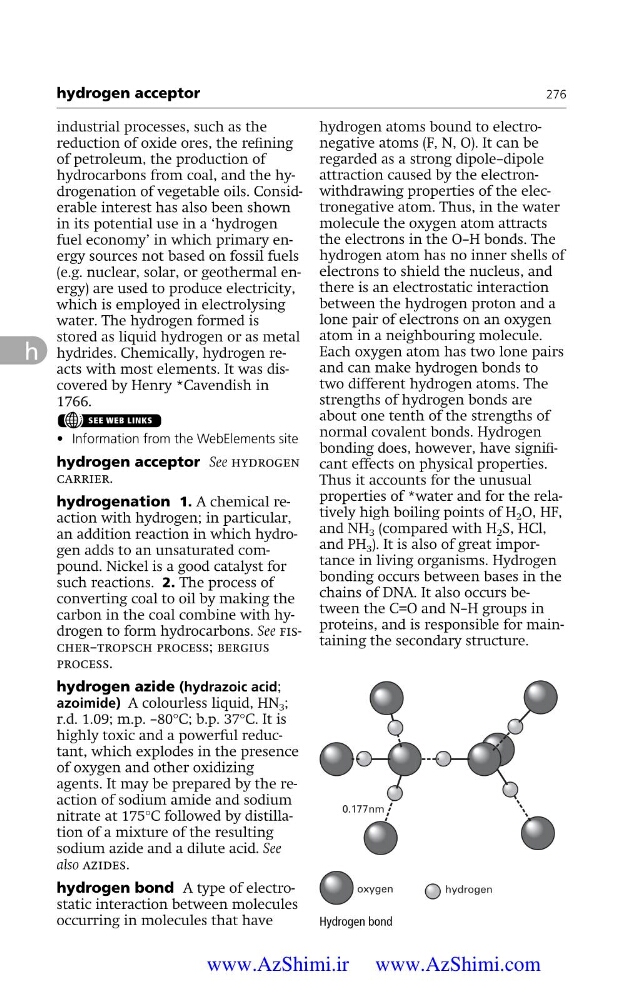
hydrogen atoms bound to electronegative atoms (F, N, O). It can be
regarded as a strong dipole–dipole
attraction caused by the electronwithdrawing properties of the electronegative atom. Thus, in the water
molecule the oxygen atom attracts
the electrons in the O–H bonds. The
hydrogen atom has no inner shells of
electrons to shield the nucleus, and
there is an electrostatic interaction
between the hydrogen proton and a
lone pair of electrons on an oxygen
atom in a neighbouring molecule.
Each oxygen atom has two lone pairs
and can make hydrogen bonds to
two different hydrogen atoms. The
strengths of hydrogen bonds are
about one tenth of the strengths of
normal covalent bonds. Hydrogen
bonding does, however, have signiÜcant effects on physical properties.
Thus it accounts for the unusual
properties of *water and for the relatively high boiling points of H 2 O, HF,
and NH 3 (compared with H 2 S, HCl,
and PH 3 ). It is also of great importance in living organisms. Hydrogen
bonding occurs between bases in the
chains of DNA. It also occurs between the C=O and N–H groups in
proteins, and is responsible for maintaining the secondary structure.
hydrogen acceptor
276
h
oxygen
hydrogen
0.177nm
Hydrogen bond
www.AzShimi.ir www.AzShimi.com
reduction of oxide ores, the reÜning
of petroleum, the production of
hydrocarbons from coal, and the hydrogenation of vegetable oils. Considerable interest has also been shown
in its potential use in a ‘hydrogen
fuel economy’ in which primary energy sources not based on fossil fuels
(e.g. nuclear, solar, or geothermal energy) are used to produce electricity,
which is employed in electrolysing
water. The hydrogen formed is
stored as liquid hydrogen or as metal
hydrides. Chemically, hydrogen reacts with most elements. It was discovered by Henry *Cavendish in
1766.
A
• Information from the WebElements site
hydrogen acceptor See hydrogen
carrier.
hydrogenation 1. A chemical reaction with hydrogen; in particular,
an addition reaction in which hydrogen adds to an unsaturated compound. Nickel is a good catalyst for
such reactions. 2. The process of
converting coal to oil by making the
carbon in the coal combine with hydrogen to form hydrocarbons. See fischer–tropsch process; bergius
process.
hydrogen azide (hydrazoic acid;
azoimide) A colourless liquid, HN 3 ;
r.d. 1.09; m.p. –80°C; b.p. 37°C. It is
highly toxic and a powerful reductant, which explodes in the presence
of oxygen and other oxidizing
agents. It may be prepared by the reaction of sodium amide and sodium
nitrate at 175°C followed by distillation of a mixture of the resulting
sodium azide and a dilute acid. See
also azides.
hydrogen bond A type of electrostatic interaction between molecules
occurring in molecules that have
hydrogen atoms bound to electronegative atoms (F, N, O). It can be
regarded as a strong dipole–dipole
attraction caused by the electronwithdrawing properties of the electronegative atom. Thus, in the water
molecule the oxygen atom attracts
the electrons in the O–H bonds. The
hydrogen atom has no inner shells of
electrons to shield the nucleus, and
there is an electrostatic interaction
between the hydrogen proton and a
lone pair of electrons on an oxygen
atom in a neighbouring molecule.
Each oxygen atom has two lone pairs
and can make hydrogen bonds to
two different hydrogen atoms. The
strengths of hydrogen bonds are
about one tenth of the strengths of
normal covalent bonds. Hydrogen
bonding does, however, have signiÜcant effects on physical properties.
Thus it accounts for the unusual
properties of *water and for the relatively high boiling points of H 2 O, HF,
and NH 3 (compared with H 2 S, HCl,
and PH 3 ). It is also of great importance in living organisms. Hydrogen
bonding occurs between bases in the
chains of DNA. It also occurs between the C=O and N–H groups in
proteins, and is responsible for maintaining the secondary structure.
hydrogen acceptor
276
h
oxygen
hydrogen
0.177nm
Hydrogen bond
www.AzShimi.ir www.AzShimi.com