

biosynthesized from amino acids and
classiÜed according to some structural feature. A simple classiÜcation
is into:
the pyridine group (e.g. coniine, nicotine)
the tropine group (e.g. atropine, cocaine)
the quinoline group (e.g. quinine,
strychnine, brucine)
the isoquinoline group (e.g. morphine, codeine)
the phenylethylamine group (e.g.
methamphetamine, mescaline,
ephedrine)
the indole group (e.g. tryptamine, lysergic acid)
the purine group (e.g. caffeine, theobromine, theophylline)
alkanal An aliphatic aldehyde.
alkanes (parafÜns) Saturated hydrocarbons with the general formula
C n H 2n+2 . In systematic chemical
nomenclature alkane names end in
the sufÜx -ane. They form a *homologous series (the alkane series)
methane (CH 4 ), ethane (C 2 H 6 ),
propane (C 3 H 8 ), butane (C 4 H 10 ), pentane (C 5 H 12 ), etc. The lower members
of the series are gases; the high-molecular weight alkanes are waxy
solids. Alkanes are present in natural
gas and petroleum. They can be
made by heating the sodium salt of a
carboxylic acid with soda lime:
RCOO
–
Na
+ + Na
+ OH
–
→ Na 2 CO 3 +
RH
Other methods include the *Wurtz
reaction and *Kolbe’s method. Generally the alkanes are fairly unreactive.
They form haloalkanes with halogens when irradiated with ultraviolet
radiation.
A
• Information about IUPAC nomenclature
• Further details about IUPAC
nomenclature
alkanol An aliphatic alcohol.
alkenes (oleÜnes; oleÜns) Unsaturated hydrocarbons that contain one
or more double carbon–carbon bonds
in their molecules. In systematic
chemical nomenclature alkene
names end in the sufÜx -ene. Alkenes
that have only one double bond form
a homologous series (the alkene series) starting ethene (ethylene),
CH 2 :CH 2 , propene, CH 3 CH:CH 2 , etc.
The general formula is C n H 2n . Higher
members of the series show isomerism depending on position of the
double bond; for example, butene
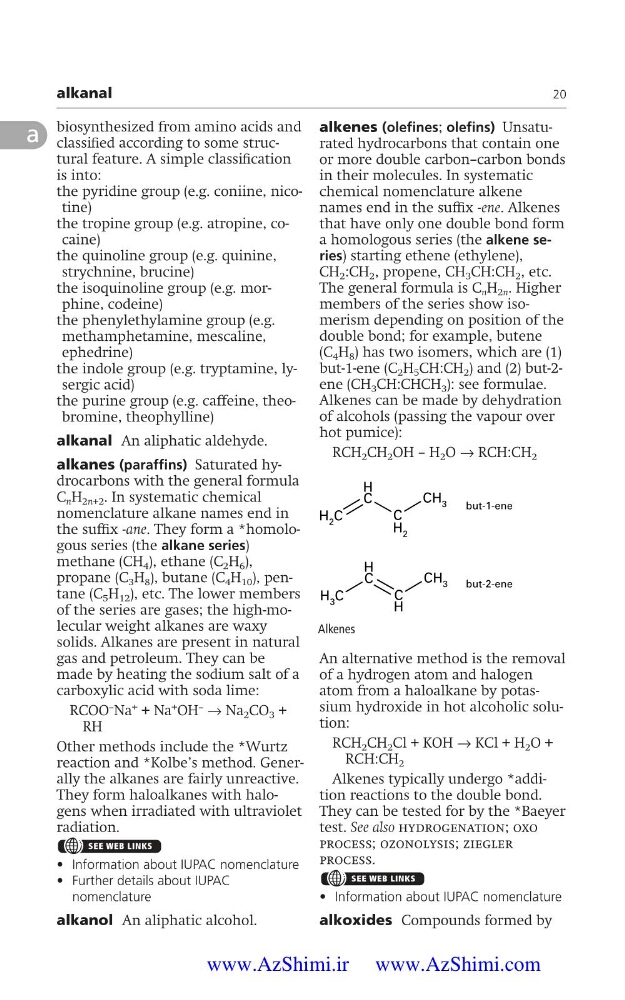
(C 4 H 8 ) has two isomers, which are (1)
but-1-ene (C 2 H 5 CH:CH 2 ) and (2) but-2ene (CH 3 CH:CHCH 3 ): see formulae.
Alkenes can be made by dehydration
of alcohols (passing the vapour over
hot pumice):
RCH 2 CH 2 OH – H 2 O → RCH:CH 2
alkanal
20
a
C
H 2
C
H
C
H 2
CH 3
C
H 3
C
H
C
H
CH 3
but-1-ene
but-2-ene
Alkenes
An alternative method is the removal
of a hydrogen atom and halogen
atom from a haloalkane by potassium hydroxide in hot alcoholic solution:
RCH 2 CH 2 Cl + KOH → KCl + H 2 O +
RCH:CH 2
Alkenes typically undergo *addition reactions to the double bond.
They can be tested for by the *Baeyer
test. See also hydrogenation; oxo
process; ozonolysis; ziegler
process.
A
• Information about IUPAC nomenclature
alkoxides Compounds formed by
www.AzShimi.ir www.AzShimi.com
classiÜed according to some structural feature. A simple classiÜcation
is into:
the pyridine group (e.g. coniine, nicotine)
the tropine group (e.g. atropine, cocaine)
the quinoline group (e.g. quinine,
strychnine, brucine)
the isoquinoline group (e.g. morphine, codeine)
the phenylethylamine group (e.g.
methamphetamine, mescaline,
ephedrine)
the indole group (e.g. tryptamine, lysergic acid)
the purine group (e.g. caffeine, theobromine, theophylline)
alkanal An aliphatic aldehyde.
alkanes (parafÜns) Saturated hydrocarbons with the general formula
C n H 2n+2 . In systematic chemical
nomenclature alkane names end in
the sufÜx -ane. They form a *homologous series (the alkane series)
methane (CH 4 ), ethane (C 2 H 6 ),
propane (C 3 H 8 ), butane (C 4 H 10 ), pentane (C 5 H 12 ), etc. The lower members
of the series are gases; the high-molecular weight alkanes are waxy
solids. Alkanes are present in natural
gas and petroleum. They can be
made by heating the sodium salt of a
carboxylic acid with soda lime:
RCOO
–
Na
+ + Na
+ OH
–
→ Na 2 CO 3 +
RH
Other methods include the *Wurtz
reaction and *Kolbe’s method. Generally the alkanes are fairly unreactive.
They form haloalkanes with halogens when irradiated with ultraviolet
radiation.
A
• Information about IUPAC nomenclature
• Further details about IUPAC
nomenclature
alkanol An aliphatic alcohol.
alkenes (oleÜnes; oleÜns) Unsaturated hydrocarbons that contain one
or more double carbon–carbon bonds
in their molecules. In systematic
chemical nomenclature alkene
names end in the sufÜx -ene. Alkenes
that have only one double bond form
a homologous series (the alkene series) starting ethene (ethylene),
CH 2 :CH 2 , propene, CH 3 CH:CH 2 , etc.
The general formula is C n H 2n . Higher
members of the series show isomerism depending on position of the
double bond; for example, butene
(C 4 H 8 ) has two isomers, which are (1)
but-1-ene (C 2 H 5 CH:CH 2 ) and (2) but-2ene (CH 3 CH:CHCH 3 ): see formulae.
Alkenes can be made by dehydration
of alcohols (passing the vapour over
hot pumice):
RCH 2 CH 2 OH – H 2 O → RCH:CH 2
alkanal
20
a
C
H 2
C
H
C
H 2
CH 3
C
H 3
C
H
C
H
CH 3
but-1-ene
but-2-ene
Alkenes
An alternative method is the removal
of a hydrogen atom and halogen
atom from a haloalkane by potassium hydroxide in hot alcoholic solution:
RCH 2 CH 2 Cl + KOH → KCl + H 2 O +
RCH:CH 2
Alkenes typically undergo *addition reactions to the double bond.
They can be tested for by the *Baeyer
test. See also hydrogenation; oxo
process; ozonolysis; ziegler
process.
A
• Information about IUPAC nomenclature
alkoxides Compounds formed by
www.AzShimi.ir www.AzShimi.com