

H
Haber, Fritz (1868–1934) German
chemist who worked at the Karlsruhe Technical Institute, where he
perfected the *Haber process for
making ammonia in 1908. As a Jew,
he left Germany in 1933 to go into
exile in Britain, working in Cambridge at the Cavendish Laboratory.
For his Haber process, he was
awarded the 1918 Nobel Prize for
chemistry.
Haber process An industrial
process for producing ammonia by
reaction of nitrogen with hydrogen:
N 2 + 3H 2 ˆ 2NH 3
The reaction is reversible and
exothermic, so that a high yield of
ammonia is favoured by low temperature (see le chatelier’s principle).
However, the rate of reaction would
be too slow for equilibrium to be
reached at normal temperatures, so
an optimum temperature of about
450°C is used, with a catalyst of iron
containing potassium and aluminium oxide promoters. The higher
the pressure the greater the yield, although there are technical difÜculties in using very high pressures. A
pressure of about 250 atmospheres is
commonly employed.
The process is of immense importance for the Üxation of nitrogen for
fertilizers. It was developed in 1908
by Fritz *Haber and was developed
for industrial use by Carl Bosch
(1874–1940), hence the alternative
name Haber–Bosch process. The nitrogen is obtained from liquid air.
Formerly, the hydrogen was from
*water gas and the water–gas shift
reaction (the Bosch process) but now
the raw material (called synthesis
gas) is obtained by steam *reforming
natural gas.
habit See crystal.
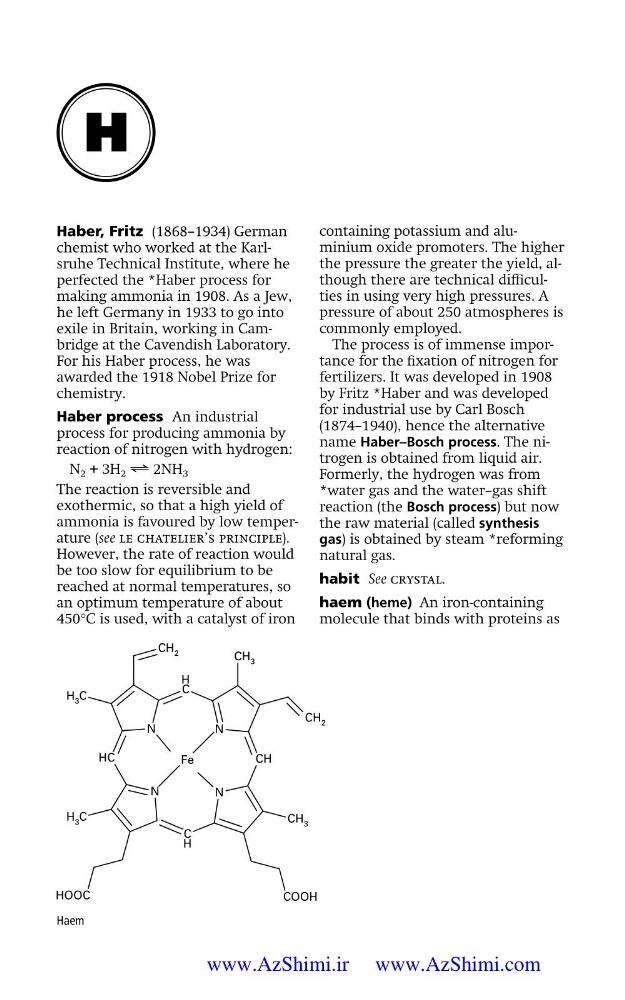
haem (heme) An iron-containing
molecule that binds with proteins as
C
H
CH
C
H
C
H
N
N
N
N
CH 2
CH 2
C
H 3
CH 3
C
H 3
CH 3
COOH
HOOC
Fe
Haem
www.AzShimi.ir www.AzShimi.com
Haber, Fritz (1868–1934) German
chemist who worked at the Karlsruhe Technical Institute, where he
perfected the *Haber process for
making ammonia in 1908. As a Jew,
he left Germany in 1933 to go into
exile in Britain, working in Cambridge at the Cavendish Laboratory.
For his Haber process, he was
awarded the 1918 Nobel Prize for
chemistry.
Haber process An industrial
process for producing ammonia by
reaction of nitrogen with hydrogen:
N 2 + 3H 2 ˆ 2NH 3
The reaction is reversible and
exothermic, so that a high yield of
ammonia is favoured by low temperature (see le chatelier’s principle).
However, the rate of reaction would
be too slow for equilibrium to be
reached at normal temperatures, so
an optimum temperature of about
450°C is used, with a catalyst of iron
containing potassium and aluminium oxide promoters. The higher
the pressure the greater the yield, although there are technical difÜculties in using very high pressures. A
pressure of about 250 atmospheres is
commonly employed.
The process is of immense importance for the Üxation of nitrogen for
fertilizers. It was developed in 1908
by Fritz *Haber and was developed
for industrial use by Carl Bosch
(1874–1940), hence the alternative
name Haber–Bosch process. The nitrogen is obtained from liquid air.
Formerly, the hydrogen was from
*water gas and the water–gas shift
reaction (the Bosch process) but now
the raw material (called synthesis
gas) is obtained by steam *reforming
natural gas.
habit See crystal.
haem (heme) An iron-containing
molecule that binds with proteins as
C
H
CH
C
H
C
H
N
N
N
N
CH 2
CH 2
C
H 3
CH 3
C
H 3
CH 3
COOH
HOOC
Fe
Haem
www.AzShimi.ir www.AzShimi.com