

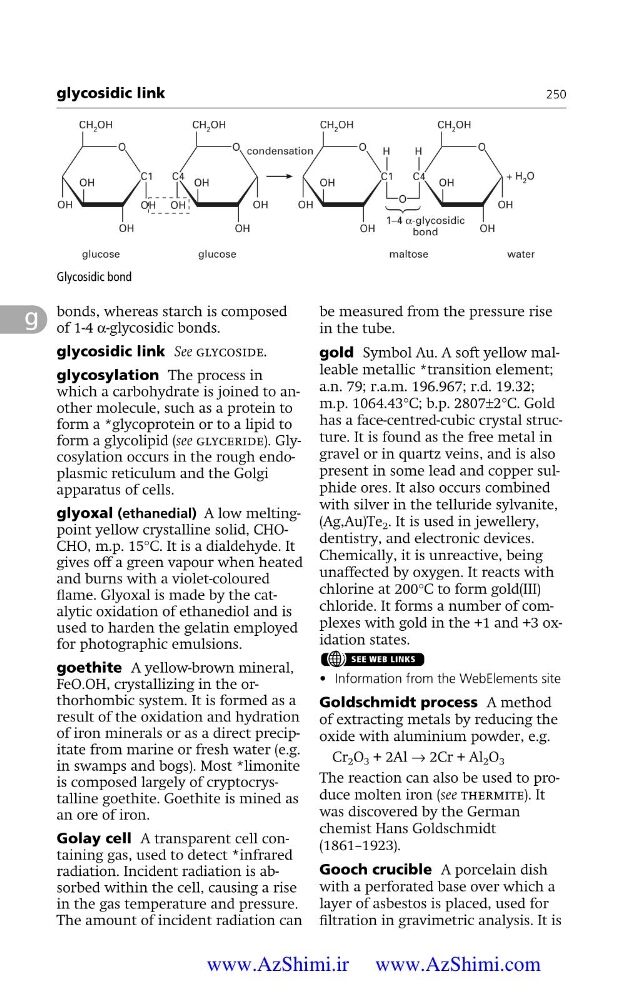
bonds, whereas starch is composed
of 1-4 α-glycosidic bonds.
glycosidic link See glycoside.
glycosylation The process in
which a carbohydrate is joined to another molecule, such as a protein to
form a *glycoprotein or to a lipid to
form a glycolipid (see glyceride). Glycosylation occurs in the rough endoplasmic reticulum and the Golgi
apparatus of cells.
glyoxal (ethanedial) A low meltingpoint yellow crystalline solid, CHOCHO, m.p. 15°C. It is a dialdehyde. It
gives off a green vapour when heated
and burns with a violet-coloured
Ûame. Glyoxal is made by the catalytic oxidation of ethanediol and is
used to harden the gelatin employed
for photographic emulsions.
goethite A yellow-brown mineral,
FeO.OH, crystallizing in the orthorhombic system. It is formed as a
result of the oxidation and hydration
of iron minerals or as a direct precipitate from marine or fresh water (e.g.
in swamps and bogs). Most *limonite
is composed largely of cryptocrystalline goethite. Goethite is mined as
an ore of iron.
Golay cell A transparent cell containing gas, used to detect *infrared
radiation. Incident radiation is absorbed within the cell, causing a rise
in the gas temperature and pressure.
The amount of incident radiation can
be measured from the pressure rise
in the tube.
gold Symbol Au. A soft yellow malleable metallic *transition element;
a.n. 79; r.a.m. 196.967; r.d. 19.32;
m.p. 1064.43°C; b.p. 2807±2°C. Gold
has a face-centred-cubic crystal structure. It is found as the free metal in
gravel or in quartz veins, and is also
present in some lead and copper sulphide ores. It also occurs combined
with silver in the telluride sylvanite,
(Ag,Au)Te 2 . It is used in jewellery,
dentistry, and electronic devices.
Chemically, it is unreactive, being
unaffected by oxygen. It reacts with
chlorine at 200°C to form gold(III)
chloride. It forms a number of complexes with gold in the +1 and +3 oxidation states.
A
• Information from the WebElements site
Goldschmidt process A method
of extracting metals by reducing the
oxide with aluminium powder, e.g.
Cr 2 O 3 + 2Al → 2Cr + Al 2 O 3
The reaction can also be used to produce molten iron (see thermite). It
was discovered by the German
chemist Hans Goldschmidt
(1861–1923).
Gooch crucible A porcelain dish
with a perforated base over which a
layer of asbestos is placed, used for
Ültration in gravimetric analysis. It is
glycosidic link
250
g
CH 2 OH
CH 2 OH
CH 2 OH
CH 2 OH
O
OH
OH
C1
OH
OH OH
C4 OH
OH
OH
O
OH
OH
OH
condensation
O
H
C1
O
H
C4 OH
OH
OH
O
+ H 2 O
1–4 α-glycosidic
bond
maltose
water
glucose
glucose
Glycosidic bond
www.AzShimi.ir www.AzShimi.com
of 1-4 α-glycosidic bonds.
glycosidic link See glycoside.
glycosylation The process in
which a carbohydrate is joined to another molecule, such as a protein to
form a *glycoprotein or to a lipid to
form a glycolipid (see glyceride). Glycosylation occurs in the rough endoplasmic reticulum and the Golgi
apparatus of cells.
glyoxal (ethanedial) A low meltingpoint yellow crystalline solid, CHOCHO, m.p. 15°C. It is a dialdehyde. It
gives off a green vapour when heated
and burns with a violet-coloured
Ûame. Glyoxal is made by the catalytic oxidation of ethanediol and is
used to harden the gelatin employed
for photographic emulsions.
goethite A yellow-brown mineral,
FeO.OH, crystallizing in the orthorhombic system. It is formed as a
result of the oxidation and hydration
of iron minerals or as a direct precipitate from marine or fresh water (e.g.
in swamps and bogs). Most *limonite
is composed largely of cryptocrystalline goethite. Goethite is mined as
an ore of iron.
Golay cell A transparent cell containing gas, used to detect *infrared
radiation. Incident radiation is absorbed within the cell, causing a rise
in the gas temperature and pressure.
The amount of incident radiation can
be measured from the pressure rise
in the tube.
gold Symbol Au. A soft yellow malleable metallic *transition element;
a.n. 79; r.a.m. 196.967; r.d. 19.32;
m.p. 1064.43°C; b.p. 2807±2°C. Gold
has a face-centred-cubic crystal structure. It is found as the free metal in
gravel or in quartz veins, and is also
present in some lead and copper sulphide ores. It also occurs combined
with silver in the telluride sylvanite,
(Ag,Au)Te 2 . It is used in jewellery,
dentistry, and electronic devices.
Chemically, it is unreactive, being
unaffected by oxygen. It reacts with
chlorine at 200°C to form gold(III)
chloride. It forms a number of complexes with gold in the +1 and +3 oxidation states.
A
• Information from the WebElements site
Goldschmidt process A method
of extracting metals by reducing the
oxide with aluminium powder, e.g.
Cr 2 O 3 + 2Al → 2Cr + Al 2 O 3
The reaction can also be used to produce molten iron (see thermite). It
was discovered by the German
chemist Hans Goldschmidt
(1861–1923).
Gooch crucible A porcelain dish
with a perforated base over which a
layer of asbestos is placed, used for
Ültration in gravimetric analysis. It is
glycosidic link
250
g
CH 2 OH
CH 2 OH
CH 2 OH
CH 2 OH
O
OH
OH
C1
OH
OH OH
C4 OH
OH
OH
O
OH
OH
OH
condensation
O
H
C1
O
H
C4 OH
OH
OH
O
+ H 2 O
1–4 α-glycosidic
bond
maltose
water
glucose
glucose
Glycosidic bond
www.AzShimi.ir www.AzShimi.com