

θ is the ratio of adsorption sites occupied to the number of adsorption
sites available, c 1 , and c 2 are constants, and P is the pressure of gas.
The Freundlich isotherm is frequently used with adsorption from
liquid solutions, when it has the
form: w = c 1 × c
1/c2 , where w is the
mass of solute adsorbed per unit
mass of adsorbent (a quantity called
the mass fraction) and c is the concentration of the solution. Like other
isotherms the Freundlich isotherm
agrees with experiment for limited
ranges of parameter. If the limits of
applicability have been established
these isotherms, such as the Freundlich isotherm, are useful in considering heterogeneous catalysis.
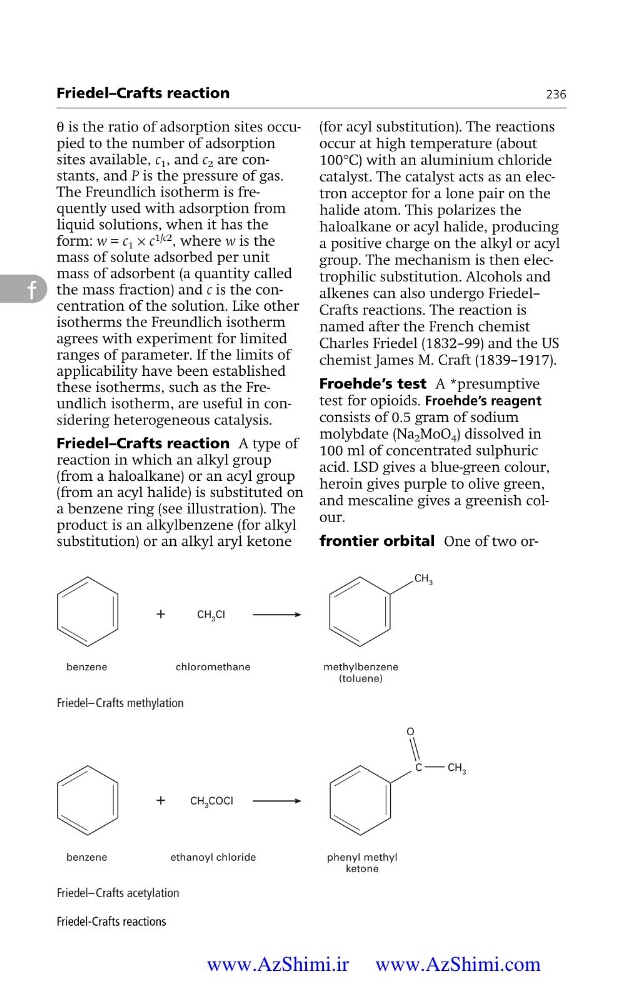
Friedel–Crafts reaction A type of
reaction in which an alkyl group
(from a haloalkane) or an acyl group
(from an acyl halide) is substituted on
a benzene ring (see illustration). The
product is an alkylbenzene (for alkyl
substitution) or an alkyl aryl ketone
(for acyl substitution). The reactions
occur at high temperature (about
100°C) with an aluminium chloride
catalyst. The catalyst acts as an electron acceptor for a lone pair on the
halide atom. This polarizes the
haloalkane or acyl halide, producing
a positive charge on the alkyl or acyl
group. The mechanism is then electrophilic substitution. Alcohols and
alkenes can also undergo Friedel–
Crafts reactions. The reaction is
named after the French chemist
Charles Friedel (1832–99) and the US
chemist James M. Craft (1839–1917).
Froehde’s test A *presumptive
test for opioids. Froehde’s reagent
consists of 0.5 gram of sodium
molybdate (Na 2 MoO 4 ) dissolved in
100 ml of concentrated sulphuric
acid. LSD gives a blue-green colour,
heroin gives purple to olive green,
and mescaline gives a greenish colour.
frontier orbital One of two orFriedel–Crafts reaction
236
f
+
CH 3 CI
+ CH 3 COCI
benzene
chloromethane
methylbenzene
(toluene)
benzene
ethanoyl chloride
phenyl methyl
ketone
C
O
CH 3
CH 3
Friedel Crafts methylation
Friedel Crafts acetylation
Friedel-Crafts reactions
www.AzShimi.ir www.AzShimi.com
sites available, c 1 , and c 2 are constants, and P is the pressure of gas.
The Freundlich isotherm is frequently used with adsorption from
liquid solutions, when it has the
form: w = c 1 × c
1/c2 , where w is the
mass of solute adsorbed per unit
mass of adsorbent (a quantity called
the mass fraction) and c is the concentration of the solution. Like other
isotherms the Freundlich isotherm
agrees with experiment for limited
ranges of parameter. If the limits of
applicability have been established
these isotherms, such as the Freundlich isotherm, are useful in considering heterogeneous catalysis.
Friedel–Crafts reaction A type of
reaction in which an alkyl group
(from a haloalkane) or an acyl group
(from an acyl halide) is substituted on
a benzene ring (see illustration). The
product is an alkylbenzene (for alkyl
substitution) or an alkyl aryl ketone
(for acyl substitution). The reactions
occur at high temperature (about
100°C) with an aluminium chloride
catalyst. The catalyst acts as an electron acceptor for a lone pair on the
halide atom. This polarizes the
haloalkane or acyl halide, producing
a positive charge on the alkyl or acyl
group. The mechanism is then electrophilic substitution. Alcohols and
alkenes can also undergo Friedel–
Crafts reactions. The reaction is
named after the French chemist
Charles Friedel (1832–99) and the US
chemist James M. Craft (1839–1917).
Froehde’s test A *presumptive
test for opioids. Froehde’s reagent
consists of 0.5 gram of sodium
molybdate (Na 2 MoO 4 ) dissolved in
100 ml of concentrated sulphuric
acid. LSD gives a blue-green colour,
heroin gives purple to olive green,
and mescaline gives a greenish colour.
frontier orbital One of two orFriedel–Crafts reaction
236
f
+
CH 3 CI
+ CH 3 COCI
benzene
chloromethane
methylbenzene
(toluene)
benzene
ethanoyl chloride
phenyl methyl
ketone
C
O
CH 3
CH 3
Friedel Crafts methylation
Friedel Crafts acetylation
Friedel-Crafts reactions
www.AzShimi.ir www.AzShimi.com