

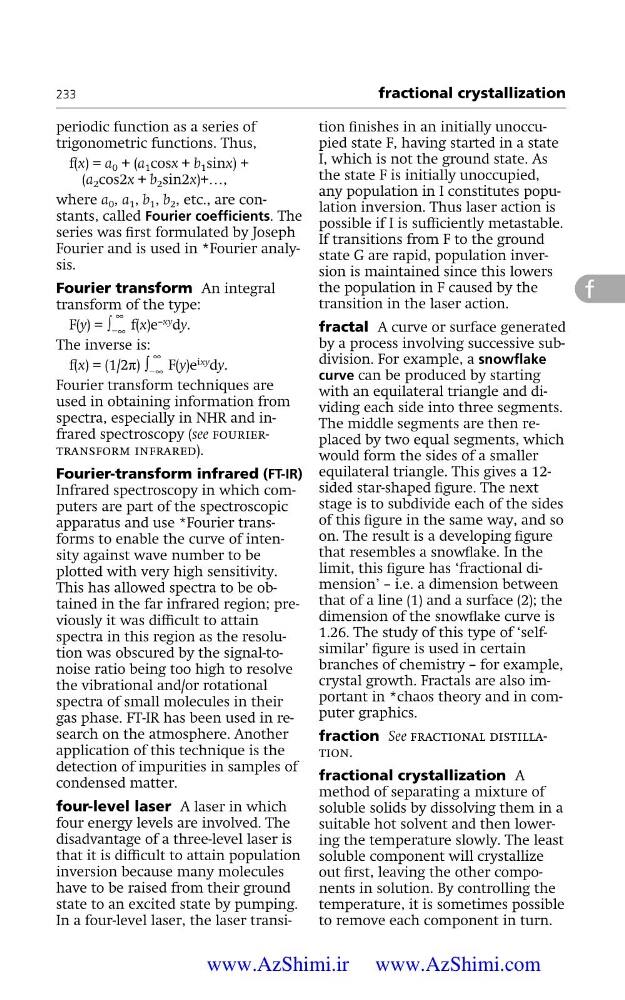
periodic function as a series of
trigonometric functions. Thus,
f(x) = a 0 + (a 1 cosx + b 1 sinx) +
(a 2 cos2x + b 2 sin2x)+…,
where a 0 , a 1 , b 1 , b 2 , etc., are constants, called Fourier coefÜcients. The
series was Ürst formulated by Joseph
Fourier and is used in *Fourier analysis.
Fourier transform An integral
transform of the type:
F(y) = ∫
∞
–∞ f(x)e
–xy
dy.
The inverse is:
f(x) = (1/2π) ∫
∞
–∞ F(y)e
ixy
dy.
Fourier transform techniques are
used in obtaining information from
spectra, especially in NHR and infrared spectroscopy (see fouriertransform infrared).
Fourier-transform infrared (FT-IR)
Infrared spectroscopy in which computers are part of the spectroscopic
apparatus and use *Fourier transforms to enable the curve of intensity against wave number to be
plotted with very high sensitivity.
This has allowed spectra to be obtained in the far infrared region; previously it was difÜcult to attain
spectra in this region as the resolution was obscured by the signal-tonoise ratio being too high to resolve
the vibrational and/or rotational
spectra of small molecules in their
gas phase. FT-IR has been used in research on the atmosphere. Another
application of this technique is the
detection of impurities in samples of
condensed matter.
four-level laser A laser in which
four energy levels are involved. The
disadvantage of a three-level laser is
that it is difÜcult to attain population
inversion because many molecules
have to be raised from their ground
state to an excited state by pumping.
In a four-level laser, the laser transition Ünishes in an initially unoccupied state F, having started in a state
I, which is not the ground state. As
the state F is initially unoccupied,
any population in I constitutes population inversion. Thus laser action is
possible if I is sufÜciently metastable.
If transitions from F to the ground
state G are rapid, population inversion is maintained since this lowers
the population in F caused by the
transition in the laser action.
fractal A curve or surface generated
by a process involving successive subdivision. For example, a snowÛake
curve can be produced by starting
with an equilateral triangle and dividing each side into three segments.
The middle segments are then replaced by two equal segments, which
would form the sides of a smaller
equilateral triangle. This gives a 12sided star-shaped Ügure. The next
stage is to subdivide each of the sides
of this Ügure in the same way, and so
on. The result is a developing Ügure
that resembles a snowÛake. In the
limit, this Ügure has ‘fractional dimension’ – i.e. a dimension between
that of a line (1) and a surface (2); the
dimension of the snowÛake curve is
1.26. The study of this type of ‘selfsimilar’ Ügure is used in certain
branches of chemistry – for example,
crystal growth. Fractals are also important in *chaos theory and in computer graphics.
fraction See fractional distillation.
fractional crystallization A
method of separating a mixture of
soluble solids by dissolving them in a
suitable hot solvent and then lowering the temperature slowly. The least
soluble component will crystallize
out Ürst, leaving the other components in solution. By controlling the
temperature, it is sometimes possible
to remove each component in turn.
233
fractional crystallization
f
www.AzShimi.ir www.AzShimi.com
trigonometric functions. Thus,
f(x) = a 0 + (a 1 cosx + b 1 sinx) +
(a 2 cos2x + b 2 sin2x)+…,
where a 0 , a 1 , b 1 , b 2 , etc., are constants, called Fourier coefÜcients. The
series was Ürst formulated by Joseph
Fourier and is used in *Fourier analysis.
Fourier transform An integral
transform of the type:
F(y) = ∫
∞
–∞ f(x)e
–xy
dy.
The inverse is:
f(x) = (1/2π) ∫
∞
–∞ F(y)e
ixy
dy.
Fourier transform techniques are
used in obtaining information from
spectra, especially in NHR and infrared spectroscopy (see fouriertransform infrared).
Fourier-transform infrared (FT-IR)
Infrared spectroscopy in which computers are part of the spectroscopic
apparatus and use *Fourier transforms to enable the curve of intensity against wave number to be
plotted with very high sensitivity.
This has allowed spectra to be obtained in the far infrared region; previously it was difÜcult to attain
spectra in this region as the resolution was obscured by the signal-tonoise ratio being too high to resolve
the vibrational and/or rotational
spectra of small molecules in their
gas phase. FT-IR has been used in research on the atmosphere. Another
application of this technique is the
detection of impurities in samples of
condensed matter.
four-level laser A laser in which
four energy levels are involved. The
disadvantage of a three-level laser is
that it is difÜcult to attain population
inversion because many molecules
have to be raised from their ground
state to an excited state by pumping.
In a four-level laser, the laser transition Ünishes in an initially unoccupied state F, having started in a state
I, which is not the ground state. As
the state F is initially unoccupied,
any population in I constitutes population inversion. Thus laser action is
possible if I is sufÜciently metastable.
If transitions from F to the ground
state G are rapid, population inversion is maintained since this lowers
the population in F caused by the
transition in the laser action.
fractal A curve or surface generated
by a process involving successive subdivision. For example, a snowÛake
curve can be produced by starting
with an equilateral triangle and dividing each side into three segments.
The middle segments are then replaced by two equal segments, which
would form the sides of a smaller
equilateral triangle. This gives a 12sided star-shaped Ügure. The next
stage is to subdivide each of the sides
of this Ügure in the same way, and so
on. The result is a developing Ügure
that resembles a snowÛake. In the
limit, this Ügure has ‘fractional dimension’ – i.e. a dimension between
that of a line (1) and a surface (2); the
dimension of the snowÛake curve is
1.26. The study of this type of ‘selfsimilar’ Ügure is used in certain
branches of chemistry – for example,
crystal growth. Fractals are also important in *chaos theory and in computer graphics.
fraction See fractional distillation.
fractional crystallization A
method of separating a mixture of
soluble solids by dissolving them in a
suitable hot solvent and then lowering the temperature slowly. The least
soluble component will crystallize
out Ürst, leaving the other components in solution. By controlling the
temperature, it is sometimes possible
to remove each component in turn.
233
fractional crystallization
f
www.AzShimi.ir www.AzShimi.com