

able it to be used as the basis of a
*temperature scale.
Ûagpole See ring conformations.
Ûame A hot luminous mixture of
gases undergoing combustion. The
chemical reactions in a Ûame are
mainly free-radical chain reactions
and the light comes from Ûuorescence of excited molecules or ions or
from incandescence of small solid
particles (e.g. carbon).
Ûame test A simple test for metals, in which a small amount of the
sample (usually moistened with hydrochloric acid) is placed on the end
of a platinum wire and held in a Bunsen Ûame. Certain metals can be detected by the colour produced:
barium (green), calcium (brick red),
lithium (crimson), potassium (lilac),
sodium (yellow), strontium (red).
Ûash photolysis A technique for
studying free-radical reactions in
gases. The apparatus used typically
consists of a long glass or quartz tube
holding the gas, with a lamp outside
the tube suitable for producing an intense Ûash of light. This dissociates
molecules in the sample creating free
radicals, which can be detected spectroscopically by a beam of light
passed down the axis of the tube. It is
possible to focus the spectrometer on
an absorption line for a particular
product and measure its change in
intensity with time using an oscilloscope. In this way the kinetics of very
fast free-radical gas reactions can be
studied.
Ûash point The temperature at
which the vapour above a volatile liquid forms a combustible mixture
with air. At the Ûash point the application of a naked Ûame gives a momentary Ûash rather than sustained
combustion, for which the temperature is too low.
Ûavin adenine dinucleotide See
fad.
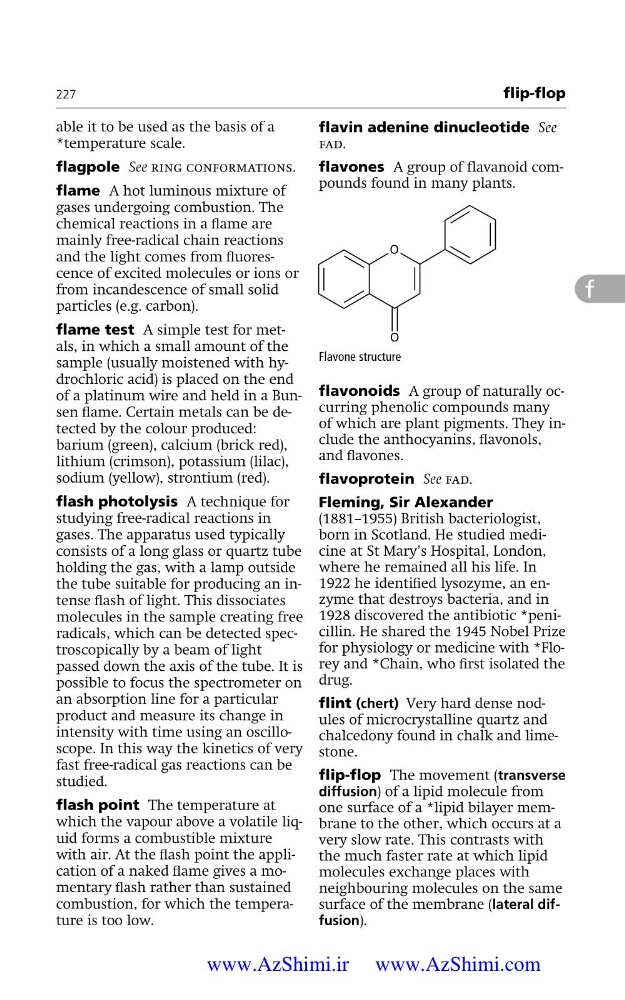
Ûavones A group of flavanoid compounds found in many plants.
227
flip-flop
f
O
O
Flavone structure
Ûavonoids A group of naturally occurring phenolic compounds many
of which are plant pigments. They include the anthocyanins, Ûavonols,
and Ûavones.
Ûavoprotein See fad.
Fleming, Sir Alexander
(1881–1955) British bacteriologist,
born in Scotland. He studied medicine at St Mary’s Hospital, London,
where he remained all his life. In
1922 he identiÜed lysozyme, an enzyme that destroys bacteria, and in
1928 discovered the antibiotic *penicillin. He shared the 1945 Nobel Prize
for physiology or medicine with *Florey and *Chain, who Ürst isolated the
drug.
Ûint (chert) Very hard dense nodules of microcrystalline quartz and
chalcedony found in chalk and limestone.
Ûip-Ûop The movement (transverse
diffusion) of a lipid molecule from
one surface of a *lipid bilayer membrane to the other, which occurs at a
very slow rate. This contrasts with
the much faster rate at which lipid
molecules exchange places with
neighbouring molecules on the same
surface of the membrane (lateral diffusion).
www.AzShimi.ir www.AzShimi.com
*temperature scale.
Ûagpole See ring conformations.
Ûame A hot luminous mixture of
gases undergoing combustion. The
chemical reactions in a Ûame are
mainly free-radical chain reactions
and the light comes from Ûuorescence of excited molecules or ions or
from incandescence of small solid
particles (e.g. carbon).
Ûame test A simple test for metals, in which a small amount of the
sample (usually moistened with hydrochloric acid) is placed on the end
of a platinum wire and held in a Bunsen Ûame. Certain metals can be detected by the colour produced:
barium (green), calcium (brick red),
lithium (crimson), potassium (lilac),
sodium (yellow), strontium (red).
Ûash photolysis A technique for
studying free-radical reactions in
gases. The apparatus used typically
consists of a long glass or quartz tube
holding the gas, with a lamp outside
the tube suitable for producing an intense Ûash of light. This dissociates
molecules in the sample creating free
radicals, which can be detected spectroscopically by a beam of light
passed down the axis of the tube. It is
possible to focus the spectrometer on
an absorption line for a particular
product and measure its change in
intensity with time using an oscilloscope. In this way the kinetics of very
fast free-radical gas reactions can be
studied.
Ûash point The temperature at
which the vapour above a volatile liquid forms a combustible mixture
with air. At the Ûash point the application of a naked Ûame gives a momentary Ûash rather than sustained
combustion, for which the temperature is too low.
Ûavin adenine dinucleotide See
fad.
Ûavones A group of flavanoid compounds found in many plants.
227
flip-flop
f
O
O
Flavone structure
Ûavonoids A group of naturally occurring phenolic compounds many
of which are plant pigments. They include the anthocyanins, Ûavonols,
and Ûavones.
Ûavoprotein See fad.
Fleming, Sir Alexander
(1881–1955) British bacteriologist,
born in Scotland. He studied medicine at St Mary’s Hospital, London,
where he remained all his life. In
1922 he identiÜed lysozyme, an enzyme that destroys bacteria, and in
1928 discovered the antibiotic *penicillin. He shared the 1945 Nobel Prize
for physiology or medicine with *Florey and *Chain, who Ürst isolated the
drug.
Ûint (chert) Very hard dense nodules of microcrystalline quartz and
chalcedony found in chalk and limestone.
Ûip-Ûop The movement (transverse
diffusion) of a lipid molecule from
one surface of a *lipid bilayer membrane to the other, which occurs at a
very slow rate. This contrasts with
the much faster rate at which lipid
molecules exchange places with
neighbouring molecules on the same
surface of the membrane (lateral diffusion).
www.AzShimi.ir www.AzShimi.com