

ergy bands), in insulators it lies in
the valence band, and in semiconductors it falls in the gap between
the conduction band and the valence
band. At absolute zero all the electrons would occupy energy levels up
to the Fermi level and no higher levels would be occupied. It is named
after the Italian-born US physicist Enrico Fermi (1901–54).
fermion An *elementary particle
(or bound state of an elementary particle, e.g. an atomic nucleus or an
atom) with half-integral spin; i.e.
a particle that conforms to Fermi–
Dirac statistics (see quantum statistics). Compare boson.
fermium Symbol Fm. A radioactive
metallic transuranic element belonging to the *actinoids; a.n. 100; mass
number of the most stable isotope
257 (half-life 10 days). Ten isotopes
are known. The element was Ürst
identiÜed by A. Ghiorso and associates in debris from the Ürst hydrogen-bomb explosion in 1952. It is
named after Enrico Fermi.
A
• Information from the WebElements site
ferrate An iron-containing anion,
FeO 4
2– . It exists only in strong alkaline solutions, in which it forms purple solutions.
ferric alum One of the *alums,
K 2 SO 4 .Fe 2 (SO 4 ) 3 .24H 2 O, in which the
aluminium ion Al
3+ is replaced by
the iron(III) (ferric) ion Fe
3+ .
ferric chloride test A *presumptive test for morphine. The reagent is
a 10% solution of ferric chloride
(iron(III) chloride, Fe Cl 3 ) in water.
With morphine a blue-green coloration occurs, changing to green.
ferric compounds Compounds of
iron in its +3 oxidation state; e.g. ferric chloride is iron(III) chloride, FeCl 3 .
ferricyanide A compound containing the complex ion [Fe(CN) 6 ]
3–
, i.e.
the hexacyanoferrate(III) ion.
ferrimagnetism See magnetism.
ferrite 1. A member of a class of
mixed oxides MO.Fe 2 O 3 , where M is a
metal such as cobalt, manganese,
nickel, or zinc. The ferrites are ceramic materials that show either ferrimagnetism or ferromagnetism, but
are not electrical conductors. For
this reason they are used in highfrequency circuits as magnetic cores.
2. See steel.
ferroalloys Alloys of iron with
other elements made by smelting
mixtures of iron ore and the metal
ore; e.g. ferrochromium, ferrovanadium, ferromanganese, ferrosilicon,
etc. They are used in making alloy
*steels.
ferrocene An orange-red crystalline solid, Fe(C 5 H 5 ) 2 ; m.p. 173°C. It
can be made by adding the ionic
compound Na
+ C 5 H 5
– (cyclopentadienyl sodium, made from sodium and
cyclopentadiene) to iron(III) chloride.
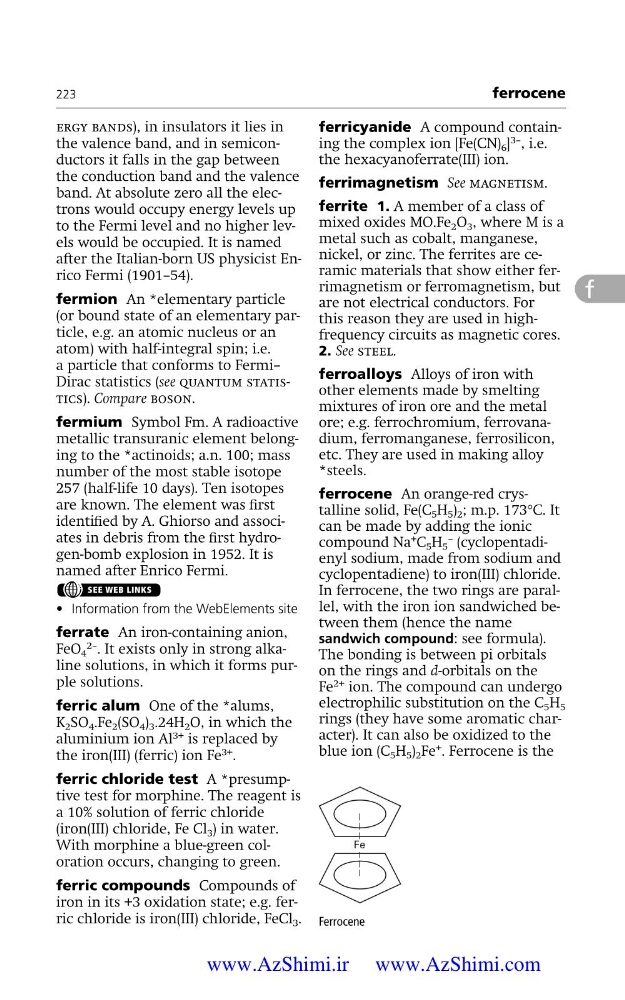
In ferrocene, the two rings are parallel, with the iron ion sandwiched between them (hence the name
sandwich compound: see formula).
The bonding is between pi orbitals
on the rings and d-orbitals on the
Fe
2+ ion. The compound can undergo
electrophilic substitution on the C 5 H 5
rings (they have some aromatic character). It can also be oxidized to the
blue ion (C 5 H 5 ) 2 Fe
+
. Ferrocene is the
223
ferrocene
f
Fe
Ferrocene
www.AzShimi.ir www.AzShimi.com
the valence band, and in semiconductors it falls in the gap between
the conduction band and the valence
band. At absolute zero all the electrons would occupy energy levels up
to the Fermi level and no higher levels would be occupied. It is named
after the Italian-born US physicist Enrico Fermi (1901–54).
fermion An *elementary particle
(or bound state of an elementary particle, e.g. an atomic nucleus or an
atom) with half-integral spin; i.e.
a particle that conforms to Fermi–
Dirac statistics (see quantum statistics). Compare boson.
fermium Symbol Fm. A radioactive
metallic transuranic element belonging to the *actinoids; a.n. 100; mass
number of the most stable isotope
257 (half-life 10 days). Ten isotopes
are known. The element was Ürst
identiÜed by A. Ghiorso and associates in debris from the Ürst hydrogen-bomb explosion in 1952. It is
named after Enrico Fermi.
A
• Information from the WebElements site
ferrate An iron-containing anion,
FeO 4
2– . It exists only in strong alkaline solutions, in which it forms purple solutions.
ferric alum One of the *alums,
K 2 SO 4 .Fe 2 (SO 4 ) 3 .24H 2 O, in which the
aluminium ion Al
3+ is replaced by
the iron(III) (ferric) ion Fe
3+ .
ferric chloride test A *presumptive test for morphine. The reagent is
a 10% solution of ferric chloride
(iron(III) chloride, Fe Cl 3 ) in water.
With morphine a blue-green coloration occurs, changing to green.
ferric compounds Compounds of
iron in its +3 oxidation state; e.g. ferric chloride is iron(III) chloride, FeCl 3 .
ferricyanide A compound containing the complex ion [Fe(CN) 6 ]
3–
, i.e.
the hexacyanoferrate(III) ion.
ferrimagnetism See magnetism.
ferrite 1. A member of a class of
mixed oxides MO.Fe 2 O 3 , where M is a
metal such as cobalt, manganese,
nickel, or zinc. The ferrites are ceramic materials that show either ferrimagnetism or ferromagnetism, but
are not electrical conductors. For
this reason they are used in highfrequency circuits as magnetic cores.
2. See steel.
ferroalloys Alloys of iron with
other elements made by smelting
mixtures of iron ore and the metal
ore; e.g. ferrochromium, ferrovanadium, ferromanganese, ferrosilicon,
etc. They are used in making alloy
*steels.
ferrocene An orange-red crystalline solid, Fe(C 5 H 5 ) 2 ; m.p. 173°C. It
can be made by adding the ionic
compound Na
+ C 5 H 5
– (cyclopentadienyl sodium, made from sodium and
cyclopentadiene) to iron(III) chloride.
In ferrocene, the two rings are parallel, with the iron ion sandwiched between them (hence the name
sandwich compound: see formula).
The bonding is between pi orbitals
on the rings and d-orbitals on the
Fe
2+ ion. The compound can undergo
electrophilic substitution on the C 5 H 5
rings (they have some aromatic character). It can also be oxidized to the
blue ion (C 5 H 5 ) 2 Fe
+
. Ferrocene is the
223
ferrocene
f
Fe
Ferrocene
www.AzShimi.ir www.AzShimi.com