

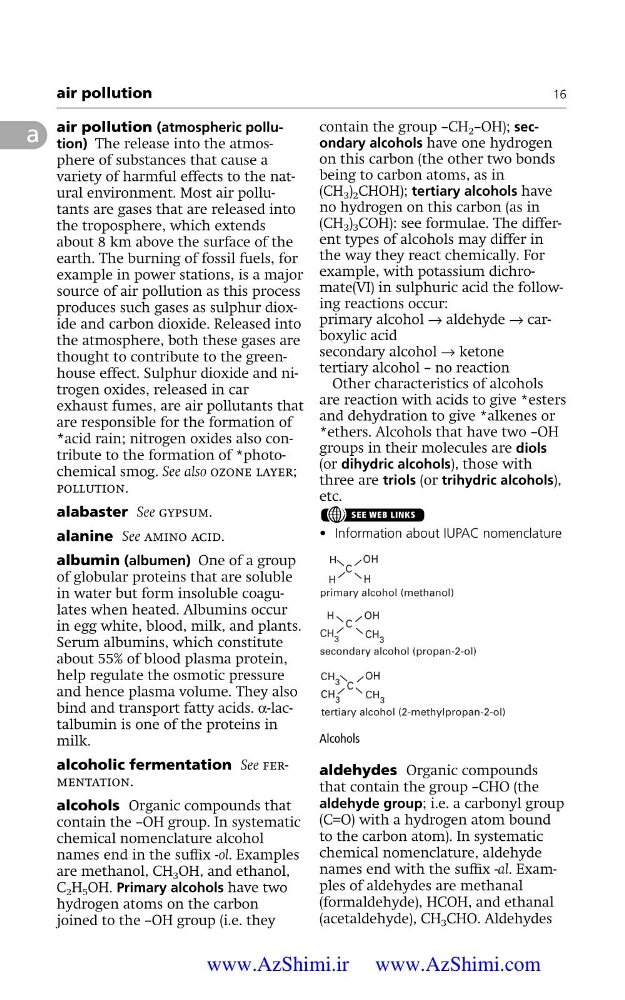
air pollution (atmospheric pollution) The release into the atmosphere of substances that cause a
variety of harmful effects to the natural environment. Most air pollutants are gases that are released into
the troposphere, which extends
about 8 km above the surface of the
earth. The burning of fossil fuels, for
example in power stations, is a major
source of air pollution as this process
produces such gases as sulphur dioxide and carbon dioxide. Released into
the atmosphere, both these gases are
thought to contribute to the greenhouse effect. Sulphur dioxide and nitrogen oxides, released in car
exhaust fumes, are air pollutants that
are responsible for the formation of
*acid rain; nitrogen oxides also contribute to the formation of *photochemical smog. See also ozone layer;
pollution.
alabaster See gypsum.
alanine See amino acid.
albumin (albumen) One of a group
of globular proteins that are soluble
in water but form insoluble coagulates when heated. Albumins occur
in egg white, blood, milk, and plants.
Serum albumins, which constitute
about 55% of blood plasma protein,
help regulate the osmotic pressure
and hence plasma volume. They also
bind and transport fatty acids. α-lactalbumin is one of the proteins in
milk.
alcoholic fermentation See fermentation.
alcohols Organic compounds that
contain the –OH group. In systematic
chemical nomenclature alcohol
names end in the sufÜx -ol. Examples
are methanol, CH 3 OH, and ethanol,
C 2 H 5 OH. Primary alcohols have two
hydrogen atoms on the carbon
joined to the –OH group (i.e. they
contain the group –CH 2 –OH); secondary alcohols have one hydrogen
on this carbon (the other two bonds
being to carbon atoms, as in
(CH 3 ) 2 CHOH); tertiary alcohols have
no hydrogen on this carbon (as in
(CH 3 ) 3 COH): see formulae. The different types of alcohols may differ in
the way they react chemically. For
example, with potassium dichromate(VI) in sulphuric acid the following reactions occur:
primary alcohol → aldehyde → carboxylic acid
secondary alcohol → ketone
tertiary alcohol – no reaction
Other characteristics of alcohols
are reaction with acids to give *esters
and dehydration to give *alkenes or
*ethers. Alcohols that have two –OH
groups in their molecules are diols
(or dihydric alcohols), those with
three are triols (or trihydric alcohols),
etc.
A
• Information about IUPAC nomenclature
air pollution
16
a
H
H
H
C
OH
H
C
CH 3
CH 3
OH
C
OH
tertiary alcohol (2-methylpropan-2-ol)
_
_
_
_
_
_
_
_
_
_ _
_
primary alcohol (methanol)
secondary alcohol (propan-2-ol)
CH 3
CH 3
CH 3
Alcohols
aldehydes Organic compounds
that contain the group –CHO (the
aldehyde group; i.e. a carbonyl group
(C=O) with a hydrogen atom bound
to the carbon atom). In systematic
chemical nomenclature, aldehyde
names end with the sufÜx -al. Examples of aldehydes are methanal
(formaldehyde), HCOH, and ethanal
(acetaldehyde), CH 3 CHO. Aldehydes
www.AzShimi.ir www.AzShimi.com
variety of harmful effects to the natural environment. Most air pollutants are gases that are released into
the troposphere, which extends
about 8 km above the surface of the
earth. The burning of fossil fuels, for
example in power stations, is a major
source of air pollution as this process
produces such gases as sulphur dioxide and carbon dioxide. Released into
the atmosphere, both these gases are
thought to contribute to the greenhouse effect. Sulphur dioxide and nitrogen oxides, released in car
exhaust fumes, are air pollutants that
are responsible for the formation of
*acid rain; nitrogen oxides also contribute to the formation of *photochemical smog. See also ozone layer;
pollution.
alabaster See gypsum.
alanine See amino acid.
albumin (albumen) One of a group
of globular proteins that are soluble
in water but form insoluble coagulates when heated. Albumins occur
in egg white, blood, milk, and plants.
Serum albumins, which constitute
about 55% of blood plasma protein,
help regulate the osmotic pressure
and hence plasma volume. They also
bind and transport fatty acids. α-lactalbumin is one of the proteins in
milk.
alcoholic fermentation See fermentation.
alcohols Organic compounds that
contain the –OH group. In systematic
chemical nomenclature alcohol
names end in the sufÜx -ol. Examples
are methanol, CH 3 OH, and ethanol,
C 2 H 5 OH. Primary alcohols have two
hydrogen atoms on the carbon
joined to the –OH group (i.e. they
contain the group –CH 2 –OH); secondary alcohols have one hydrogen
on this carbon (the other two bonds
being to carbon atoms, as in
(CH 3 ) 2 CHOH); tertiary alcohols have
no hydrogen on this carbon (as in
(CH 3 ) 3 COH): see formulae. The different types of alcohols may differ in
the way they react chemically. For
example, with potassium dichromate(VI) in sulphuric acid the following reactions occur:
primary alcohol → aldehyde → carboxylic acid
secondary alcohol → ketone
tertiary alcohol – no reaction
Other characteristics of alcohols
are reaction with acids to give *esters
and dehydration to give *alkenes or
*ethers. Alcohols that have two –OH
groups in their molecules are diols
(or dihydric alcohols), those with
three are triols (or trihydric alcohols),
etc.
A
• Information about IUPAC nomenclature
air pollution
16
a
H
H
H
C
OH
H
C
CH 3
CH 3
OH
C
OH
tertiary alcohol (2-methylpropan-2-ol)
_
_
_
_
_
_
_
_
_
_ _
_
primary alcohol (methanol)
secondary alcohol (propan-2-ol)
CH 3
CH 3
CH 3
Alcohols
aldehydes Organic compounds
that contain the group –CHO (the
aldehyde group; i.e. a carbonyl group
(C=O) with a hydrogen atom bound
to the carbon atom). In systematic
chemical nomenclature, aldehyde
names end with the sufÜx -al. Examples of aldehydes are methanal
(formaldehyde), HCOH, and ethanal
(acetaldehyde), CH 3 CHO. Aldehydes
www.AzShimi.ir www.AzShimi.com