

divided by an arbitrary extensive
variable, such as the volume, an *intensive variable results. A macroscopic system can be described by
one extensive variable and a set of intensive variables.
external conversion A process in
which molecules in electronically excited states pass to a lower electronic
state (which is frequently the ground
state) by colliding with other molecules. In this process the electronic
217
external conversion
e
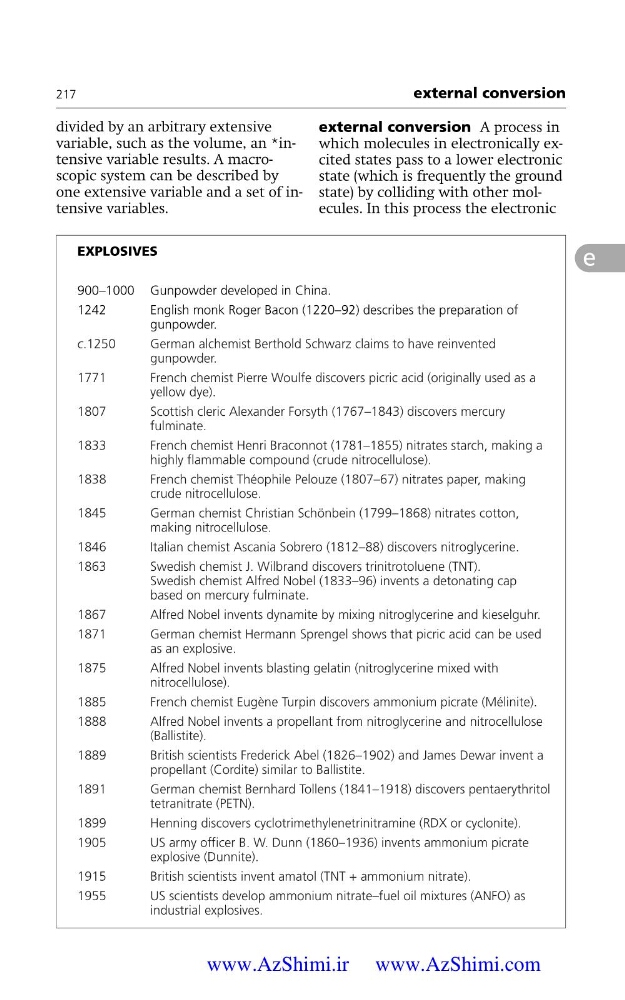
EXPLOSIVES
900–1000 Gunpowder developed in China.
1242
English monk Roger Bacon (1220–92) describes the preparation of
gunpowder.
c.1250
German alchemist Berthold Schwarz claims to have reinvented
gunpowder.
1771
French chemist Pierre Woulfe discovers picric acid (originally used as a
yellow dye).
1807
Scottish cleric Alexander Forsyth (1767–1843) discovers mercury
fulminate.
1833
French chemist Henri Braconnot (1781–1855) nitrates starch, making a
highly flammable compound (crude nitrocellulose).
1838
French chemist Théophile Pelouze (1807–67) nitrates paper, making
crude nitrocellulose.
1845
German chemist Christian Schönbein (1799–1868) nitrates cotton,
making nitrocellulose.
1846
Italian chemist Ascania Sobrero (1812–88) discovers nitroglycerine.
1863
Swedish chemist J. Wilbrand discovers trinitrotoluene (TNT).
Swedish chemist Alfred Nobel (1833–96) invents a detonating cap
based on mercury fulminate.
1867
Alfred Nobel invents dynamite by mixing nitroglycerine and kieselguhr.
1871
German chemist Hermann Sprengel shows that picric acid can be used
as an explosive.
1875
Alfred Nobel invents blasting gelatin (nitroglycerine mixed with
nitrocellulose).
1885
French chemist Eugène Turpin discovers ammonium picrate (Mélinite).
1888
Alfred Nobel invents a propellant from nitroglycerine and nitrocellulose
(Ballistite).
1889
British scientists Frederick Abel (1826–1902) and James Dewar invent a
propellant (Cordite) similar to Ballistite.
1891
German chemist Bernhard Tollens (1841–1918) discovers pentaerythritol
tetranitrate (PETN).
1899
Henning discovers cyclotrimethylenetrinitramine (RDX or cyclonite).
1905
US army officer B. W. Dunn (1860–1936) invents ammonium picrate
explosive (Dunnite).
1915
British scientists invent amatol (TNT + ammonium nitrate).
1955
US scientists develop ammonium nitrate–fuel oil mixtures (ANFO) as
industrial explosives.
www.AzShimi.ir www.AzShimi.com
variable, such as the volume, an *intensive variable results. A macroscopic system can be described by
one extensive variable and a set of intensive variables.
external conversion A process in
which molecules in electronically excited states pass to a lower electronic
state (which is frequently the ground
state) by colliding with other molecules. In this process the electronic
217
external conversion
e
EXPLOSIVES
900–1000 Gunpowder developed in China.
1242
English monk Roger Bacon (1220–92) describes the preparation of
gunpowder.
c.1250
German alchemist Berthold Schwarz claims to have reinvented
gunpowder.
1771
French chemist Pierre Woulfe discovers picric acid (originally used as a
yellow dye).
1807
Scottish cleric Alexander Forsyth (1767–1843) discovers mercury
fulminate.
1833
French chemist Henri Braconnot (1781–1855) nitrates starch, making a
highly flammable compound (crude nitrocellulose).
1838
French chemist Théophile Pelouze (1807–67) nitrates paper, making
crude nitrocellulose.
1845
German chemist Christian Schönbein (1799–1868) nitrates cotton,
making nitrocellulose.
1846
Italian chemist Ascania Sobrero (1812–88) discovers nitroglycerine.
1863
Swedish chemist J. Wilbrand discovers trinitrotoluene (TNT).
Swedish chemist Alfred Nobel (1833–96) invents a detonating cap
based on mercury fulminate.
1867
Alfred Nobel invents dynamite by mixing nitroglycerine and kieselguhr.
1871
German chemist Hermann Sprengel shows that picric acid can be used
as an explosive.
1875
Alfred Nobel invents blasting gelatin (nitroglycerine mixed with
nitrocellulose).
1885
French chemist Eugène Turpin discovers ammonium picrate (Mélinite).
1888
Alfred Nobel invents a propellant from nitroglycerine and nitrocellulose
(Ballistite).
1889
British scientists Frederick Abel (1826–1902) and James Dewar invent a
propellant (Cordite) similar to Ballistite.
1891
German chemist Bernhard Tollens (1841–1918) discovers pentaerythritol
tetranitrate (PETN).
1899
Henning discovers cyclotrimethylenetrinitramine (RDX or cyclonite).
1905
US army officer B. W. Dunn (1860–1936) invents ammonium picrate
explosive (Dunnite).
1915
British scientists invent amatol (TNT + ammonium nitrate).
1955
US scientists develop ammonium nitrate–fuel oil mixtures (ANFO) as
industrial explosives.
www.AzShimi.ir www.AzShimi.com