

duce fragment ions in electronimpact impact ionization sources.
The sample is dissolved in a volatile
solvent, which may also contain
volatile acids or bases so that the
sample exists in an ionic form. The
solution is forced through a charged
metal capillary tube and forms an
aerosol. Evaporation of the solvent
results in single ions of the sample,
which are analyzed by the mass spectrometer. Electrospray ionization is
the ionization technique often used
in chromatography–mass spectrometry.
electrovalent bond See chemical
bond.
electrum 1. An alloy of gold and
silver containing 55–88% of gold.
2. A *German silver alloy containing
52% copper, 26% nickel, and 22%
zinc.
element A substance that cannot
be decomposed into simpler substances. In an element, all the atoms
have the same number of protons or
electrons, although the number of
neutrons may vary. There are 92
naturally occurring elements. See
also periodic table; transuranic elements; transactinide elements.
elementary particle One of the
fundamental particles of which matter is composed, such as the electron,
proton, or neutron.
elementary reaction A reaction
with no intermediates; i.e. one that
takes place in a single step with a single transition state.
elevation of boiling point An increase in the boiling point of a liquid
when a solid is dissolved in it. The elevation is proportional to the number of particles dissolved (molecules
or ions) and is given by ∆t = k B C,
where C is the molal concentration
of solute. The constant k B is the ebullioscopic constant of the solvent and
if this is known, the molecular
weight of the solute can be calculated from the measured value of ∆t.
The elevation is measured by a Beckmann thermometer. See also colligative properties.
elimination reaction A reaction
in which one molecule decomposes
into two, one much smaller than the
other.
Elinvar Trade name for a nickel–
chromium steel containing about
36% nickel, 12% chromium, and
smaller proportions of tungsten and
manganese. Its elasticity does not
vary with temperature and it is
therefore used to make hairsprings
for watches.
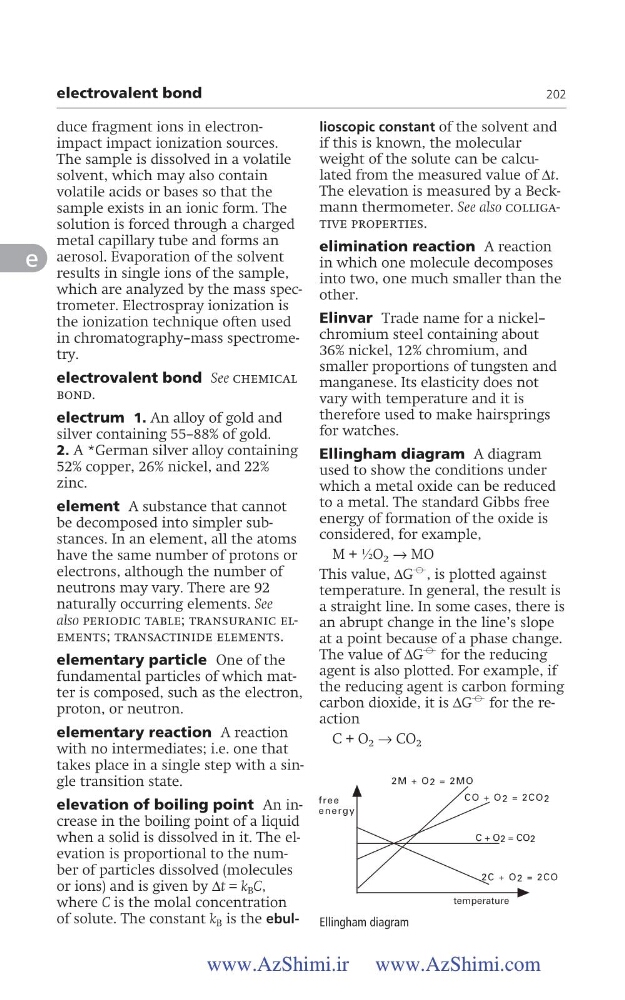
Ellingham diagram A diagram
used to show the conditions under
which a metal oxide can be reduced
to a metal. The standard Gibbs free
energy of formation of the oxide is
considered, for example,
M + ½O 2 → MO
This value, ∆GŠ, is plotted against
temperature. In general, the result is
a straight line. In some cases, there is
an abrupt change in the line’s slope
at a point because of a phase change.
The value of ∆GŠ for the reducing
agent is also plotted. For example, if
the reducing agent is carbon forming
carbon dioxide, it is ∆GŠ for the reaction
C + O 2 → CO 2
electrovalent bond
202
e
temperature
C + O2 = CO2
2M + O2 = 2MO
CO + O2 = 2CO2
2C + O2 = 2CO
free
energy
Ellingham diagram
www.AzShimi.ir www.AzShimi.com
The sample is dissolved in a volatile
solvent, which may also contain
volatile acids or bases so that the
sample exists in an ionic form. The
solution is forced through a charged
metal capillary tube and forms an
aerosol. Evaporation of the solvent
results in single ions of the sample,
which are analyzed by the mass spectrometer. Electrospray ionization is
the ionization technique often used
in chromatography–mass spectrometry.
electrovalent bond See chemical
bond.
electrum 1. An alloy of gold and
silver containing 55–88% of gold.
2. A *German silver alloy containing
52% copper, 26% nickel, and 22%
zinc.
element A substance that cannot
be decomposed into simpler substances. In an element, all the atoms
have the same number of protons or
electrons, although the number of
neutrons may vary. There are 92
naturally occurring elements. See
also periodic table; transuranic elements; transactinide elements.
elementary particle One of the
fundamental particles of which matter is composed, such as the electron,
proton, or neutron.
elementary reaction A reaction
with no intermediates; i.e. one that
takes place in a single step with a single transition state.
elevation of boiling point An increase in the boiling point of a liquid
when a solid is dissolved in it. The elevation is proportional to the number of particles dissolved (molecules
or ions) and is given by ∆t = k B C,
where C is the molal concentration
of solute. The constant k B is the ebullioscopic constant of the solvent and
if this is known, the molecular
weight of the solute can be calculated from the measured value of ∆t.
The elevation is measured by a Beckmann thermometer. See also colligative properties.
elimination reaction A reaction
in which one molecule decomposes
into two, one much smaller than the
other.
Elinvar Trade name for a nickel–
chromium steel containing about
36% nickel, 12% chromium, and
smaller proportions of tungsten and
manganese. Its elasticity does not
vary with temperature and it is
therefore used to make hairsprings
for watches.
Ellingham diagram A diagram
used to show the conditions under
which a metal oxide can be reduced
to a metal. The standard Gibbs free
energy of formation of the oxide is
considered, for example,
M + ½O 2 → MO
This value, ∆GŠ, is plotted against
temperature. In general, the result is
a straight line. In some cases, there is
an abrupt change in the line’s slope
at a point because of a phase change.
The value of ∆GŠ for the reducing
agent is also plotted. For example, if
the reducing agent is carbon forming
carbon dioxide, it is ∆GŠ for the reaction
C + O 2 → CO 2
electrovalent bond
202
e
temperature
C + O2 = CO2
2M + O2 = 2MO
CO + O2 = 2CO2
2C + O2 = 2CO
free
energy
Ellingham diagram
www.AzShimi.ir www.AzShimi.com