

Ürst sheet in the solution. In the
Helmholtz model the double layer is
regarded as consisting of two planes
of charge, with the inner plane of
ions from the solution being caused
by the charge on the electrode and
the outer plane being caused by oppositely charged ions in the solution
responding to the Ürst layer of ions.
In the *Gouy–Chapman model (diffuse double layer) thermal motion of
ions is taken into account. Neither
model is completely successful since
the Helmholtz model exaggerates the
rigidity of the structure of the
charges and the Gouy–Chapman
model underestimates the rigidity of
the structure. The Stern model improves on both models by assuming
that the ions next to the electrode
have a rigid structure, while taking
the second layer to be as described
by the Gouy–Chapman model.
electric-arc furnace A furnace
used in melting metals to make alloys, especially in steel manufacture,
in which the heat source is an electric arc. In the direct-arc furnace,
such as the Héroult furnace, an arc is
formed between the metal and an
electrode. In the indirect-arc furnace,
such as the Stassano furnace, the arc
is formed between two electrodes
and the heat is radiated onto the
metal.
electrochemical cell See cell.
electrochemical equivalent
Symbol z. The mass of a given element liberated from a solution of its
ions in electrolysis by one coulomb
of charge. See faraday’s laws.
electrochemical series See electromotive series.
electrochemistry The study of
chemical properties and reactions involving ions in solution, including
electrolysis and electric cells.
electrochromatography See electrophoresis.
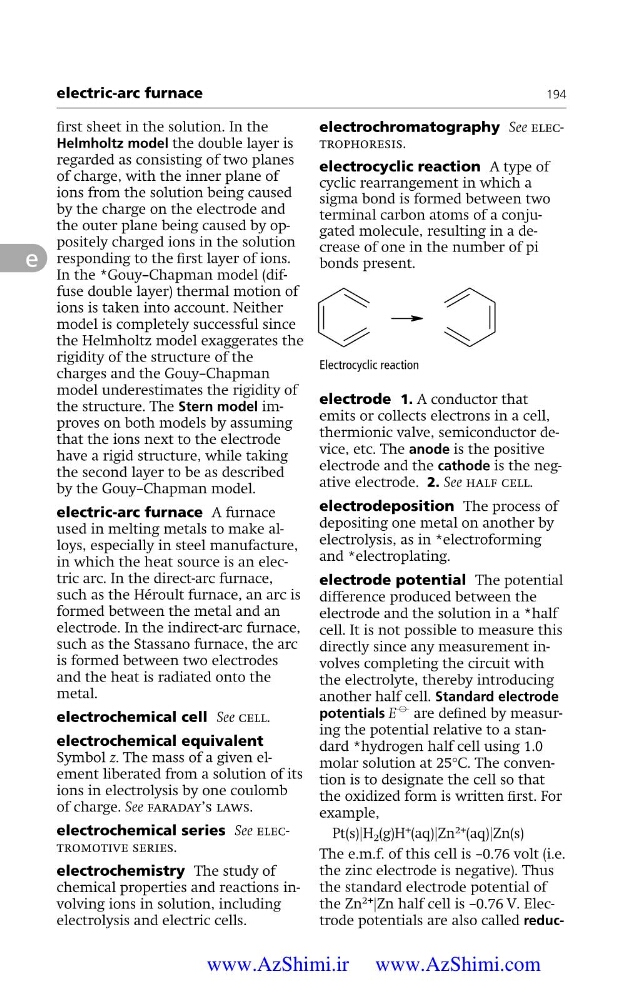
electrocyclic reaction A type of
cyclic rearrangement in which a
sigma bond is formed between two
terminal carbon atoms of a conjugated molecule, resulting in a decrease of one in the number of pi
bonds present.
electric-arc furnace
194
e
Electrocyclic reaction
electrode 1. A conductor that
emits or collects electrons in a cell,
thermionic valve, semiconductor device, etc. The anode is the positive
electrode and the cathode is the negative electrode. 2. See half cell.
electrodeposition The process of
depositing one metal on another by
electrolysis, as in *electroforming
and *electroplating.
electrode potential The potential
difference produced between the
electrode and the solution in a *half
cell. It is not possible to measure this
directly since any measurement involves completing the circuit with
the electrolyte, thereby introducing
another half cell. Standard electrode
potentials EŠ are deÜned by measuring the potential relative to a standard *hydrogen half cell using 1.0
molar solution at 25°C. The convention is to designate the cell so that
the oxidized form is written Ürst. For
example,
Pt(s)|H 2 (g)H
+ (aq)|Zn
2+ (aq)|Zn(s)
The e.m.f. of this cell is –0.76 volt (i.e.
the zinc electrode is negative). Thus
the standard electrode potential of
the Zn
2+ |Zn half cell is –0.76 V. Electrode potentials are also called reducwww.AzShimi.ir www.AzShimi.com
Helmholtz model the double layer is
regarded as consisting of two planes
of charge, with the inner plane of
ions from the solution being caused
by the charge on the electrode and
the outer plane being caused by oppositely charged ions in the solution
responding to the Ürst layer of ions.
In the *Gouy–Chapman model (diffuse double layer) thermal motion of
ions is taken into account. Neither
model is completely successful since
the Helmholtz model exaggerates the
rigidity of the structure of the
charges and the Gouy–Chapman
model underestimates the rigidity of
the structure. The Stern model improves on both models by assuming
that the ions next to the electrode
have a rigid structure, while taking
the second layer to be as described
by the Gouy–Chapman model.
electric-arc furnace A furnace
used in melting metals to make alloys, especially in steel manufacture,
in which the heat source is an electric arc. In the direct-arc furnace,
such as the Héroult furnace, an arc is
formed between the metal and an
electrode. In the indirect-arc furnace,
such as the Stassano furnace, the arc
is formed between two electrodes
and the heat is radiated onto the
metal.
electrochemical cell See cell.
electrochemical equivalent
Symbol z. The mass of a given element liberated from a solution of its
ions in electrolysis by one coulomb
of charge. See faraday’s laws.
electrochemical series See electromotive series.
electrochemistry The study of
chemical properties and reactions involving ions in solution, including
electrolysis and electric cells.
electrochromatography See electrophoresis.
electrocyclic reaction A type of
cyclic rearrangement in which a
sigma bond is formed between two
terminal carbon atoms of a conjugated molecule, resulting in a decrease of one in the number of pi
bonds present.
electric-arc furnace
194
e
Electrocyclic reaction
electrode 1. A conductor that
emits or collects electrons in a cell,
thermionic valve, semiconductor device, etc. The anode is the positive
electrode and the cathode is the negative electrode. 2. See half cell.
electrodeposition The process of
depositing one metal on another by
electrolysis, as in *electroforming
and *electroplating.
electrode potential The potential
difference produced between the
electrode and the solution in a *half
cell. It is not possible to measure this
directly since any measurement involves completing the circuit with
the electrolyte, thereby introducing
another half cell. Standard electrode
potentials EŠ are deÜned by measuring the potential relative to a standard *hydrogen half cell using 1.0
molar solution at 25°C. The convention is to designate the cell so that
the oxidized form is written Ürst. For
example,
Pt(s)|H 2 (g)H
+ (aq)|Zn
2+ (aq)|Zn(s)
The e.m.f. of this cell is –0.76 volt (i.e.
the zinc electrode is negative). Thus
the standard electrode potential of
the Zn
2+ |Zn half cell is –0.76 V. Electrode potentials are also called reducwww.AzShimi.ir www.AzShimi.com