

E
EAC Emergency action code. See
hazchem code.
Earnshaw’s theorem The principle that a system of particles interacting via an inverse square law, such as
Coulomb’s law of electrostatics, cannot exist in a state of static equilibrium. The Reverend Samuel
Earnshaw (1805–88) proved this result in 1842. The theorem is of fundamental importance in chemistry
since it shows that it is not possible
to construct a correct model of atoms
and molecules if the electrons are
taken to be stationary.
earth The planet that orbits the sun
between the planets Venus and Mars.
The earth consists of three layers: the
gaseous atmosphere (see earth’s atmosphere), the liquid hydrosphere,
and the solid lithosphere. The solid
part of the earth also consists of
three layers: the crust with a mean
thickness of about 32 km under the
land and 10 km under the seas; the
mantle, which extends some
2900 km below the crust; and the
core, part of which is believed to be
liquid. The composition of the crust
is: oxygen 47%, silicon 28%, aluminium 8%, iron 4.5%, calcium 3.5%,
sodium and potassium 2.5% each,
and magnesium 2.2%. Hydrogen,
carbon, phosphorus, and sulphur are
all present to an extent of less than
1%.
earth’s atmosphere The gas that
surrounds the earth. The composition of dry air at sea level is: nitrogen
78.08%, oxygen 20.95%, argon 0.93%,
carbon dioxide 0.03%, neon 0.0018%,
helium 0.0005%, krypton 0.0001%,
and xenon 0.00001%. In addition to
water vapour, air in some localities
contains sulphur compounds, hydrogen peroxide, hydrocarbons, and
dust particles.
ebonite See vulcanite.
ebullioscopic constant See elevation of boiling point.
ebullioscopy The use of *elevation
of boiling point to determine relative
molecular masses.
echelon A form of interferometer
consisting of a stack of glass plates
arranged stepwise with a constant
offset. It gives a high resolution and
is used in spectroscopy to study
hyperÜne line structure.
eclipsed See conformation.
eclipsed conformation See conformation.
eclipsing See conformation.
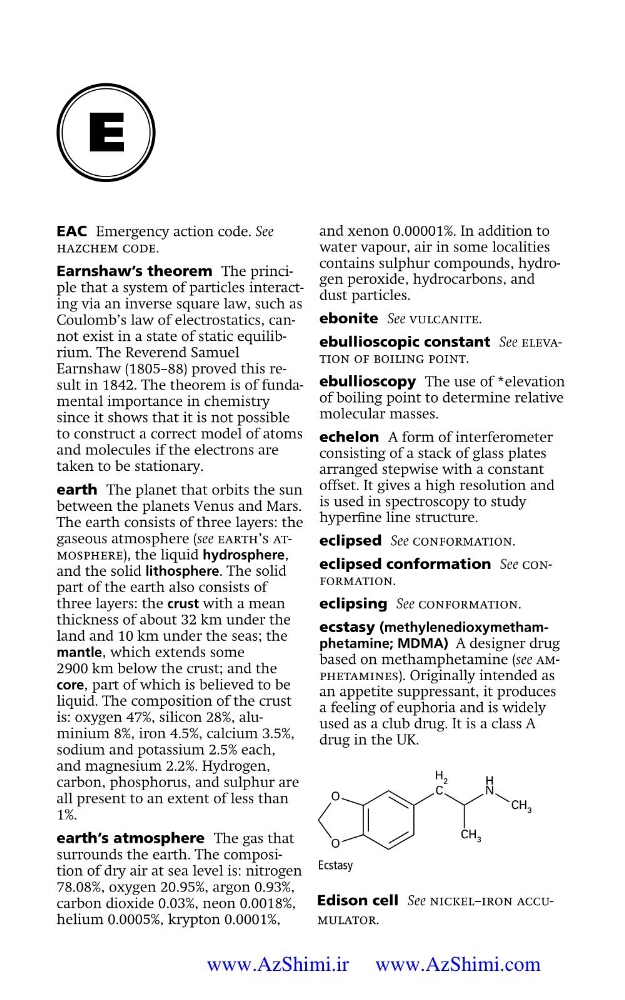
ecstasy (methylenedioxymethamphetamine; MDMA) A designer drug
based on methamphetamine (see amphetamines). Originally intended as
an appetite suppressant, it produces
a feeling of euphoria and is widely
used as a club drug. It is a class A
drug in the UK.
O
O
C
H 2
N
H
CH 3
CH 3
Ecstasy
Edison cell See nickel–iron accumulator.
www.AzShimi.ir www.AzShimi.com
EAC Emergency action code. See
hazchem code.
Earnshaw’s theorem The principle that a system of particles interacting via an inverse square law, such as
Coulomb’s law of electrostatics, cannot exist in a state of static equilibrium. The Reverend Samuel
Earnshaw (1805–88) proved this result in 1842. The theorem is of fundamental importance in chemistry
since it shows that it is not possible
to construct a correct model of atoms
and molecules if the electrons are
taken to be stationary.
earth The planet that orbits the sun
between the planets Venus and Mars.
The earth consists of three layers: the
gaseous atmosphere (see earth’s atmosphere), the liquid hydrosphere,
and the solid lithosphere. The solid
part of the earth also consists of
three layers: the crust with a mean
thickness of about 32 km under the
land and 10 km under the seas; the
mantle, which extends some
2900 km below the crust; and the
core, part of which is believed to be
liquid. The composition of the crust
is: oxygen 47%, silicon 28%, aluminium 8%, iron 4.5%, calcium 3.5%,
sodium and potassium 2.5% each,
and magnesium 2.2%. Hydrogen,
carbon, phosphorus, and sulphur are
all present to an extent of less than
1%.
earth’s atmosphere The gas that
surrounds the earth. The composition of dry air at sea level is: nitrogen
78.08%, oxygen 20.95%, argon 0.93%,
carbon dioxide 0.03%, neon 0.0018%,
helium 0.0005%, krypton 0.0001%,
and xenon 0.00001%. In addition to
water vapour, air in some localities
contains sulphur compounds, hydrogen peroxide, hydrocarbons, and
dust particles.
ebonite See vulcanite.
ebullioscopic constant See elevation of boiling point.
ebullioscopy The use of *elevation
of boiling point to determine relative
molecular masses.
echelon A form of interferometer
consisting of a stack of glass plates
arranged stepwise with a constant
offset. It gives a high resolution and
is used in spectroscopy to study
hyperÜne line structure.
eclipsed See conformation.
eclipsed conformation See conformation.
eclipsing See conformation.
ecstasy (methylenedioxymethamphetamine; MDMA) A designer drug
based on methamphetamine (see amphetamines). Originally intended as
an appetite suppressant, it produces
a feeling of euphoria and is widely
used as a club drug. It is a class A
drug in the UK.
O
O
C
H 2
N
H
CH 3
CH 3
Ecstasy
Edison cell See nickel–iron accumulator.
www.AzShimi.ir www.AzShimi.com