

moment is a measure of the polar nature of the bond (see polar molecule); i.e. the extent to which the
average electron charge is displaced
towards one atom (in the case of HCl,
the electrons are attracted towards
the more electronegative chlorine
atom). In a polyatomic molecule, the
dipole moment is the vector sum of
the dipole moments of the individual
bonds. In a symmetrical molecule,
such as tetrachloromethane (CCl 4 ),
there is no overall dipole moment, although the individual C–Cl bonds are
polar.
dipole–dipole interaction The
interaction of two systems, such as
atoms or molecules, by their *dipole
moments. The energy of dipole–
dipole interaction depends on the
relative orientation and the strength
of the dipoles and how far apart they
are. A water molecule has a permanent dipole moment, thus causing a
dipole–dipole interaction if two
water molecules are near each other.
Although isolated atoms do not have
permanent dipole moments, a dipole
moment can be induced by the presence of another atom near it, thus
leading to induced dipole–dipole interactions. Dipole–dipole interactions
are responsible for *van der Waals’
forces and *surface tension in liquids.
dipole radiation See forbidden
transitions.
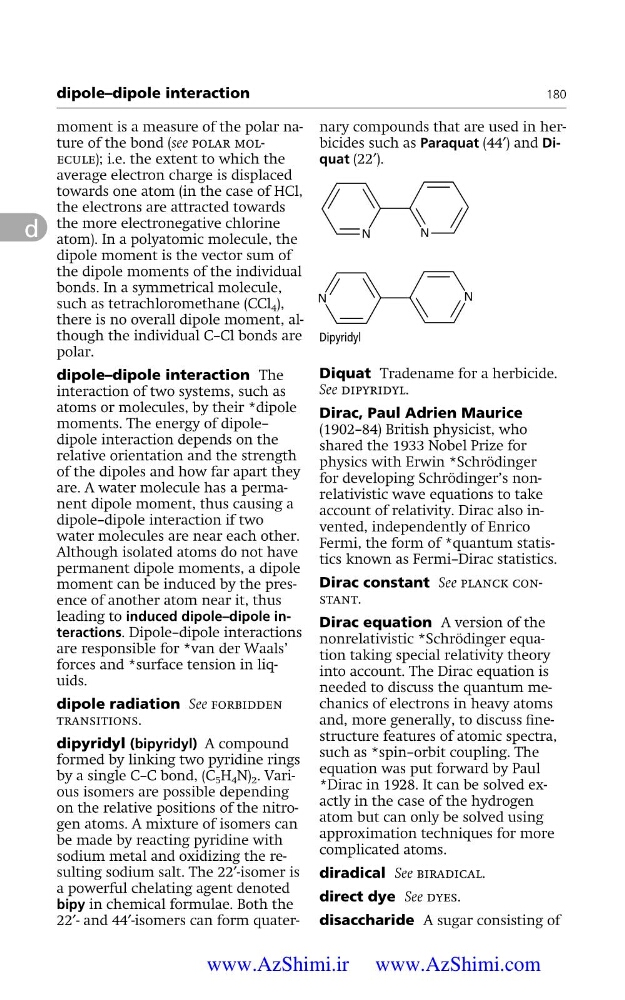
dipyridyl (bipyridyl) A compound
formed by linking two pyridine rings
by a single C–C bond, (C 5 H 4 N) 2 . Various isomers are possible depending
on the relative positions of the nitrogen atoms. A mixture of isomers can
be made by reacting pyridine with
sodium metal and oxidizing the resulting sodium salt. The 22′-isomer is
a powerful chelating agent denoted
bipy in chemical formulae. Both the
22′- and 44′-isomers can form quaternary compounds that are used in herbicides such as Paraquat (44′) and Diquat (22′).
dipole–dipole interaction
180
d
N
N
N
N
Dipyridyl
Diquat Tradename for a herbicide.
See dipyridyl.
Dirac, Paul Adrien Maurice
(1902–84) British physicist, who
shared the 1933 Nobel Prize for
physics with Erwin *Schrödinger
for developing Schrödinger’s nonrelativistic wave equations to take
account of relativity. Dirac also invented, independently of Enrico
Fermi, the form of *quantum statistics known as Fermi–Dirac statistics.
Dirac constant See planck constant.
Dirac equation A version of the
nonrelativistic *Schrödinger equation taking special relativity theory
into account. The Dirac equation is
needed to discuss the quantum mechanics of electrons in heavy atoms
and, more generally, to discuss Ünestructure features of atomic spectra,
such as *spin–orbit coupling. The
equation was put forward by Paul
*Dirac in 1928. It can be solved exactly in the case of the hydrogen
atom but can only be solved using
approximation techniques for more
complicated atoms.
diradical See biradical.
direct dye See dyes.
disaccharide A sugar consisting of
www.AzShimi.ir www.AzShimi.com
average electron charge is displaced
towards one atom (in the case of HCl,
the electrons are attracted towards
the more electronegative chlorine
atom). In a polyatomic molecule, the
dipole moment is the vector sum of
the dipole moments of the individual
bonds. In a symmetrical molecule,
such as tetrachloromethane (CCl 4 ),
there is no overall dipole moment, although the individual C–Cl bonds are
polar.
dipole–dipole interaction The
interaction of two systems, such as
atoms or molecules, by their *dipole
moments. The energy of dipole–
dipole interaction depends on the
relative orientation and the strength
of the dipoles and how far apart they
are. A water molecule has a permanent dipole moment, thus causing a
dipole–dipole interaction if two
water molecules are near each other.
Although isolated atoms do not have
permanent dipole moments, a dipole
moment can be induced by the presence of another atom near it, thus
leading to induced dipole–dipole interactions. Dipole–dipole interactions
are responsible for *van der Waals’
forces and *surface tension in liquids.
dipole radiation See forbidden
transitions.
dipyridyl (bipyridyl) A compound
formed by linking two pyridine rings
by a single C–C bond, (C 5 H 4 N) 2 . Various isomers are possible depending
on the relative positions of the nitrogen atoms. A mixture of isomers can
be made by reacting pyridine with
sodium metal and oxidizing the resulting sodium salt. The 22′-isomer is
a powerful chelating agent denoted
bipy in chemical formulae. Both the
22′- and 44′-isomers can form quaternary compounds that are used in herbicides such as Paraquat (44′) and Diquat (22′).
dipole–dipole interaction
180
d
N
N
N
N
Dipyridyl
Diquat Tradename for a herbicide.
See dipyridyl.
Dirac, Paul Adrien Maurice
(1902–84) British physicist, who
shared the 1933 Nobel Prize for
physics with Erwin *Schrödinger
for developing Schrödinger’s nonrelativistic wave equations to take
account of relativity. Dirac also invented, independently of Enrico
Fermi, the form of *quantum statistics known as Fermi–Dirac statistics.
Dirac constant See planck constant.
Dirac equation A version of the
nonrelativistic *Schrödinger equation taking special relativity theory
into account. The Dirac equation is
needed to discuss the quantum mechanics of electrons in heavy atoms
and, more generally, to discuss Ünestructure features of atomic spectra,
such as *spin–orbit coupling. The
equation was put forward by Paul
*Dirac in 1928. It can be solved exactly in the case of the hydrogen
atom but can only be solved using
approximation techniques for more
complicated atoms.
diradical See biradical.
direct dye See dyes.
disaccharide A sugar consisting of
www.AzShimi.ir www.AzShimi.com