

diketones are pungent-smelling yellow oils, whereas the aromatic compounds are crystalline solids. 1,3Diketones (or β-diketones), R.CO.CH 2 .
CO.R′, are more acidic and exist in
both keto and enol forms (see keto–
enol tautomerism); they form stable
compounds with metals. 1,4-Diketones (or γ-diketones), R.CO.CH 2 .CH 2 .
CO.R′, also exist and readily rearrange to form cyclic compounds.
dilatancy See newtonian fluid.
dilation (dilatation) An increase in
volume.
dilead(II) lead(IV) oxide A red
powder, Pb 3 O 4 ; r.d. 9.1; decomposes
at 500°C to lead(II) oxide. It is prepared by heating lead(II) oxide to
400°C and has the unusual property
of being black when hot and redorange when cold. The compound is
nonstoichiometric, generally containing less oxygen than implied by the
formula. It is largely covalent and has
Pb(IV)O 6 octahedral groups linked together by Pb(II) atoms, each joined to
three oxygen atoms. It is used in
glass making but its use in the paint
industry has largely been discontinued because of the toxicity of lead.
Dilead(II) lead(IV) oxide is commonly
called red lead or, more accurately,
red lead oxide.
Dillie–Koppanyi test A presumptive test for barbituates. The Dillie–
Koppanyi test reagent has two solutions: a 1% solution of colbalt acetate
in methanol, follow by a 5% solution
of isopropylamine (CH 3 CH(CH 3 )NH 2 )
in methanol. Barbiturates give a reddish-violet colour.
diluent A substance added to dilute
a solution or mixture (e.g. a *Üller).
dilute Describing a solution that
has a relatively low concentration of
solute.
dilute spin species A type of nucleus in which it is statistically unlikely that there will be more than
one such nucleus in a molecule (unless the substance has been artiÜcially enriched with isotopes having
that nucleus). An example of a dilute
spin species is
13 C since it has a natural abundance of 1.1%. This means
that for dilute spin systems it is usually not necessary to consider spin–
spin interactions between two nuclei
of the dilute spin species, e.g.
13 C–
13 C
in the same molecule. The opposite
of a dilute spin species is an abundant spin species, an example being
the proton.
dilution The volume of solvent in
which a given amount of solute is
dissolved.
dilution law See ostwald’s dilution law.
dimer An association of two identical molecules linked together. The
molecules may react to form a larger
molecule, as in the formation of dinitrogen tetroxide (N 2 O 4 ) from nitrogen dioxide (NO 2 ), or the formation
of an *aluminium chloride dimer
(Al 2 Cl 6 ) in the vapour. Alternatively,
they may be held by hydrogen bonds.
For example, carboxylic acids form
dimers in organic solvents, in which
hydrogen bonds exist between the O
of the C=O group and the H of the
–O–H group.
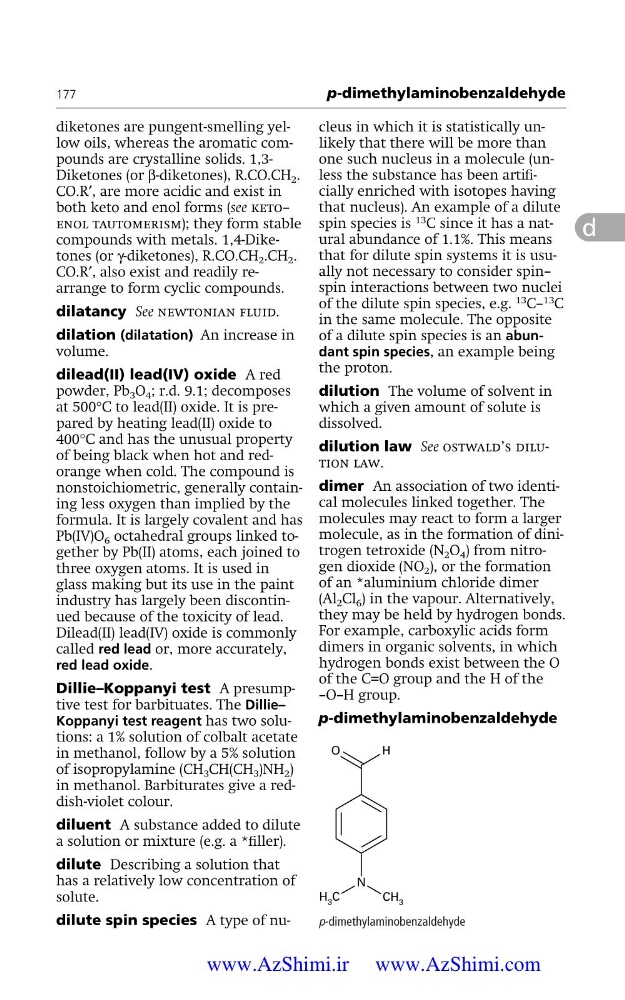
p-dimethylaminobenzaldehyde
177
p-dimethylaminobenzaldehyde
d
O
H
N
CH 3
C
H 3
p-dimethylaminobenzaldehyde
www.AzShimi.ir www.AzShimi.com
CO.R′, are more acidic and exist in
both keto and enol forms (see keto–
enol tautomerism); they form stable
compounds with metals. 1,4-Diketones (or γ-diketones), R.CO.CH 2 .CH 2 .
CO.R′, also exist and readily rearrange to form cyclic compounds.
dilatancy See newtonian fluid.
dilation (dilatation) An increase in
volume.
dilead(II) lead(IV) oxide A red
powder, Pb 3 O 4 ; r.d. 9.1; decomposes
at 500°C to lead(II) oxide. It is prepared by heating lead(II) oxide to
400°C and has the unusual property
of being black when hot and redorange when cold. The compound is
nonstoichiometric, generally containing less oxygen than implied by the
formula. It is largely covalent and has
Pb(IV)O 6 octahedral groups linked together by Pb(II) atoms, each joined to
three oxygen atoms. It is used in
glass making but its use in the paint
industry has largely been discontinued because of the toxicity of lead.
Dilead(II) lead(IV) oxide is commonly
called red lead or, more accurately,
red lead oxide.
Dillie–Koppanyi test A presumptive test for barbituates. The Dillie–
Koppanyi test reagent has two solutions: a 1% solution of colbalt acetate
in methanol, follow by a 5% solution
of isopropylamine (CH 3 CH(CH 3 )NH 2 )
in methanol. Barbiturates give a reddish-violet colour.
diluent A substance added to dilute
a solution or mixture (e.g. a *Üller).
dilute Describing a solution that
has a relatively low concentration of
solute.
dilute spin species A type of nucleus in which it is statistically unlikely that there will be more than
one such nucleus in a molecule (unless the substance has been artiÜcially enriched with isotopes having
that nucleus). An example of a dilute
spin species is
13 C since it has a natural abundance of 1.1%. This means
that for dilute spin systems it is usually not necessary to consider spin–
spin interactions between two nuclei
of the dilute spin species, e.g.
13 C–
13 C
in the same molecule. The opposite
of a dilute spin species is an abundant spin species, an example being
the proton.
dilution The volume of solvent in
which a given amount of solute is
dissolved.
dilution law See ostwald’s dilution law.
dimer An association of two identical molecules linked together. The
molecules may react to form a larger
molecule, as in the formation of dinitrogen tetroxide (N 2 O 4 ) from nitrogen dioxide (NO 2 ), or the formation
of an *aluminium chloride dimer
(Al 2 Cl 6 ) in the vapour. Alternatively,
they may be held by hydrogen bonds.
For example, carboxylic acids form
dimers in organic solvents, in which
hydrogen bonds exist between the O
of the C=O group and the H of the
–O–H group.
p-dimethylaminobenzaldehyde
177
p-dimethylaminobenzaldehyde
d
O
H
N
CH 3
C
H 3
p-dimethylaminobenzaldehyde
www.AzShimi.ir www.AzShimi.com