

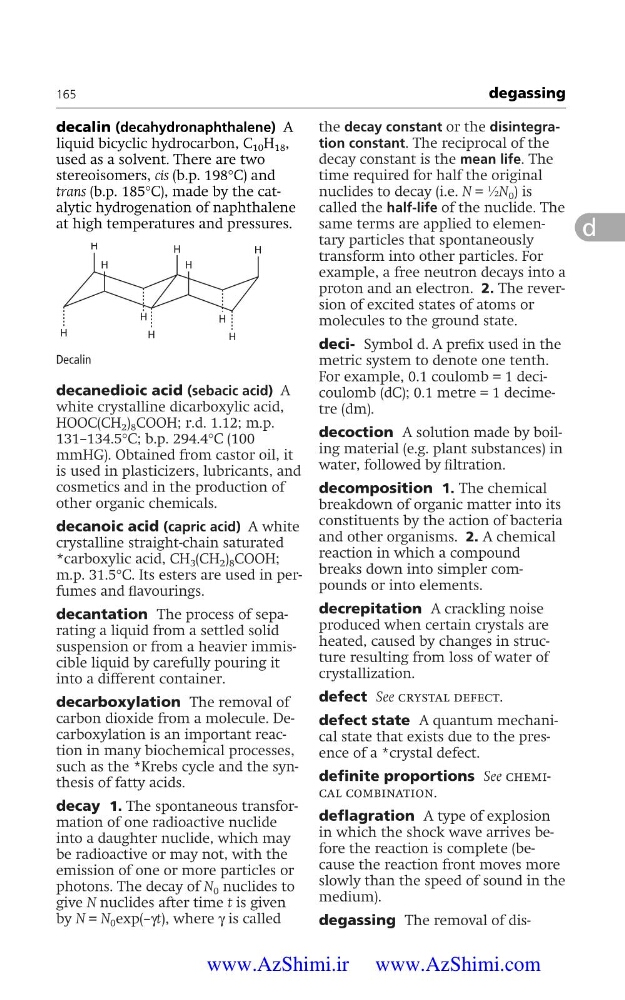
decalin (decahydronaphthalene) A
liquid bicyclic hydrocarbon, C 10 H 18 ,
used as a solvent. There are two
stereoisomers, cis (b.p. 198°C) and
trans (b.p. 185°C), made by the catalytic hydrogenation of naphthalene
at high temperatures and pressures.
165
degassing
d
H
H
H
H
H
H
H
H
H
H
Decalin
decanedioic acid (sebacic acid) A
white crystalline dicarboxylic acid,
HOOC(CH 2 ) 8 COOH; r.d. 1.12; m.p.
131–134.5°C; b.p. 294.4°C (100
mmHG). Obtained from castor oil, it
is used in plasticizers, lubricants, and
cosmetics and in the production of
other organic chemicals.
decanoic acid (capric acid) A white
crystalline straight-chain saturated
*carboxylic acid, CH 3 (CH 2 ) 8 COOH;
m.p. 31.5°C. Its esters are used in perfumes and Ûavourings.
decantation The process of separating a liquid from a settled solid
suspension or from a heavier immiscible liquid by carefully pouring it
into a different container.
decarboxylation The removal of
carbon dioxide from a molecule. Decarboxylation is an important reaction in many biochemical processes,
such as the *Krebs cycle and the synthesis of fatty acids.
decay 1. The spontaneous transformation of one radioactive nuclide
into a daughter nuclide, which may
be radioactive or may not, with the
emission of one or more particles or
photons. The decay of N 0 nuclides to
give N nuclides after time t is given
by N = N 0 exp(–γt), where γ is called
the decay constant or the disintegration constant. The reciprocal of the
decay constant is the mean life. The
time required for half the original
nuclides to decay (i.e. N = ½N 0 ) is
called the half-life of the nuclide. The
same terms are applied to elementary particles that spontaneously
transform into other particles. For
example, a free neutron decays into a
proton and an electron. 2. The reversion of excited states of atoms or
molecules to the ground state.
deci- Symbol d. A preÜx used in the
metric system to denote one tenth.
For example, 0.1 coulomb = 1 decicoulomb (dC); 0.1 metre = 1 decimetre (dm).
decoction A solution made by boiling material (e.g. plant substances) in
water, followed by Ültration.
decomposition 1. The chemical
breakdown of organic matter into its
constituents by the action of bacteria
and other organisms. 2. A chemical
reaction in which a compound
breaks down into simpler compounds or into elements.
decrepitation A crackling noise
produced when certain crystals are
heated, caused by changes in structure resulting from loss of water of
crystallization.
defect See crystal defect.
defect state A quantum mechanical state that exists due to the presence of a *crystal defect.
deÜnite proportions See chemical combination.
deÛagration A type of explosion
in which the shock wave arrives before the reaction is complete (because the reaction front moves more
slowly than the speed of sound in the
medium).
degassing The removal of diswww.AzShimi.ir www.AzShimi.com
liquid bicyclic hydrocarbon, C 10 H 18 ,
used as a solvent. There are two
stereoisomers, cis (b.p. 198°C) and
trans (b.p. 185°C), made by the catalytic hydrogenation of naphthalene
at high temperatures and pressures.
165
degassing
d
H
H
H
H
H
H
H
H
H
H
Decalin
decanedioic acid (sebacic acid) A
white crystalline dicarboxylic acid,
HOOC(CH 2 ) 8 COOH; r.d. 1.12; m.p.
131–134.5°C; b.p. 294.4°C (100
mmHG). Obtained from castor oil, it
is used in plasticizers, lubricants, and
cosmetics and in the production of
other organic chemicals.
decanoic acid (capric acid) A white
crystalline straight-chain saturated
*carboxylic acid, CH 3 (CH 2 ) 8 COOH;
m.p. 31.5°C. Its esters are used in perfumes and Ûavourings.
decantation The process of separating a liquid from a settled solid
suspension or from a heavier immiscible liquid by carefully pouring it
into a different container.
decarboxylation The removal of
carbon dioxide from a molecule. Decarboxylation is an important reaction in many biochemical processes,
such as the *Krebs cycle and the synthesis of fatty acids.
decay 1. The spontaneous transformation of one radioactive nuclide
into a daughter nuclide, which may
be radioactive or may not, with the
emission of one or more particles or
photons. The decay of N 0 nuclides to
give N nuclides after time t is given
by N = N 0 exp(–γt), where γ is called
the decay constant or the disintegration constant. The reciprocal of the
decay constant is the mean life. The
time required for half the original
nuclides to decay (i.e. N = ½N 0 ) is
called the half-life of the nuclide. The
same terms are applied to elementary particles that spontaneously
transform into other particles. For
example, a free neutron decays into a
proton and an electron. 2. The reversion of excited states of atoms or
molecules to the ground state.
deci- Symbol d. A preÜx used in the
metric system to denote one tenth.
For example, 0.1 coulomb = 1 decicoulomb (dC); 0.1 metre = 1 decimetre (dm).
decoction A solution made by boiling material (e.g. plant substances) in
water, followed by Ültration.
decomposition 1. The chemical
breakdown of organic matter into its
constituents by the action of bacteria
and other organisms. 2. A chemical
reaction in which a compound
breaks down into simpler compounds or into elements.
decrepitation A crackling noise
produced when certain crystals are
heated, caused by changes in structure resulting from loss of water of
crystallization.
defect See crystal defect.
defect state A quantum mechanical state that exists due to the presence of a *crystal defect.
deÜnite proportions See chemical combination.
deÛagration A type of explosion
in which the shock wave arrives before the reaction is complete (because the reaction front moves more
slowly than the speed of sound in the
medium).
degassing The removal of diswww.AzShimi.ir www.AzShimi.com