

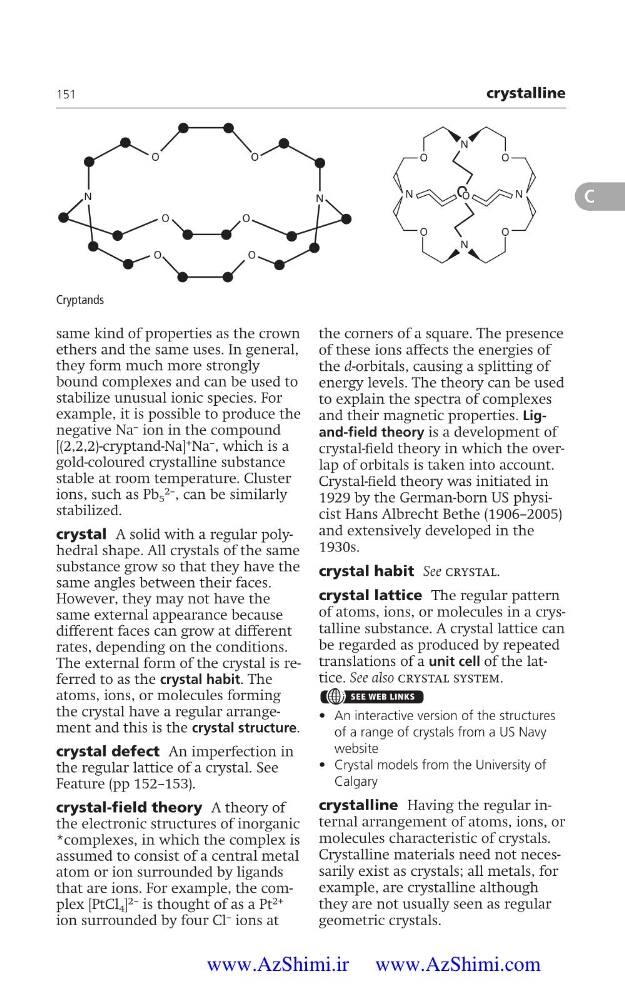
same kind of properties as the crown
ethers and the same uses. In general,
they form much more strongly
bound complexes and can be used to
stabilize unusual ionic species. For
example, it is possible to produce the
negative Na
– ion in the compound
[(2,2,2)-cryptand-Na]
+ Na
– , which is a
gold-coloured crystalline substance
stable at room temperature. Cluster
ions, such as Pb 5
2–
, can be similarly
stabilized.
crystal A solid with a regular polyhedral shape. All crystals of the same
substance grow so that they have the
same angles between their faces.
However, they may not have the
same external appearance because
different faces can grow at different
rates, depending on the conditions.
The external form of the crystal is referred to as the crystal habit. The
atoms, ions, or molecules forming
the crystal have a regular arrangement and this is the crystal structure.
crystal defect An imperfection in
the regular lattice of a crystal. See
Feature (pp 152–153).
crystal-Üeld theory A theory of
the electronic structures of inorganic
*complexes, in which the complex is
assumed to consist of a central metal
atom or ion surrounded by ligands
that are ions. For example, the complex [PtCl 4 ]
2– is thought of as a Pt
2+
ion surrounded by four Cl
– ions at
the corners of a square. The presence
of these ions affects the energies of
the d-orbitals, causing a splitting of
energy levels. The theory can be used
to explain the spectra of complexes
and their magnetic properties. Ligand-Üeld theory is a development of
crystal-Üeld theory in which the overlap of orbitals is taken into account.
Crystal-Üeld theory was initiated in
1929 by the German-born US physicist Hans Albrecht Bethe (1906–2005)
and extensively developed in the
1930s.
crystal habit See crystal.
crystal lattice The regular pattern
of atoms, ions, or molecules in a crystalline substance. A crystal lattice can
be regarded as produced by repeated
translations of a unit cell of the lattice. See also crystal system.
A
• An interactive version of the structures
of a range of crystals from a US Navy
website
• Crystal models from the University of
Calgary
crystalline Having the regular internal arrangement of atoms, ions, or
molecules characteristic of crystals.
Crystalline materials need not necessarily exist as crystals; all metals, for
example, are crystalline although
they are not usually seen as regular
geometric crystals.
151
crystalline
c
N
O
O
N
O
O
O
O
N
N
N
N
O
O
O
O
O
Cryptands
www.AzShimi.ir www.AzShimi.com
ethers and the same uses. In general,
they form much more strongly
bound complexes and can be used to
stabilize unusual ionic species. For
example, it is possible to produce the
negative Na
– ion in the compound
[(2,2,2)-cryptand-Na]
+ Na
– , which is a
gold-coloured crystalline substance
stable at room temperature. Cluster
ions, such as Pb 5
2–
, can be similarly
stabilized.
crystal A solid with a regular polyhedral shape. All crystals of the same
substance grow so that they have the
same angles between their faces.
However, they may not have the
same external appearance because
different faces can grow at different
rates, depending on the conditions.
The external form of the crystal is referred to as the crystal habit. The
atoms, ions, or molecules forming
the crystal have a regular arrangement and this is the crystal structure.
crystal defect An imperfection in
the regular lattice of a crystal. See
Feature (pp 152–153).
crystal-Üeld theory A theory of
the electronic structures of inorganic
*complexes, in which the complex is
assumed to consist of a central metal
atom or ion surrounded by ligands
that are ions. For example, the complex [PtCl 4 ]
2– is thought of as a Pt
2+
ion surrounded by four Cl
– ions at
the corners of a square. The presence
of these ions affects the energies of
the d-orbitals, causing a splitting of
energy levels. The theory can be used
to explain the spectra of complexes
and their magnetic properties. Ligand-Üeld theory is a development of
crystal-Üeld theory in which the overlap of orbitals is taken into account.
Crystal-Üeld theory was initiated in
1929 by the German-born US physicist Hans Albrecht Bethe (1906–2005)
and extensively developed in the
1930s.
crystal habit See crystal.
crystal lattice The regular pattern
of atoms, ions, or molecules in a crystalline substance. A crystal lattice can
be regarded as produced by repeated
translations of a unit cell of the lattice. See also crystal system.
A
• An interactive version of the structures
of a range of crystals from a US Navy
website
• Crystal models from the University of
Calgary
crystalline Having the regular internal arrangement of atoms, ions, or
molecules characteristic of crystals.
Crystalline materials need not necessarily exist as crystals; all metals, for
example, are crystalline although
they are not usually seen as regular
geometric crystals.
151
crystalline
c
N
O
O
N
O
O
O
O
N
N
N
N
O
O
O
O
O
Cryptands
www.AzShimi.ir www.AzShimi.com