

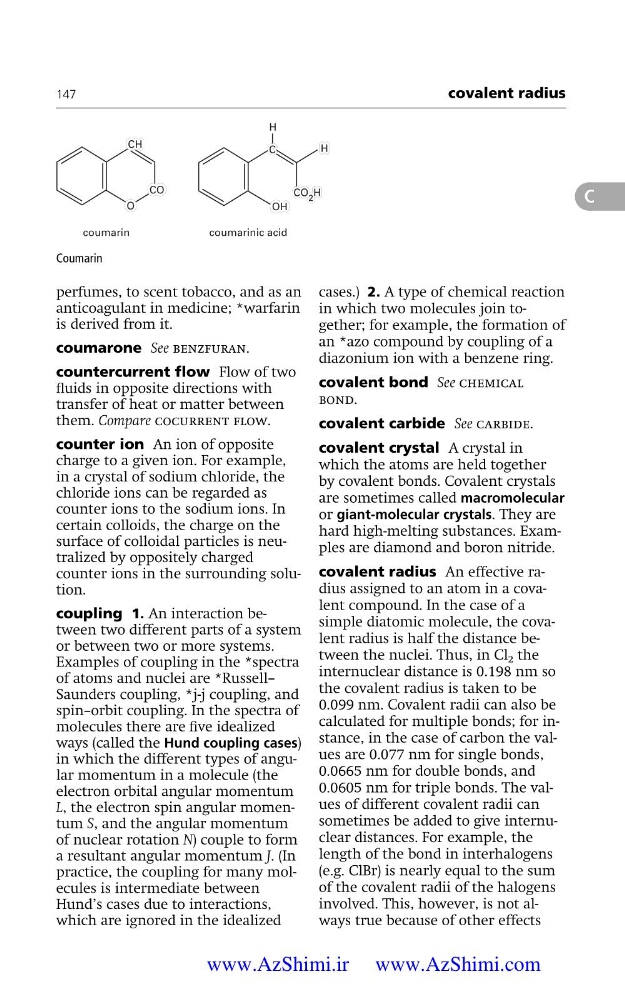
perfumes, to scent tobacco, and as an
anticoagulant in medicine; *warfarin
is derived from it.
coumarone See benzfuran.
countercurrent Ûow Flow of two
Ûuids in opposite directions with
transfer of heat or matter between
them. Compare cocurrent flow.
counter ion An ion of opposite
charge to a given ion. For example,
in a crystal of sodium chloride, the
chloride ions can be regarded as
counter ions to the sodium ions. In
certain colloids, the charge on the
surface of colloidal particles is neutralized by oppositely charged
counter ions in the surrounding solution.
coupling 1. An interaction between two different parts of a system
or between two or more systems.
Examples of coupling in the *spectra
of atoms and nuclei are *Russell–
Saunders coupling, *j-j coupling, and
spin–orbit coupling. In the spectra of
molecules there are Üve idealized
ways (called the Hund coupling cases)
in which the different types of angular momentum in a molecule (the
electron orbital angular momentum
L, the electron spin angular momentum S, and the angular momentum
of nuclear rotation N) couple to form
a resultant angular momentum J. (In
practice, the coupling for many molecules is intermediate between
Hund’s cases due to interactions,
which are ignored in the idealized
cases.) 2. A type of chemical reaction
in which two molecules join together; for example, the formation of
an *azo compound by coupling of a
diazonium ion with a benzene ring.
covalent bond See chemical
bond.
covalent carbide See carbide.
covalent crystal A crystal in
which the atoms are held together
by covalent bonds. Covalent crystals
are sometimes called macromolecular
or giant-molecular crystals. They are
hard high-melting substances. Examples are diamond and boron nitride.
covalent radius An effective radius assigned to an atom in a covalent compound. In the case of a
simple diatomic molecule, the covalent radius is half the distance between the nuclei. Thus, in Cl 2 the
internuclear distance is 0.198 nm so
the covalent radius is taken to be
0.099 nm. Covalent radii can also be
calculated for multiple bonds; for instance, in the case of carbon the values are 0.077 nm for single bonds,
0.0665 nm for double bonds, and
0.0605 nm for triple bonds. The values of different covalent radii can
sometimes be added to give internuclear distances. For example, the
length of the bond in interhalogens
(e.g. ClBr) is nearly equal to the sum
of the covalent radii of the halogens
involved. This, however, is not always true because of other effects
147
covalent radius
c
coumarin
coumarinic acid
CH CH CH
CO CO CO
O O O
H
H H H
CO 2 H
CO 2 H
CO 2 H
OH OH OH
C C C
Coumarin
www.AzShimi.ir www.AzShimi.com
anticoagulant in medicine; *warfarin
is derived from it.
coumarone See benzfuran.
countercurrent Ûow Flow of two
Ûuids in opposite directions with
transfer of heat or matter between
them. Compare cocurrent flow.
counter ion An ion of opposite
charge to a given ion. For example,
in a crystal of sodium chloride, the
chloride ions can be regarded as
counter ions to the sodium ions. In
certain colloids, the charge on the
surface of colloidal particles is neutralized by oppositely charged
counter ions in the surrounding solution.
coupling 1. An interaction between two different parts of a system
or between two or more systems.
Examples of coupling in the *spectra
of atoms and nuclei are *Russell–
Saunders coupling, *j-j coupling, and
spin–orbit coupling. In the spectra of
molecules there are Üve idealized
ways (called the Hund coupling cases)
in which the different types of angular momentum in a molecule (the
electron orbital angular momentum
L, the electron spin angular momentum S, and the angular momentum
of nuclear rotation N) couple to form
a resultant angular momentum J. (In
practice, the coupling for many molecules is intermediate between
Hund’s cases due to interactions,
which are ignored in the idealized
cases.) 2. A type of chemical reaction
in which two molecules join together; for example, the formation of
an *azo compound by coupling of a
diazonium ion with a benzene ring.
covalent bond See chemical
bond.
covalent carbide See carbide.
covalent crystal A crystal in
which the atoms are held together
by covalent bonds. Covalent crystals
are sometimes called macromolecular
or giant-molecular crystals. They are
hard high-melting substances. Examples are diamond and boron nitride.
covalent radius An effective radius assigned to an atom in a covalent compound. In the case of a
simple diatomic molecule, the covalent radius is half the distance between the nuclei. Thus, in Cl 2 the
internuclear distance is 0.198 nm so
the covalent radius is taken to be
0.099 nm. Covalent radii can also be
calculated for multiple bonds; for instance, in the case of carbon the values are 0.077 nm for single bonds,
0.0665 nm for double bonds, and
0.0605 nm for triple bonds. The values of different covalent radii can
sometimes be added to give internuclear distances. For example, the
length of the bond in interhalogens
(e.g. ClBr) is nearly equal to the sum
of the covalent radii of the halogens
involved. This, however, is not always true because of other effects
147
covalent radius
c
coumarin
coumarinic acid
CH CH CH
CO CO CO
O O O
H
H H H
CO 2 H
CO 2 H
CO 2 H
OH OH OH
C C C
Coumarin
www.AzShimi.ir www.AzShimi.com