

Many vitamins are precursors of
coenzymes. See also cofactor.
coenzyme A (CoA) A complex organic compound that acts in conjunction with enzymes involved in
various biochemical reactions, notably the oxidation of pyruvate via
the *Krebs cycle and fatty-acid oxidation and synthesis. It comprises principally the B vitamin pantothenic
acid, the nucleotide adenine, and a
ribose-phosphate group.
coenzyme Q See ubiquinone.
cofactor A nonprotein component
essential for the normal catalytic activity of an enzyme. Cofactors may
be organic molecules (*coenzymes)
or inorganic ions. They may activate
the enzyme by altering its shape or
they may actually participate in the
chemical reaction.
coherent anti-Stokes Raman
spectroscopy See cars.
coherent units A system of *units
of measurement in which derived
units are obtained by multiplying or
dividing base units without the use
of numerical factors. *SI units form a
coherent system; for example the
unit of force is the newton, which is
equal to 1 kilogram metre per second
squared (kg m s
–2
), the kilogram,
metre, and second all being base
units of the system.
cohesion The force of attraction
between like molecules.
coinage metals A group of three
malleable ductile transition metals
forming group 11 (formerly IB) of the
*periodic table: copper (Cu), silver
(Ag), and gold (Au). Their outer electronic conÜgurations have the form
nd
10 (n+1)s
1
. Although this is similar to
that of alkali metals, the coinage
metals all have much higher ionization energies and higher (and positive) standard electrode potentials.
Thus, they are much more difÜcult to
oxidize and are more resistant to corrosion. In addition, the fact that they
have d-electrons makes them show
variable valency (Cu
I , Cu
II , and Cu
III
;
Ag
I and Ag
II ; Au
I and Au
III
) and form a
wide range of coordination compounds. They are generally classiÜed
with the *transition elements.
coke A form of carbon made by the
destructive distillation of coal. Coke
is used for blast-furnaces and other
metallurgical and chemical processes
requiring a source of carbon. Lowergrade cokes, made by heating the
coal to a lower temperature, are used
as smokeless fuels for domestic heating.
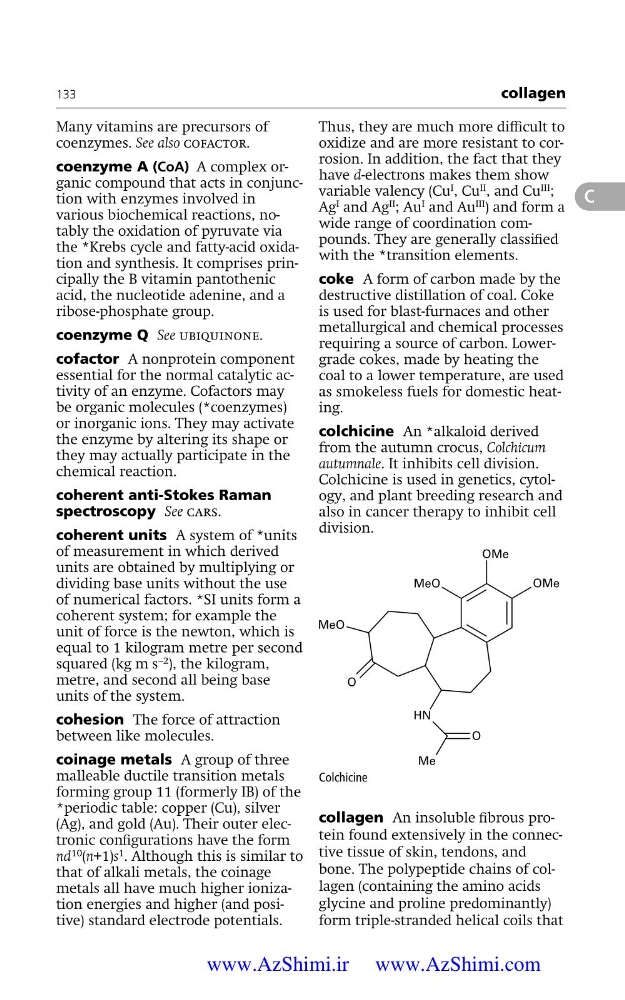
colchicine An *alkaloid derived
from the autumn crocus, Colchicum
autumnale. It inhibits cell division.
Colchicine is used in genetics, cytology, and plant breeding research and
also in cancer therapy to inhibit cell
division.
133
collagen
c
OMe
MeO
MeO
O
N
H
Me
O
OMe
Colchicine
collagen An insoluble Übrous protein found extensively in the connective tissue of skin, tendons, and
bone. The polypeptide chains of collagen (containing the amino acids
glycine and proline predominantly)
form triple-stranded helical coils that
www.AzShimi.ir www.AzShimi.com
coenzymes. See also cofactor.
coenzyme A (CoA) A complex organic compound that acts in conjunction with enzymes involved in
various biochemical reactions, notably the oxidation of pyruvate via
the *Krebs cycle and fatty-acid oxidation and synthesis. It comprises principally the B vitamin pantothenic
acid, the nucleotide adenine, and a
ribose-phosphate group.
coenzyme Q See ubiquinone.
cofactor A nonprotein component
essential for the normal catalytic activity of an enzyme. Cofactors may
be organic molecules (*coenzymes)
or inorganic ions. They may activate
the enzyme by altering its shape or
they may actually participate in the
chemical reaction.
coherent anti-Stokes Raman
spectroscopy See cars.
coherent units A system of *units
of measurement in which derived
units are obtained by multiplying or
dividing base units without the use
of numerical factors. *SI units form a
coherent system; for example the
unit of force is the newton, which is
equal to 1 kilogram metre per second
squared (kg m s
–2
), the kilogram,
metre, and second all being base
units of the system.
cohesion The force of attraction
between like molecules.
coinage metals A group of three
malleable ductile transition metals
forming group 11 (formerly IB) of the
*periodic table: copper (Cu), silver
(Ag), and gold (Au). Their outer electronic conÜgurations have the form
nd
10 (n+1)s
1
. Although this is similar to
that of alkali metals, the coinage
metals all have much higher ionization energies and higher (and positive) standard electrode potentials.
Thus, they are much more difÜcult to
oxidize and are more resistant to corrosion. In addition, the fact that they
have d-electrons makes them show
variable valency (Cu
I , Cu
II , and Cu
III
;
Ag
I and Ag
II ; Au
I and Au
III
) and form a
wide range of coordination compounds. They are generally classiÜed
with the *transition elements.
coke A form of carbon made by the
destructive distillation of coal. Coke
is used for blast-furnaces and other
metallurgical and chemical processes
requiring a source of carbon. Lowergrade cokes, made by heating the
coal to a lower temperature, are used
as smokeless fuels for domestic heating.
colchicine An *alkaloid derived
from the autumn crocus, Colchicum
autumnale. It inhibits cell division.
Colchicine is used in genetics, cytology, and plant breeding research and
also in cancer therapy to inhibit cell
division.
133
collagen
c
OMe
MeO
MeO
O
N
H
Me
O
OMe
Colchicine
collagen An insoluble Übrous protein found extensively in the connective tissue of skin, tendons, and
bone. The polypeptide chains of collagen (containing the amino acids
glycine and proline predominantly)
form triple-stranded helical coils that
www.AzShimi.ir www.AzShimi.com